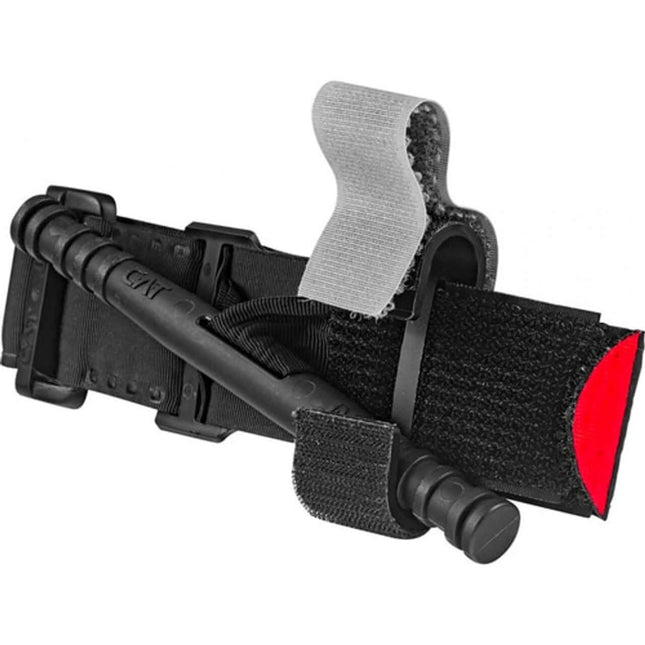
Most first aid kits contain traditional gauze. Traditional gauze is appropriate for minor wounds — abrasions, lacerations that have stopped bleeding or are bleeding slowly, wound dressings after closure. For arterial hemorrhage from a gunshot wound, stab wound, or traumatic amputation, traditional gauze is not an intervention. It's padding.
The Hartford Consensus and the TECC (Threat and Error Consequence Control) framework identified uncontrolled external hemorrhage as the leading preventable cause of pre-hospital trauma death. The clinical response to that finding produced CoTCCC's hemostatic agent standards — which is why trauma kits built around modern prehospital care contain hemostatic gauze, not rolls of cotton.
This guide covers what makes hemostatic gauze work, when traditional gauze is still the right tool, and what correct application looks like.
How hemostatic gauze works
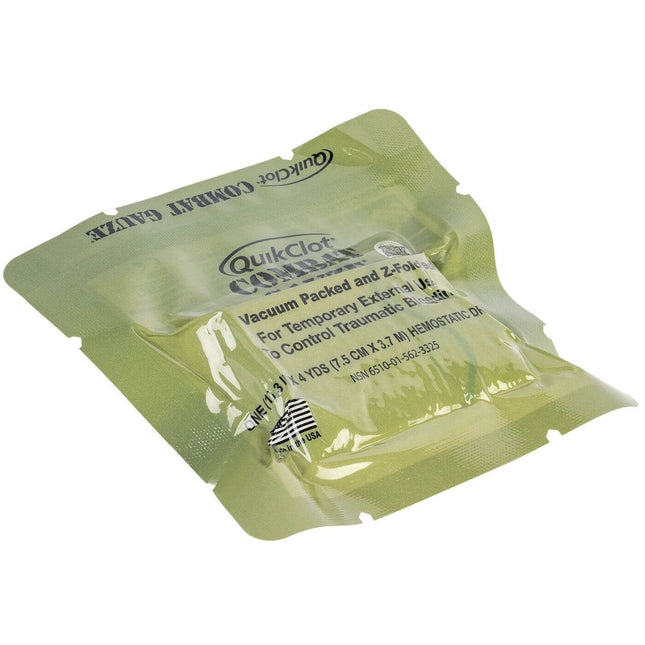
QuikClot Combat Gauze — the CoTCCC-preferred hemostatic agent — is impregnated with kaolin, a natural aluminum phyllosilicate mineral clay. When kaolin contacts blood, it activates Factor XII (Hageman factor), which initiates the intrinsic coagulation cascade. It also directly activates platelets. The combined effect dramatically accelerates the clotting process at the wound site.
The older generation of hemostatic agents (zeolite-based, including early QuikClot granules) generated significant exothermic heat — a documented concern in early TCCC adoption. Kaolin-based gauze does not produce clinically significant heat. It's also biocompatible and does not need to be removed at the wound site before transport (though surgical teams will remove it).
The mechanism doesn't work without proper wound packing. Kaolin accelerates clot formation, but that clot needs a physical matrix — the packed gauze — to form against. Laying hemostatic gauze loosely over a wound, or applying it without sustained pressure, produces the same outcome as traditional gauze: the blood pressure pushes through. Technique determines effectiveness.
Where each type belongs
The packing technique determines the outcome
Hemostatic gauze fails when the technique fails. The application sequence for wound packing is not intuitive — the instinct to dab at a wound or apply light pressure produces inadequate tamponade pressure. Correct technique:
- Locate the source bleed. Pack toward the source, not just the wound surface. If you can't see the bleeding vessel, pack deep and tight into the wound cavity.
- Pack continuously with the Z-fold. The Z-fold format of QuikClot Combat Gauze allows you to feed the gauze continuously into the wound channel, filling dead space. Don't stuff a loose ball in — feed the gauze in tight using your fingers or a blunt instrument.
- Apply direct, sustained pressure. Once the wound is packed, apply firm direct pressure for a minimum of 3 minutes (5 minutes if you have any uncertainty about hemorrhage control). Don't lift to check — every lift relieves pressure and may dislodge the forming clot.
- Secure the dressing. Apply a pressure bandage over the packing to maintain pressure during transport. The clot is fragile — movement and jostling matter.
- Do not remove in the field. Hemostatic gauze should not be removed until the patient is in a surgical setting. Removal in the field disrupts the clot and restarts the bleeding problem.
The most common error after successful wound packing is removing the gauze to check whether bleeding has stopped. The 3-minute pressure window is non-negotiable — lifting to check resets the clock and may collapse the forming clot. Keep the pressure on, note the time, and hold. If the gauze saturates through, pack more gauze on top without removing what's already there.
When hemostatic gauze is the right call
The CoTCCC recommendation applies specifically to hemorrhage not controlled by tourniquet — junctional bleeds (groin, axilla, neck), truncal wounds, and wounds on the torso where tourniquet application is anatomically impossible. For extremity arterial bleeds, the tourniquet comes first, and hemostatic gauze is backup for any bleed proximal to the tourniquet placement site.
In practice, hemostatic gauze is indicated whenever you have a deep, actively bleeding wound with a source that isn't accessible with direct surface pressure alone. The categories where this matters most:
- Gunshot wounds — entry wounds are typically small; the damage is inside. Packing to the depth of the wound cavity addresses the source. Exit wounds are typically larger and need aggressive packing.
- Stab wounds — similar principle. The visible wound may be narrow; the internal damage may be significant. Pack deep.
- Industrial trauma — machinery and power tool injuries produce complex lacerations with arterial involvement. Traditional gauze saturates in seconds. Hemostatic gauze paired with wound packing is the appropriate response.
- Vehicle crashes — glass, metal, and impact trauma can produce arterial hemorrhage at the thigh, arm, or torso. Hemostatic gauze belongs in every vehicle trauma kit.

Kit compatibility and staging
Traditional gauze and hemostatic gauze are not interchangeable — they address different categories of injury. A properly stocked trauma kit carries both. Traditional gauze handles the 80% of first aid situations that don't involve arterial hemorrhage. Hemostatic gauze handles the 20% that do, which represent the majority of preventable trauma deaths.
The Z-fold format on QuikClot Combat Gauze is designed specifically for compact storage in IFAKs and trauma pouches. A single 3-inch by 4-yard roll packs into approximately the same volume as a standard roller bandage. There's no reason to exclude it from any kit on space grounds.
For a complete TCCC-standard kit configuration that includes both, see the IFAK collection. For hemostatic gauze as a standalone resupply item, see hemostatic agents.
Application requires hands-on training
Reading about wound packing and doing it correctly on an actual wound under stress are different skills. The technique — depth of packing, pressure duration, continuous Z-fold application — requires repetition to execute reliably. Stop the Bleed training covers wound packing as a core module and is the recommended starting point. For a course near you and additional resources, see Stop the Bleed: Training, Gear, and How to Get Certified.
TCCC-based courses extend this further — including scenarios where the wound is obscured, the patient is combative, or the environment creates complications. If your kit includes hemostatic gauze, training to use it correctly is not optional. The gear has no value without the technique.
FAQ
Can I use hemostatic gauze on any wound?
Hemostatic gauze is appropriate for deep wounds with significant hemorrhage. It's overbuilt for minor cuts and scrapes — those don't need kaolin-accelerated clotting. For minor wounds, standard gauze or adhesive bandages are appropriate and more economical. Reserve hemostatic gauze for situations where hemorrhage is the clinical problem: deep lacerations, gunshot or stab wounds, arterial bleeds.
Is QuikClot safe? The old formula had heat concerns.
The current QuikClot Combat Gauze formulation is kaolin-based and does not produce the exothermic heat associated with first-generation zeolite-based QuikClot products. Kaolin is a naturally occurring mineral clay that is biocompatible and safe for wound contact. It is FDA cleared and the CoTCCC-preferred hemostatic agent for military and tactical prehospital use. The heat concern is a documented historical issue with a previous formulation — not the current product.
How long does hemostatic gauze last in a kit?
QuikClot Combat Gauze has a shelf life of approximately 5 years when stored in its original sealed packaging. Exposure to heat, moisture, or repeated repacking can degrade the packaging and reduce shelf life. Check expiration dates during your annual kit inspection and replace gauze that is past its date or shows packaging damage. See the First Aid Fundamentals blog for kit inspection and rotation guidance.
Do I need hemostatic gauze if I already have a tourniquet?
Yes. A tourniquet controls extremity bleeds on limbs distal to the application site. It cannot address junctional bleeds (groin, axilla, neck) or torso wounds. Hemostatic gauze fills exactly this gap in the CoTCCC priority stack. Most complete trauma kits carry both — the tourniquet addresses the most common life-threatening extremity bleed, hemostatic gauze addresses everything else that can't be tourniqueted.
What's the difference between hemostatic gauze and a hemostatic sponge or granules?
Hemostatic granules (older QuikClot formulations) and sponges work by similar mechanisms but have different application profiles. Gauze in Z-fold format is preferred by CoTCCC because it allows continuous deep wound packing, fills wound cavities more effectively, and is easier to remove surgically. Granules are harder to control in the field and harder to remove completely. For general IFAK and trauma kit use, gauze in the Z-fold format is the standard.
The decision isn't hemostatic versus traditional — it's having both in the right place. Traditional gauze handles everyday first aid; hemostatic gauze handles hemorrhage that would otherwise be fatal. A trauma kit that carries only one of these is only partially equipped. A kit that carries both, paired with training in how to use each correctly, covers the actual range of injuries you're likely to encounter.
For kit configuration options: IFAKs with hemostatic gauze included. For standalone resupply: hemostatic agents. For the training to use it: Stop the Bleed certification.