Why Businesses Need Public Access Bleed Control Kits
7 min reading time
7 min reading time
Uncontrolled hemorrhage is the leading cause of preventable death in trauma. The data on intervention timing is unambiguous: outcomes improve sharply when a trained bystander with the right equipment intervenes within the first three minutes. Professional EMS cannot consistently meet that window. The average urban response time in the U.S. is 7–10 minutes. The gap between injury and first responder arrival is where businesses with public access bleed control kits close the difference between survival and preventable death.
This post covers why businesses are the right deployment point for these kits, how to select equipment that meets clinical standards, the legal framework protecting responders, and how HSA/FSA accounts can offset procurement costs.
Businesses aggregate people. A retail store with 50 employees and 300 daily customers runs roughly the same actuarial exposure as a mid-size school or community center. Workplace accidents — lacerations from equipment, vehicle accidents in loading and parking areas, slips and falls that produce impact injuries — occur in every industry category at predictable rates. High-risk industries add penetrating injury risk from machinery, tools, and material handling.
The case for public-access deployment is not limited to high-risk workplaces. A severe laceration in a retail store, a vehicle-pedestrian incident in a parking structure, or a medical event that produces hemorrhage as a secondary complication can occur in any business environment. The personnel already present — employees, security staff, customers with prior training — represent the fastest possible response time. Equipping them is the operationally correct approach.
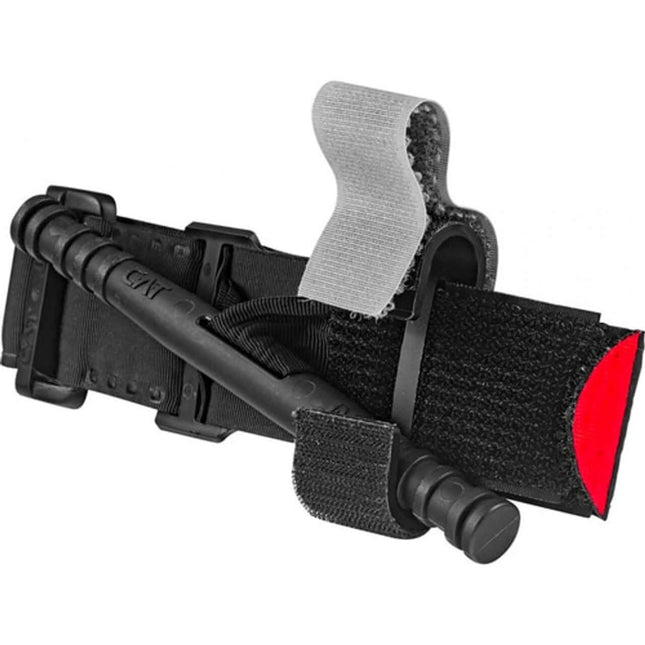
The CoTCCC (Committee on Tactical Combat Casualty Care) maintains the evidence-based list of approved hemorrhage control devices. This is the relevant standard for tourniquet selection, not price point or brand recognition. The two approved tourniquet types for limb hemorrhage are the windlass-style devices: the CAT Gen 7 and the SOF-T Wide. Both are approved, fielded by U.S. military forces, and validated in mass casualty data. Off-brand or non-CoTCCC tourniquets have documented failure rates in field application. The cost difference between approved and unapproved devices is minor. The performance difference under stress is not.
Complete public-access kit minimum contents:
The ViTAC Intermediate Bleeding Control Pack contains all of the above in a compact IFAK-format package with CoTCCC-standard components. Deploying identical kits at every station simplifies training and eliminates the decision overhead of navigating varied kit configurations under stress.
Every U.S. state has some form of Good Samaritan statute that provides civil liability protection to bystanders who render emergency aid in good faith. The scope and conditions vary by state, but the core protection is consistent: a person who acts reasonably to assist an injured individual during an emergency is generally shielded from civil liability for outcomes that result from the aid provided.
This protection applies to employees who use a workplace bleed control kit on an injured coworker or visitor. It applies to bystanders who access a public-facing kit in a retail or hospitality setting. Businesses that make kits accessible and provide training are not creating additional liability — they are demonstrating reasonable duty of care. The legal and actuarial risk of non-deployment is higher than the risk of deployment.
Field Note: Bystander Hesitation
The most common reason bystanders cite for not intervening in a hemorrhage event is uncertainty about whether they will be held responsible if the outcome is poor. Good Samaritan laws exist specifically to remove that barrier. Communicating this protection during staff training increases the likelihood of intervention. A responder who knows they are legally protected acts faster and with more confidence.
The operational placement standard is 90 seconds: any occupied area of the business should be within 90 seconds round-trip walk of a kit station. Apply this by walking your floor plan with a timer from every occupied area to the nearest station. Any area that fails the test needs its own station.
Priority placement locations for most business environments:
Kit deployment without training is incomplete preparedness. The two components are not interchangeable — a kit that no one knows how to use has the same outcome as no kit. Minimum training requirements for business deployment:
| Training Level | Who Needs It | Frequency |
|---|---|---|
| Stop the Bleed or TECC-B | All employees | Initial + annual refresher |
| Kit location walkthrough | All employees + security | Every new hire + annual |
| Scenario-based drill | Designated first responders | Semi-annual |
Bleed control kits and individual kit components — including CoTCCC-approved tourniquets — are generally considered eligible medical expenses under Health Savings Account (HSA) and Flexible Spending Account (FSA) rules. This applies to personal procurement; business procurement through an entity is a separate accounting treatment. Individuals purchasing personal IFAKs or vehicle kits should verify eligibility with their plan administrator, as IRS guidance on specific items can vary by plan year and administrator interpretation. The CAT Gen 7, SOF-T Wide, and ViTAC Intermediate Bleeding Control Pack have been purchased using HSA/FSA funds by ViTAC customers — confirm with your plan before purchase.
Assign a named inspector for each station — not a department or role. Inspection intervals: monthly visual check (cabinet secure, contents visible), quarterly full inspection (expiration dates, packaging integrity, tourniquet function), and immediate restock after any use or drill. Log every inspection with date and inspector name. Unlogged stations are not inspected stations.
Bleed control capability addresses the M in MARCH — Massive hemorrhage. A complete workplace emergency response covers all five phases of the framework: Massive hemorrhage, Airway, Respiration, Circulation, and Hypothermia. Read the full MARCH protocol guide to see what your team needs beyond a tourniquet.
For kit selection and component details, see what's inside a Stop the Bleed kit and how it works. For building-wide deployment planning, see how many bleed control kits your building actually needs.
Businesses are the right deployment point for public access bleed control kits because they aggregate people and have trained personnel already present. Select equipment that meets CoTCCC standards. Deploy under the 90-second placement rule. Train every employee. Understand the Good Samaritan protections in your state.
Equip Your Building — Shop Bleed Control Kits

OSHA minimum workplace kits don't include a tourniquet. Here's how to calculate station count, stock each station, and build bleed control coverage in any public...

One kit at the main entrance fails the 90-second coverage rule for most buildings. Here's how to run a coverage audit and calculate the correct...

Arterial hemorrhage kills in 3 minutes. Urban EMS takes 7–10. Every business needs CoTCCC-standard bleed control kits — here's how to select, deploy, and train...

40+ states mandate bleed control kits in schools — but most deployment plans miss classrooms and buses. Here's the placement standard that actually works.

Most of our trauma kits and first aid supplies qualify for HSA and FSA reimbursement. Don't let your benefits expire — invest them in gear that could save a life.


$124.95


$279.99

$37.49 - $139.46


$299.95 $269.95


$139.95 - $169.95

$49.95


$25.99


$164.95

We've been downrange. We know what it costs to be unprepared. ViTAC was built by U.S. Army Special Operations veterans to make sure the people who run toward the threat — and the families who depend on them — have gear that works when everything is on the line.
— ViTAC Solutions Founders | 40+ years combined Special Operations experience