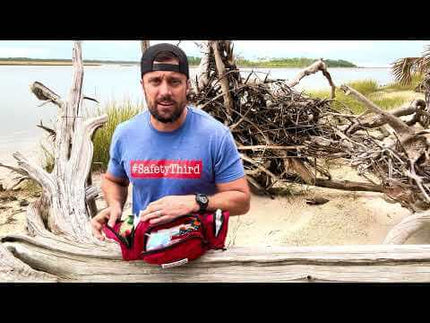
What the Advanced Adventurer First Aid Kit Is (and Isn't)
The Advanced Adventurer First Aid Kit is a trauma-capable, MARCH-informed medical kit designed for backcountry emergencies where you're hours from definitive care.
It's built for hikers, backpackers, overlanders, guides, and prepared families who need organized, rapid-access bleeding control and wound management in remote environments.
What it is: A compact, weather-resistant kit with 138 items including authentic CAT® tourniquet, QuikClot® hemostatic gauze, pressure dressings, wound care, fracture stabilization, and burn treatment—organized in labeled compartments for fast, intuitive access during high-stress situations.
What it isn't: This is not a basic boo-boo kit for minor scrapes. It's trauma-forward gear for serious backcountry medical response when professional help is distant.
Why Backcountry Travelers Choose This Kit
When you're deep in the Smokies, summiting in Yosemite, or crossing Moab's backcountry, medical emergencies don't wait.
The Advanced Adventurer delivers professional-grade organization in a packable footprint so you can control life-threatening bleeding, protect wounds from contamination, and stabilize injuries during the critical Golden Hour before evacuation.
Rapid-access layout puts bleeding control front and center—tourniquet, hemostatic gauze, and pressure dressing are immediately accessible without digging through zippered chaos.
Trauma-forward components include space for windlass tourniquet, hemostatic agents, occlusive chest seals, NPA airway, and fracture/splint supplies—covering MARCH protocol priorities (Massive hemorrhage, Airway, Respiration, Circulation, Hypothermia).
Rugged, packable design weighs 4 lbs and measures 12" × 8" × 6"—fits in daypacks, rucks, vehicle consoles, or mounts via MOLLE. Weather-resistant exterior stands up to rain, dust, snow, and rough handling.
Refillable and modular with clear compartments that make restocking simple and let you tailor contents for trip length, season, team size, and specific hazards.
How to Use It in the Field
Step 1: Assess the scene — Ensure safety for you and the patient before opening the kit.
Step 2: Address massive bleeding first — If arterial bleeding is present, apply the CAT® tourniquet high and tight, then pack the wound with QuikClot® gauze and apply direct pressure.
Step 3: Manage airway and breathing — Use NPA if needed; apply chest seals for penetrating chest trauma.
Step 4: Treat secondary injuries — Clean and dress wounds, stabilize fractures with SAM splint, manage burns, address blisters.
Step 5: Monitor and prepare for evacuation — Keep patient warm, document interventions, and coordinate rescue.
Step 6: Restock after use — Clear compartments make it easy to identify what was used and reorder supplies.
Your Questions, Answered
"Isn't this overkill for a day hike?" — If you're staying on groomed trails near trailheads, a basic kit may suffice. But if you're venturing into true backcountry where help is 2+ hours away, having trauma supplies can be the difference between a recoverable injury and a tragedy. This kit is sized for serious remote travel, not urban parks.
"I'm not trained—will I know how to use this?" — The kit is organized intuitively, and we strongly recommend pairing it with a Wilderness First Aid or Stop the Bleed course. Training amplifies effectiveness, but the kit's design helps even untrained users act faster.
"Can I get this through TSA / take it on a plane?" — Checked baggage: yes. Carry-on: tourniquets and most supplies are allowed, but shears and some sharp items must go in checked bags. Review current TSA guidelines before flying.
"How do I know when to restock or replace items?" — Hemostatic gauze and some dressings have expiration dates (typically 3–5 years). Check annually, replace expired items, and restock after any use. Clear compartments make inventory checks fast.
"How do I carry it?" - The kit includes carry handles and MOLLE-compatible straps. It fits in most daypacks, vehicle consoles, or can be mounted externally on rucks and tactical bags.
"Is this the right kit for me if I'm new to backcountry travel?" - If you're planning trips more than 1–2 hours from trailheads or roads, yes. Pair it with a Wilderness First Aid course to build confidence. If you're sticking to short, well-traveled trails, a simpler kit may be a better starting point.
Ready to Go?
Equip your next adventure with the confidence that comes from professional-grade trauma readiness. The Advanced Adventurer First Aid Kit delivers field-tested organization in a compact footprint—so you can focus on the route and be ready when it counts.