Uncontrolled hemorrhage is the leading preventable cause of death in traumatic injury. The gauze in your kit is your primary tool against it — but not all gauze works the same way. Regular gauze absorbs blood. Compressed gauze absorbs blood and packs more efficiently into a wound cavity. Hemostatic gauze accelerates clotting through a chemical mechanism. The difference between them determines whether you can stop arterial bleeding before a patient exsanguinates.
This guide covers the three types, when each one is appropriate, the wound packing protocol, and what to actually carry in your kit.
The three types of gauze
Standard woven cotton or synthetic material. Absorbs blood but does not promote clotting or pack efficiently into deep wounds.
Best for: Minor cuts, abrasions, post-procedure dressing over closed wounds
Not for: Deep penetrating wounds, arterial bleeding, junctional injuries
Same base material as regular gauze, compressed and vacuum-packed to a fraction of the volume. Designed for wound packing — identical material expands once inside the wound cavity.
Best for: Deep lacerations, puncture wounds, extremity bleeding requiring packing
Not for: Wounds requiring hemostatic acceleration (where QuikClot should be used)
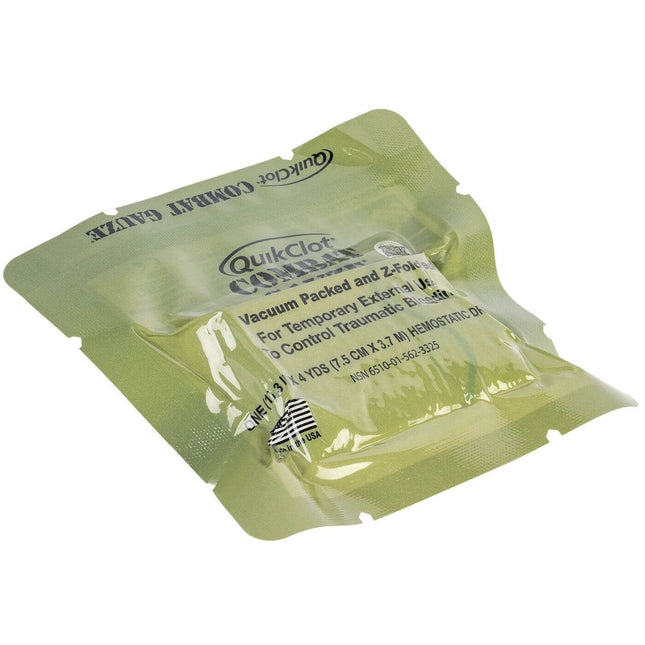
Gauze impregnated with kaolin, a mineral that accelerates the body's natural clotting cascade. CoTCCC-recommended for wounds where tourniquets cannot be applied — neck, groin, axilla.
Best for: Junctional wounds, arterial bleeding not accessible to tourniquet, high-risk trauma
NSN: 6510-01-562-3325 (QuikClot Combat Gauze)
When to use each type
| Wound Type | First Choice | Notes |
|---|---|---|
| Minor cut or abrasion | Regular gauze | Direct pressure alone is usually sufficient |
| Deep laceration (extremity) | Compressed gauze | Pack tightly, apply direct pressure, consider tourniquet |
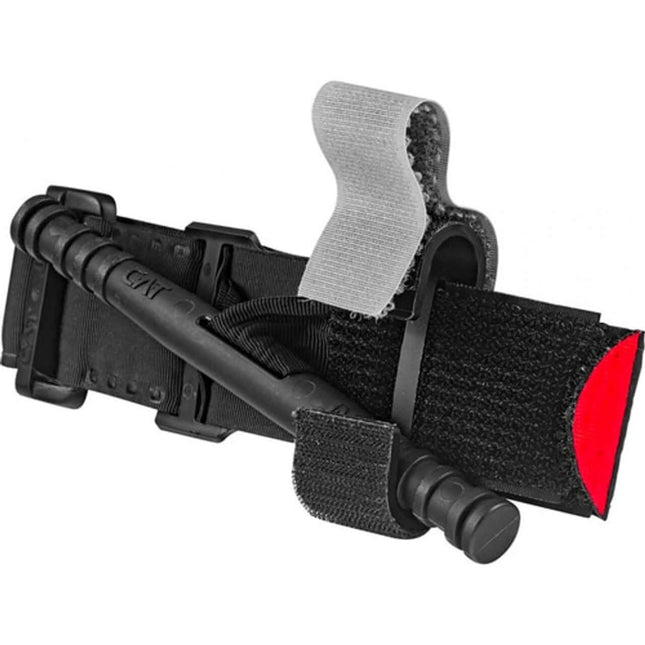
| Arterial bleed (extremity) | CAT Gen 7 tourniquet first | Tourniquet is primary; gauze for wounds where TQ fails to control |
| Junctional wound (groin, axilla, neck) | QuikClot hemostatic gauze | Tourniquet not applicable; hemostatic packing is the primary intervention |
| Penetrating torso wound | Hemostatic gauze + chest seal | Beyond scope of basic TCCC; prioritize evacuation |
The takeaway: regular gauze has a role in basic wound care, but it does not belong in a trauma kit's primary hemorrhage control position. That position belongs to compressed or hemostatic gauze — whichever type matches the wound category.

The wound packing protocol
The gauge type matters. The technique matters more. Correct wound packing with the right gauze is the complete intervention — incorrect packing with the right gauze still fails.
- Expose the wound. Cut away clothing. Identify the wound source — you're packing to the origin of bleeding, not just filling the surface cavity.
- Open the gauze. Z-fold or accordion-style gauze (QuikClot format) is designed to be packed in layers, not shoved in as a mass. Start at the back of the wound and pack forward.
- Pack tightly to the wound origin. Use your finger or a gloved thumb to push the gauze deep and maintain contact with the bleeding vessel. Loose packing does not generate sufficient pressure.
- Hold direct pressure for 3 minutes minimum. Do not lift to check. The clot forms under continuous pressure — lifting disrupts it. With QuikClot hemostatic gauze, the kaolin is activating during this window.
- Secure with a pressure dressing. Lock the packed gauze in place so it doesn't shift during transport.
- Mark the time and monitor. Document when packing was applied. If bleeding soaks through, do not remove — add more gauze on top and hold pressure again. Repacking from scratch disrupts the clot.
Correct packing with the wrong gauze fails. Incorrect packing with the right gauze also fails. The protocol is not optional.— ViTAC Field Standard
How hemostatic gauze works
QuikClot Combat Gauze uses kaolin — an aluminum silicate mineral — impregnated throughout the gauze. When kaolin contacts blood, it activates Factor XII in the coagulation cascade, accelerating the body's natural clotting process by approximately 5x compared to plain gauze. It does not generate heat (the previous generation of QuikClot powder did; the current gauze formulation does not).
The kaolin mechanism is effective within approximately 30 seconds of contact with blood. The 3-minute hold is still required to allow the clot to form and stabilize — kaolin accelerates the start of the cascade, not the time to complete clot formation.
This is why hemostatic gauze is the CoTCCC-preferred intervention for junctional wounds where a tourniquet cannot be placed. For extremity wounds, the CAT Gen 7 tourniquet is still primary — the tourniquet cuts off the arterial supply entirely. Hemostatic gauze is the fallback for wounds the tourniquet cannot reach.
Where gauze fits in the MARCH framework
The MARCH framework prioritizes massive hemorrhage control above everything else. Gauze addresses the M in two scenarios: junctional wounds where tourniquet cannot be applied, and wounds that continue to bleed past a correctly placed tourniquet.
Regular gauze does not belong in the M phase. It absorbs blood; it does not stop hemorrhage. Compressed gauze handles packing efficiently. Hemostatic gauze handles the wounds where packing alone is insufficient. Both belong in a properly configured IFAK — regular gauze belongs in a general first aid kit, not a trauma kit.
Shelf life and storage
Gauze stored correctly is stable for years. The variables that degrade it are heat, moisture, and physical damage to the sterile packaging.
| Gauze Type | Typical Shelf Life | Storage Notes |
|---|---|---|
| Regular gauze | 5 years (sealed packaging) | Any climate-controlled environment; replace if packaging is compromised |
| Compressed gauze | 5 years (sealed) | Same as regular; vacuum seal is the protection layer — inspect regularly |
| QuikClot Combat Gauze | 5 years (manufacturer stated) | Avoid humidity and extreme heat; kaolin degrades if packaging is wet or torn |
Inspect kit gauze every 6 months. Torn packaging, moisture staining, or discoloration is grounds for replacement. With hemostatic gauze specifically, a compromised package means the kaolin may have activated prematurely or been contaminated — replace it, don't use it.
FAQ
Can I use regular gauze if I don't have compressed or hemostatic gauze?
In an emergency, any clean absorbent material and sustained direct pressure is better than nothing. But regular gauze won't pack a deep wound cavity effectively and provides no hemostatic acceleration. It's a last resort, not a substitute. The solution is to carry the right gear before you need it — hemostatic gauze is not expensive relative to its function.
Is QuikClot safe to use — does it burn?
Current-generation QuikClot Combat Gauze is kaolin-based and does not generate heat. The earlier powder formulation (pre-2008) caused thermal burns in some documented cases. That product is no longer in service. The Combat Gauze you'll find in CoTCCC-compliant kits today is the kaolin-impregnated cloth format — no heat generation, confirmed by independent testing and field documentation.
Should I remove the gauze once bleeding stops?
No. Packed gauze — especially hemostatic gauze — should not be removed in the field. The gauze and clot are integrated. Removing it disrupts the clot and can restart hemorrhage. Only trauma surgeons remove hemostatic gauze, typically in an OR with suction and the ability to immediately address re-bleeding. In the field, secure the dressing, monitor the patient, and get them to definitive care.
How much gauze should I carry in a kit?
A minimum TCCC-compliant IFAK includes one hemostatic gauze dressing. More is better — a serious wound may require more than one dressing to pack correctly, and a multi-casualty situation compounds the need. ViTAC IFAKs are configured with CoTCCC minimum requirements; check the kit contents list for specific quantities.
Bottom line
Gauze selection is not a preference — it's a clinical decision based on wound type. Regular gauze handles minor wounds. Compressed gauze handles wound packing where hemostatic acceleration isn't required. QuikClot hemostatic gauze handles junctional wounds and arterial bleeds where a tourniquet can't reach. Each type belongs in a different kit configuration and a different part of the treatment protocol.
Build your kit around what your most likely wound scenario requires. For most civilians and tactical operators, that means hemostatic gauze as the primary dressing, compressed gauze as the secondary, and a CAT Gen 7 for extremity arterial bleeds. See ViTAC's IFAK collection for kits pre-configured to that standard.