What Belongs in a Bleed Control Kit
7 min reading time
7 min reading time
Extremity hemorrhage is the leading cause of preventable death in both combat and civilian trauma. The Hartford Consensus and subsequent TECC guidelines place hemorrhage control as the first priority in any mass casualty or penetrating trauma event — ahead of airway, ahead of breathing. The gear required to stop life-threatening bleeding is specific, validated, and not found in a standard first aid kit. This post covers exactly what belongs in a bleed control kit and why each component earns its place.
A standard first aid kit is built for lacerations, sprains, and minor burns. It contains adhesive bandages, antiseptic wipes, and over-the-counter analgesics. None of those items slow arterial hemorrhage. A bleed control kit — also called a trauma kit or IFAK — is built for a different threat: high-volume blood loss from penetrating wounds, crush injuries, and amputations where the patient will die in minutes without intervention.
The MARCH protocol (Massive hemorrhage, Airway, Respiration, Circulation, Hypothermia) is the operational standard for trauma casualty care. A bleed control kit addresses the first letter: M. Everything in the kit must support that mission. Anything that doesn't is weight and clutter.
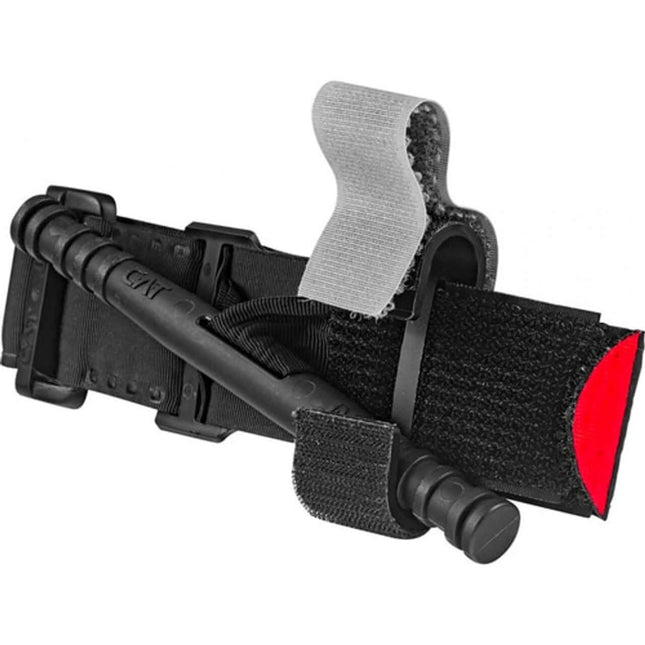
For arterial bleeding on an arm or leg, a tourniquet is the fastest and most reliable intervention. No improvised pressure technique matches the mechanical compression of a purpose-built tourniquet applied correctly. The two field-validated options are the CAT Gen 7 and the SOF-T Wide.
The CAT Gen 7 is the current U.S. military standard. It applies one-handed and is the default choice for civilian carriers who may need to self-apply. The SOF-T Wide uses a wider band that distributes pressure over a larger surface area — preferred for extended wear and for patients with significant thigh circumference. Both are TCCC-approved. No other tourniquet types belong in a kit built to this standard.
Carry at minimum one tourniquet per limb-capable person in your group. TCCC field data consistently shows that a single tourniquet is insufficient for complex lower-extremity injuries. If your kit has room, carry two.
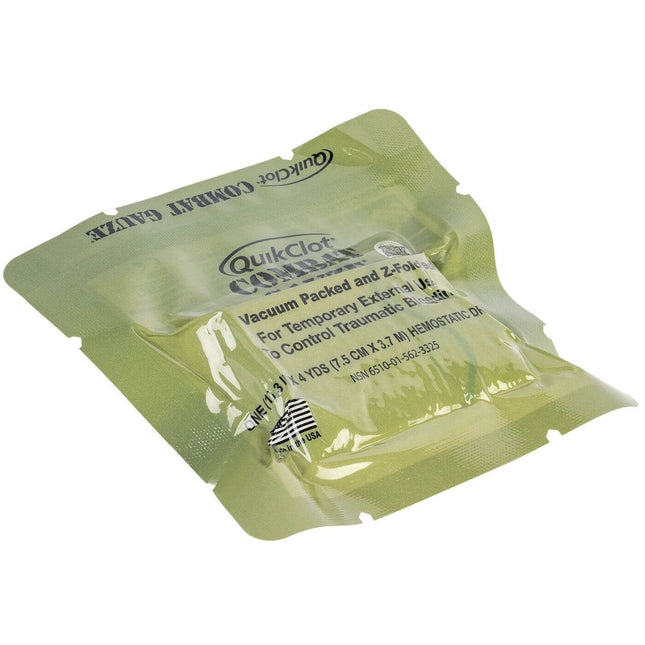
Tourniquets do not work on wounds in the neck, groin, or axilla (armpit). These junctional zones require wound packing with hemostatic gauze — gauze impregnated with a clotting accelerant that augments the body's coagulation cascade. Kaolin-based gauze (the active agent in QuikClot Combat Gauze) is the TCCC-recommended standard. It is z-folded to allow full wound cavity packing and treated to accelerate clot formation at the bleeding source.
Wound packing technique: insert the gauze with a gloved finger, pressing it into direct contact with the bleeding vessel. Do not leave air gaps. Once the cavity is packed, maintain direct hand pressure for a minimum of three minutes. Hemostatic gauze does not work if it sits on top of the wound — it requires tissue contact to activate.
Field Note: Intervention Sequence
Knowing which tool to reach for is the difference between effective intervention and wasted seconds. Tourniquet: limb bleeding. Hemostatic gauze: junctional and deep cavity wounds. Pressure dressing: securing the pack and maintaining compression. These tools are not interchangeable. Train on the decision sequence before you need it.
After wound packing, a pressure dressing holds the hemostatic gauze in place and maintains compression at the wound site. The Israeli Bandage (Emergency Bandage) is the standard for this application — it includes a primary pad, an integrated pressure bar, and a closure mechanism that allows a single operator to apply it with one hand. Compression gauze (conforming gauze rolls) serves the same securing function for wounds that are accessible but too large for a single pressure dressing.
Do not use standard gauze rolls as a substitute for a pressure dressing on a packed wound. Standard gauze lacks the compression mechanism needed to maintain pressure when the operator removes their hand. The dressing must hold tension without continuous manual pressure.
A penetrating chest wound (gunshot, stab, impalement) that creates a hole in the thoracic cavity can produce a tension pneumothorax — air accumulating in the pleural space, collapsing the lung, and eventually preventing the heart from pumping. A vented chest seal covers the wound and allows air to escape through the vent during exhalation while preventing additional air entry on inhalation. Carry two — one for the entry wound, one for a potential exit wound.
Chest seals are a required component of any kit carried in environments where penetrating trauma is a plausible risk: range operations, law enforcement duty, backcountry, and active threat environments. They are not heavy and do not take significant space. There is no reasonable argument for carrying a tourniquet and hemostatic gauze but not a chest seal.
Three supporting items complete the kit:
An assembled trauma kit from a verified supplier is the fastest way to field a complete, compatible set of components. The ViTAC Intermediate Bleeding Control Pack contains a tourniquet, hemostatic gauze, pressure bandage, gloves, and trauma shears in a compact IFAK-ready package. All components meet TCCC supply standards.
Custom builds are appropriate when you have specific requirements — additional tourniquets for a multi-person team, specific hemostatic gauze brands required by your agency's protocol, or chest seals not included in a standard assembled kit. Either way, the component list remains the same. The only variable is whether you source items individually or as a matched set.
Can I substitute regular gauze for hemostatic gauze?
No. Regular gauze has no clotting accelerant and cannot match the hemostatic performance of kaolin-treated gauze in a deep cavity wound. The substitution is a documented failure pattern in civilian trauma response. Standard gauze belongs in a first aid kit; hemostatic gauze belongs in a bleed control kit.
How many tourniquets should a bleed control kit contain?
Minimum one. TCCC field data recommends two for kits used in operational or high-risk environments — a complex lower-extremity injury can require both. If the kit is a compact personal carry IFAK, one is acceptable. If it is staged for team or workplace use, carry two.
Does every bleed control kit need a chest seal?
Yes, if the kit will be used in any environment where penetrating thoracic wounds are plausible. That includes range operations, duty carry, and backcountry. A tourniquet without a chest seal is an incomplete hemorrhage control kit.
A bleed control kit contains a tourniquet, hemostatic gauze, a pressure dressing, a chest seal, trauma shears, nitrile gloves, and a permanent marker. These are not optional additions to a first aid kit — they are a separate category of gear with a specific operational purpose. Own them. Know how to use them.
For the foundational context on what a bleed control kit is and who needs one, see What a Bleed Control Kit Is and Why You Need One. For the decision framework on which kit to reach for in a trauma scenario, see When to Use a Bleed Control Kit vs. a First Aid Kit.
Browse ViTAC Bleed Control Kits

OSHA minimum workplace kits don't include a tourniquet. Here's how to calculate station count, stock each station, and build bleed control coverage in any public...

One kit at the main entrance fails the 90-second coverage rule for most buildings. Here's how to run a coverage audit and calculate the correct...

Arterial hemorrhage kills in 3 minutes. Urban EMS takes 7–10. Every business needs CoTCCC-standard bleed control kits — here's how to select, deploy, and train...

40+ states mandate bleed control kits in schools — but most deployment plans miss classrooms and buses. Here's the placement standard that actually works.

Most of our trauma kits and first aid supplies qualify for HSA and FSA reimbursement. Don't let your benefits expire — invest them in gear that could save a life.


$124.95


$279.99

$37.49 - $139.46


$299.95 $269.95


$139.95 - $169.95

$49.95


$25.99


$164.95

We've been downrange. We know what it costs to be unprepared. ViTAC was built by U.S. Army Special Operations veterans to make sure the people who run toward the threat — and the families who depend on them — have gear that works when everything is on the line.
— ViTAC Solutions Founders | 40+ years combined Special Operations experience