The Tourniquets Police, Military, and First Responders Actually Use
6 min reading time
6 min reading time
Limb exsanguination killed approximately 7 to 9 percent of combat casualties in Vietnam and Somalia. By the end of the Iraq and Afghanistan conflicts, CoTCCC-driven tourniquet protocols had reduced that rate to under 2 percent. That outcome came from two simultaneous changes: faster battlefield evacuation and universal soldier-level tourniquet training. Law enforcement agencies drew the same conclusion after the Boston Marathon bombing in 2013, when bystander and first-responder tourniquet application controlled limb hemorrhage at scale before EMS arrived. Both transitions moved the same device — the windlass tourniquet — from a specialized medical tool to standard-issue equipment for anyone likely to be first on scene.
Through most of the 20th century, tourniquets were considered a last resort in both military and civilian medicine. The concern was ischemic damage to tissue and nerves during prolonged battlefield evacuation. Post-World War II analysis of wound mortality, combined with data from Vietnam casualties, established that many preventable hemorrhage deaths occurred in the gap between injury and medical care — precisely the gap a tourniquet addresses.
The early 2000s accelerated the reversal. TCCC adoption by the U.S. military, reduced evacuation times, and real-world survival data from Iraq and Afghanistan built the evidence base for a simple operational change: place tourniquet application first in the MARCH sequence (Massive hemorrhage, Airway, Respiration, Circulation, Hypothermia), before airway assessment. That sequencing is now standard in both military and civilian emergency medicine education.
Two devices hold CoTCCC approval and represent the overwhelming majority of professional carry:
Both devices are manufactured to ASTM F3143. Both are in standard issue across military branches, law enforcement agencies, and EMS systems that have adopted CoTCCC-based protocols.
Police departments in Virginia, Dallas, Philadelphia, and dozens of other jurisdictions issued tourniquets to officers beginning in the mid-2010s following evidence from tactical medicine data and active shooter incident analysis. The operational logic is straightforward: law enforcement officers arrive at active shooter, vehicle accident, and assault scenes before EMS. An officer with a CAT and training applies hemorrhage control in the first minute. EMS arrives at minute seven to a patient who has not bled out.
The National Association of Emergency Medical Technicians (NAEMT) provides standardized training through its Law Enforcement and First Response Tactical Casualty Care (LEFR-TCC) and Bleeding Control for the Injured (BCon) courses. These programs train officers on CoTCCC-based assessment, tourniquet placement, wound packing, and documentation protocols.
Tourniquet training follows a hierarchy from foundational to advanced:
All three curricula teach the same clinical standard: tourniquet to arterial occlusion, windlass locked, time documented on the patient's forehead.
Civilian studies following the military's adoption have shown consistent results. When tourniquets are applied for clearly indicated hemorrhage — arterial bleed, amputation, uncontrolled limb hemorrhage — survival rates improve with a low complication rate. Complications including nerve palsy, compartment syndrome, and amputation occur at low rates in indicated applications. Amputation directly attributable to the tourniquet device is rare in cases where the device was applied correctly and converted within the two-hour window.
Complication rates rise significantly in non-indicated applications — cases where the bleed was manageable with direct pressure and a tourniquet was applied unnecessarily. Training programs focus substantially on this assessment skill: recognizing the threshold between a wound that warrants a tourniquet and one that does not.
Field Note: Training Is Non-Optional
A tourniquet applied incorrectly and left on for an extended period on a non-indicated injury has produced amputations in documented cases. The error was not the device — it was absence of training. Every person carrying a CoTCCC-approved tourniquet should be able to correctly answer: when is it indicated, where does it go, and how tight is tight enough.
Limb Occlusion Pressure (LOP) is the minimum cuff pressure required to stop arterial blood flow in a specific limb at a specific application site. It varies by patient body composition, limb circumference, and limb position. Modern clinical settings use LOP measurement to calibrate tourniquet pressure to the minimum effective level, reducing ischemic injury risk while maintaining occlusion. For field application — military, law enforcement, civilian — the practical standard remains tighten until arterial bleeding stops. LOP measurement is a clinical optimization tool for controlled settings, not a field procedure.
A tourniquet is a compressive device applied to a limb to stop life-threatening hemorrhage by compressing arteries against the underlying bone, occluding blood flow distal to the application point. It is the primary first-line intervention for uncontrolled extremity bleeding in both military and civilian trauma protocols.
Reduced battlefield evacuation times changed the risk-benefit calculation. When evacuation takes hours, prolonged tourniquet application causes ischemic injury that may outweigh the bleed risk. When evacuation takes under two hours, the tourniquet saves the life and the limb survives conversion to wound packing at the medical facility. That shift in transport capability drove the CoTCCC protocol change.
Yes. Civilian tourniquet carry and application are legal and encouraged through the Hartford Consensus and Stop the Bleed program. A trained bystander with a tourniquet and the willingness to act is the most effective first-responder resource in the critical first minutes of an arterial bleed event.
For specific guidance on tourniquet placement decisions, read Tourniquet Placement: High and Tight vs. Closer to the Wound. For a side-by-side comparison of the two CoTCCC-approved devices, see CAT vs. SOFTT-W: Which Should You Carry. The full trauma response framework governing how these devices fit into casualty care is covered in the MARCH Protocol guide.
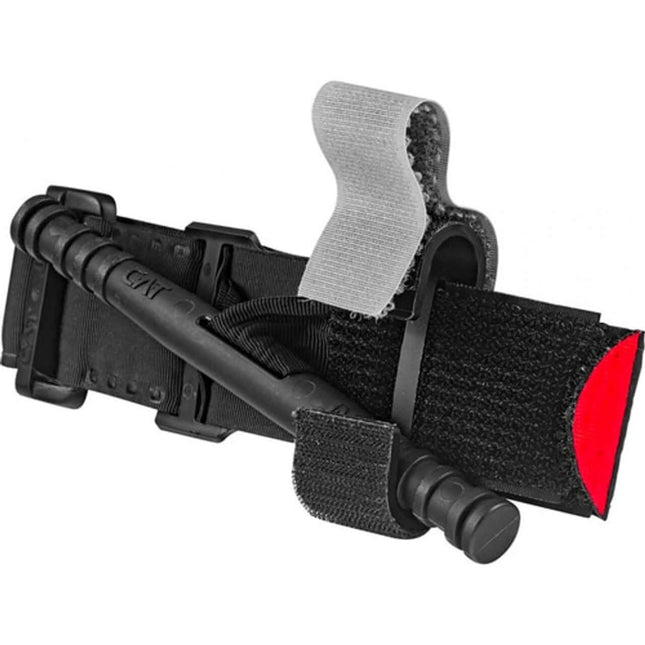
The devices carried by law enforcement, military, and first responders are commercially manufactured, CoTCCC-approved windlass tourniquets — specifically the CAT Gen 7 and the SOF-T Wide. They carry these devices because the data on survival outcomes is unambiguous. The same data applies to every driver, hunter, and family building a hemorrhage control kit. Carry what the professionals carry, trained to the same standard.
Shop CoTCCC-Approved Tourniquets

OSHA minimum workplace kits don't include a tourniquet. Here's how to calculate station count, stock each station, and build bleed control coverage in any public...

One kit at the main entrance fails the 90-second coverage rule for most buildings. Here's how to run a coverage audit and calculate the correct...

Arterial hemorrhage kills in 3 minutes. Urban EMS takes 7–10. Every business needs CoTCCC-standard bleed control kits — here's how to select, deploy, and train...

40+ states mandate bleed control kits in schools — but most deployment plans miss classrooms and buses. Here's the placement standard that actually works.

Most of our trauma kits and first aid supplies qualify for HSA and FSA reimbursement. Don't let your benefits expire — invest them in gear that could save a life.


$124.95


$279.99

$37.49 - $139.46


$299.95 $269.95


$139.95 - $169.95

$49.95


$25.99


$164.95

We've been downrange. We know what it costs to be unprepared. ViTAC was built by U.S. Army Special Operations veterans to make sure the people who run toward the threat — and the families who depend on them — have gear that works when everything is on the line.
— ViTAC Solutions Founders | 40+ years combined Special Operations experience