Tourniquet Placement: High and Tight vs. Closer to the Wound
7 min reading time
In 2017, the Committee on Tactical Combat Casualty Care updated its tourniquet placement guidance based on a decade of combat data. The revision moved away from a rigid "always high and tight" doctrine toward a situation-dependent model: targeted placement 2 to 3 inches proximal to the wound when conditions allow, high and tight when they do not. Understanding when each approach applies is the practical skill.
In most cases, place the tourniquet 2 to 3 inches proximal to the bleeding site, between the wound and the torso. This position compresses the primary feeding artery against the underlying bone without the extended ischemic zone of a proximal placement. The constraints are fixed:
High and tight means placing the tourniquet as far proximal as possible on the limb — as close to the axilla on the arm, or as close to the groin on the leg. This is the correct choice when:
The tradeoff is a larger volume of ischemic tissue below the tourniquet. That tradeoff is acceptable when the alternative is delayed hemorrhage control. A high-and-tight tourniquet applied in seconds outperforms a perfectly positioned tourniquet applied after the patient has lost two liters of blood.
If you can identify the wound clearly and have a few seconds to position, targeted placement 2 to 3 inches above the injury is preferred. This approach reduces the volume of affected tissue and simplifies reassessment by medical personnel who will eventually convert the tourniquet to wound packing and pressure.
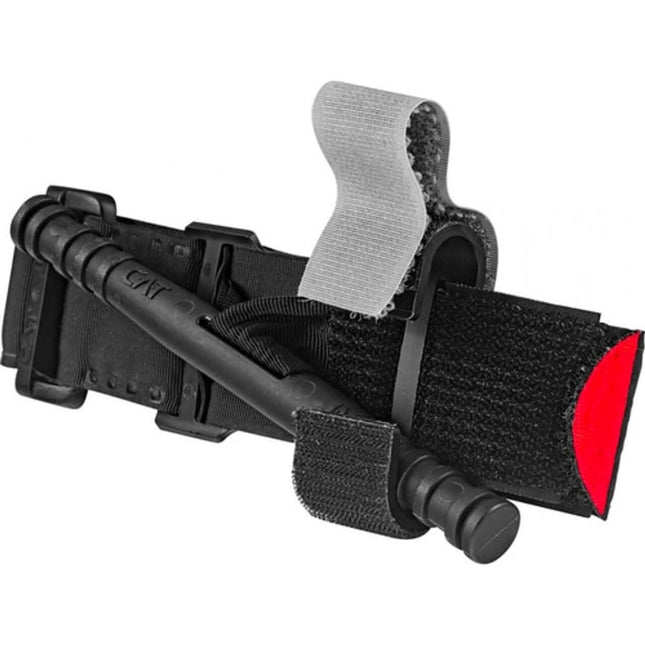
Targeted placement is appropriate in post-chaos stabilization, rescue scenarios with established scene safety, and any situation where the patient is accessible and the wound is visible. The CAT Gen 7 and SOF-T Wide are both designed to work equally well in either configuration.
Apply the tourniquet over a single thin layer if unavoidable. Thick or layered clothing under the strap reduces the effective pressure at the arterial wall. Cut clothing away whenever the situation permits.
Position the tourniquet proximal to all visible wounds. If two wounds are present on the same limb at different levels, the tourniquet goes above the most proximal wound. If bleeding from the distal wound remains uncontrolled, that wound requires wound packing in addition to the tourniquet.
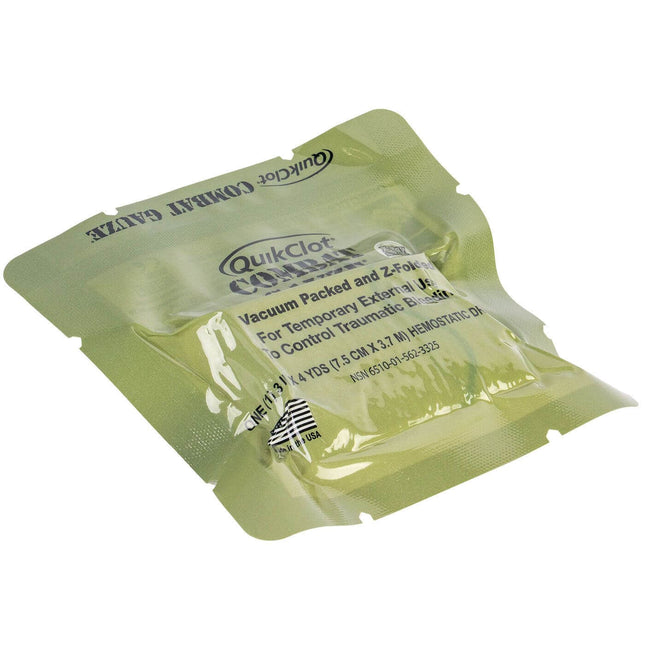
Wounds at the groin, axilla, or neck cannot be controlled with a limb tourniquet. These require wound packing with hemostatic gauze. The Intermediate Bleeding Control Pack includes hemostatic gauze and instruction for junctional packing.
If the first tourniquet is maximally tightened and active arterial bleeding continues, apply a second immediately proximal to the first. Stacked tourniquets address large-limb injuries where a single compression point may not fully occlude all supplying vessels. Both application times must be documented.
Do not remove or loosen the first tourniquet to reposition it. If placement was suboptimal, add the second tourniquet above it rather than disturbing the one already in place.
Tourniquet-related tissue and nerve complications correlate with application time, not tightness. The priority is hemorrhage control, not minimizing tourniquet duration — that is a decision for medical personnel with the patient in a controlled setting. Two key indicators in the field:
Document the time of application on the patient's forehead or tourniquet strap. TCCC guidelines target conversion within two hours — that window starts at your documented time.
Tourniquet application is the primary intervention in the MARCH framework — the tactical trauma care sequence used across military and civilian emergency response. Massive Hemorrhage is the first priority in that sequence because it is the leading cause of preventable trauma death. Correct placement and confirmed occlusion address that priority completely.
For a side-by-side comparison of CAT Gen 7 versus SOFTT-W with counterfeit identification, see Best Tourniquet for Emergency First Aid: CAT vs. SOFTT-W. For the case for the CAT as the established standard across all scenarios, see CAT Tourniquet vs. Everything Else: Why the Standard Matters.
A tourniquet is a compressive device applied to a limb to stop life-threatening hemorrhage. Use one when direct pressure cannot control bleeding from an arm or leg — arterial bleeds, amputations, or high-volume wounds that overwhelm manual pressure.
2 to 3 inches proximal to the wound, between the wound and the torso, avoiding joints. When the wound is obscured or conditions are chaotic, go high and tight — as far proximal on the limb as possible.
High and tight means placing the tourniquet at the most proximal point of the limb — closest to the armpit on an arm, or closest to the groin on a leg. It is the appropriate technique when precise placement is not possible or when speed is the primary requirement.
Yes. Apply a second tourniquet immediately proximal to the first and document both application times. Do not remove or readjust the first.
Pain is expected and indicates effective arterial compression. Do not loosen the tourniquet in the field. Tourniquet conversion is performed by trained medical personnel after the patient reaches a controlled care environment.
Commercial tourniquets — the CAT Gen 7 and SOF-T Wide — are tested to ASTM F3143 and designed for reliable one-handed application. Improvised devices frequently fail to achieve arterial occlusion. Carry a commercial tourniquet anywhere the risk of limb injury is present.
Placement protocol is not a fixed rule — it is a decision tree based on what you can see, how much time you have, and where the wound is located. High and tight when conditions are chaotic or the wound is unclear. Targeted at 2 to 3 inches proximal when you have visibility and a moment to position. The CAT Gen 7 Tourniquet performs reliably in both configurations and is the current TCCC-approved standard. Know your kit before you need it.

OSHA minimum workplace kits don't include a tourniquet. Here's how to calculate station count, stock each station, and build bleed control coverage in any public...

One kit at the main entrance fails the 90-second coverage rule for most buildings. Here's how to run a coverage audit and calculate the correct...

Arterial hemorrhage kills in 3 minutes. Urban EMS takes 7–10. Every business needs CoTCCC-standard bleed control kits — here's how to select, deploy, and train...

40+ states mandate bleed control kits in schools — but most deployment plans miss classrooms and buses. Here's the placement standard that actually works.

Most of our trauma kits and first aid supplies qualify for HSA and FSA reimbursement. Don't let your benefits expire — invest them in gear that could save a life.


$124.95

$37.49 - $139.46


$299.95 $269.95


$279.99


$139.95 - $169.95

$49.95


$25.99


$164.95

We've been downrange. We know what it costs to be unprepared. ViTAC was built by U.S. Army Special Operations veterans to make sure the people who run toward the threat — and the families who depend on them — have gear that works when everything is on the line.
— ViTAC Solutions Founders | 40+ years combined Special Operations experience