QuikClot Combat Gauze: Hemostatic Standard for Vehicle Trauma
7 min reading time
7 min reading time
Uncontrolled bleeding is the leading cause of preventable death after traumatic injury. From a severed femoral or brachial artery, a casualty can bleed out in three to five minutes — often before EMS arrives, and almost always before they reach definitive care. A tourniquet handles extremity bleeds. But not every wound is one a tourniquet can solve. Junctional injuries — the groin, axilla, neck — and deep extremity wounds that won't seal under direct pressure are exactly where hemostatic gauze earns its place in your kit.
QuikClot Combat Gauze has been the CoTCCC-recommended hemostatic dressing of choice since April 2008, and it is the only hemostatic gauze fielded across all branches of the U.S. military. If your vehicle trauma kit doesn't include it, your kit is incomplete.
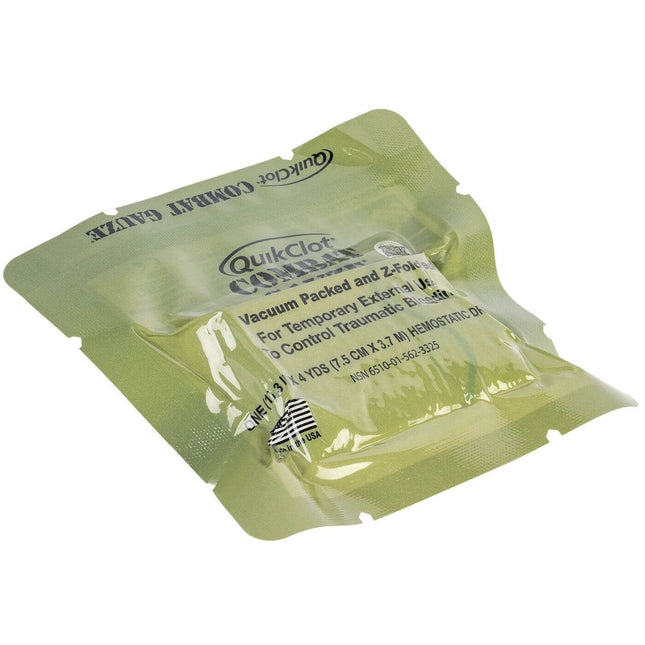
QuikClot Combat Gauze is a 3-inch by 4-yard, Z-folded, sterile non-woven gauze impregnated with kaolin — an inert clay mineral that activates Factor XII (Hageman factor) in the body's intrinsic coagulation cascade. Translation: it accelerates the natural clotting process at the wound site without generating heat and without introducing animal or human proteins.
The performance numbers that matter:
This is not a "nice to have." It is the standard of care for compressible hemorrhage that a tourniquet cannot reach.
Combat Gauze is used during the H — Hemorrhage step of the MARCH framework, specifically in two scenarios:
Order of operations on a serious extremity bleed: tourniquet first, fast and high. Then assess. If you have time, training, and reason to convert — pack the wound with Combat Gauze, apply three minutes of direct pressure, and overwrap with a pressure dressing. The tourniquet stays on the limb, loose, in case re-application is needed.
Field Note: Training Is Not Optional
Hemostatic gauze does not work if you don't pack the wound correctly. Effective wound packing means stuffing gauze directly into the bleeding source — into the cavity, against the vessel — until the wound is full, then holding firm pressure for a full three minutes without lifting to peek. Stop the Bleed certification covers this in two hours. It is free. If you carry a trauma kit, take the class.
Three hemostatic options sit in the trauma-kit market. Here is the honest comparison:
| Gauze | Mechanism | Compression Time | CoTCCC Status | Best For |
|---|---|---|---|---|
| Plain compressed gauze | Mechanical pressure / clot scaffolding | Indefinite | Standard wound packing | Backup volume, smaller bleeds |
| QuikClot Combat Gauze (kaolin) | Activates Factor XII, accelerates clotting cascade | 3 minutes | CoTCCC-recommended (2008–present) | Primary hemostatic for severe bleeds; military, LE, civilian standard |
| Celox Rapid (chitosan) | Chito-R bioadhesive, binds to red blood cells independent of clotting cascade | 60 seconds | Approved for use; secondary option | Anticoagulated patients, hypothermic patients, high-tempo response |
The takeaway: Combat Gauze is the default. Celox Rapid is a complementary option for patients on blood thinners or in conditions where the clotting cascade is impaired. Plain compressed gauze is for restock, training, and lower-acuity wounds. A serious vehicle kit carries Combat Gauze plus compressed gauze for volume. Browse the full Hemostatics collection for kit-building options.
Vehicle trauma is not theoretical. Roadside MVAs, work-site accidents, hunting injuries, and on-duty incidents all share a common variable: distance from the trauma center. Rural EMS response routinely exceeds 14 minutes nationally, and in some counties pushes well past 30. That timeline is incompatible with a 3-to-5-minute exsanguination window.
Your vehicle kit is the gear that closes that gap. A tourniquet handles the extremity bleed. Combat Gauze handles everything a tourniquet can't reach.
A vehicle-staged kit built for serious bleeding control runs this loadout, at minimum:
Built right, this stack lives in a rip-away pouch staged within reach of the driver's seat — not in the trunk. If you cannot reach it from the driver's position with one arm, you have not staged it correctly.
Shelf life is five years from manufacture in the unopened foil pouch. Heat cycling in a vehicle does shorten shelf life — rotate the kit annually and check the pouch for damage every time you re-stock other items.
The kaolin mechanism relies on the intrinsic clotting cascade, which is impaired by anticoagulants like warfarin, heparin, and direct oral anticoagulants. It will still work, but consider pairing with chitosan-based gauze (Celox Rapid) for high-risk patients. Either way, sustained pressure is what stops the bleed — the gauze is a force multiplier, not a substitute for compression.
No. Wound packing is taught in Stop the Bleed — a free two-hour course open to civilians, teachers, and law enforcement. If you carry hemostatic gauze, you owe yourself the training to use it correctly under stress.
The math is simple: arterial bleeding kills in minutes, and a tourniquet does not solve every bleed. QuikClot Combat Gauze is the CoTCCC-recommended hemostatic for compressible wounds the tourniquet can't reach — every serious vehicle trauma kit carries it.
Build a vehicle kit that closes the gap before EMS arrives. Start with the Vehicle-Ready Kits collection, or restock with QuikClot Combat Gauze Z-Fold directly.

OSHA minimum workplace kits don't include a tourniquet. Here's how to calculate station count, stock each station, and build bleed control coverage in any public...

One kit at the main entrance fails the 90-second coverage rule for most buildings. Here's how to run a coverage audit and calculate the correct...

Arterial hemorrhage kills in 3 minutes. Urban EMS takes 7–10. Every business needs CoTCCC-standard bleed control kits — here's how to select, deploy, and train...

40+ states mandate bleed control kits in schools — but most deployment plans miss classrooms and buses. Here's the placement standard that actually works.

Most of our trauma kits and first aid supplies qualify for HSA and FSA reimbursement. Don't let your benefits expire — invest them in gear that could save a life.


$124.95


$279.99

$37.49 - $139.46


$299.95 $269.95


$139.95 - $169.95

$49.95


$25.99


$164.95

We've been downrange. We know what it costs to be unprepared. ViTAC was built by U.S. Army Special Operations veterans to make sure the people who run toward the threat — and the families who depend on them — have gear that works when everything is on the line.
— ViTAC Solutions Founders | 40+ years combined Special Operations experience