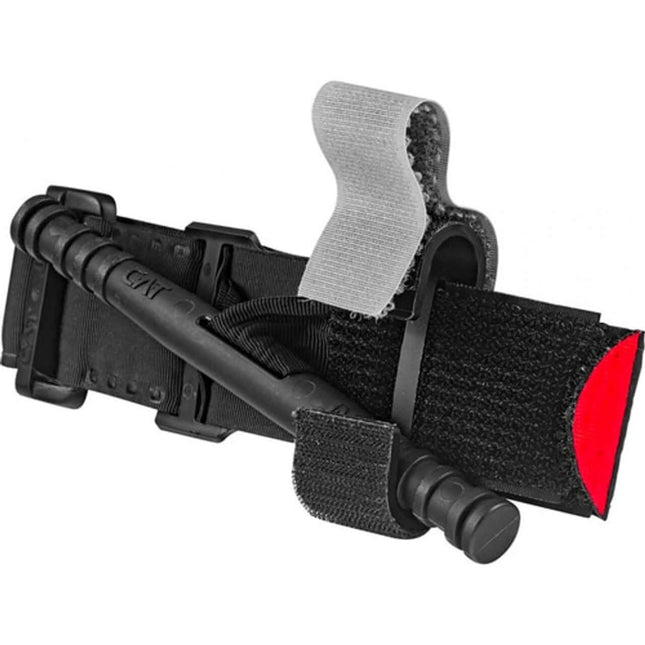
Uncontrolled bleeding is the leading cause of preventable death after traumatic injury, according to DHS's Stop the Bleed program. A severe arterial bleed can cause exsanguination in 3–5 minutes under TCCC guidelines — faster than most people can dial 911 and get a callback. Direct pressure and a tourniquet handle a lot of that risk. Hemostatic gauze handles what they can't: junctional wounds where a windlass has nowhere to bite, and bleeds severe enough that plain gauze and pressure alone won't clot fast enough.
This is a breakdown of what hemostatic gauze actually is, how it stops bleeding at the chemical level, when to reach for it instead of (or alongside) a tourniquet, and how to apply it correctly the first time. There isn't a second attempt when the wound is arterial.
How hemostatic gauze works
Hemostatic gauze is a wound dressing infused with a clotting agent that accelerates the body's natural coagulation response on contact with blood. It's designed to be packed directly into a wound cavity, not laid across the surface like a standard dressing. Two clotting chemistries dominate the field:
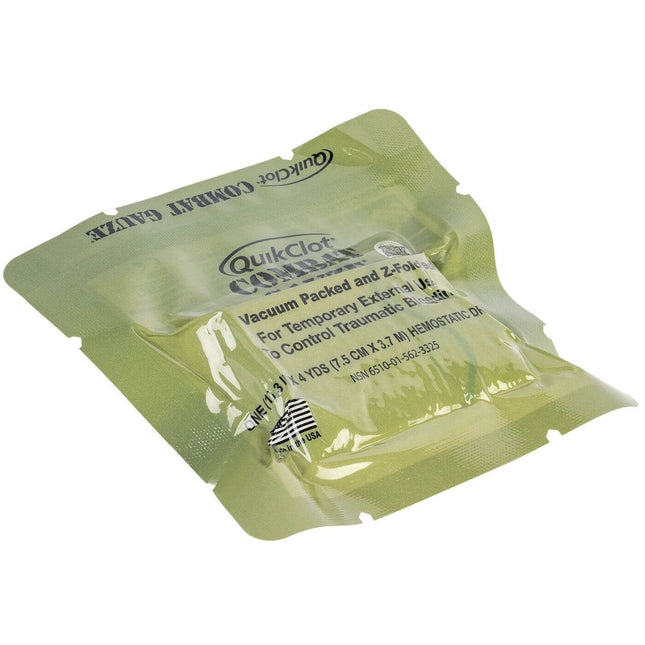
- Kaolin: an inert mineral that activates Factor XII in the clotting cascade and speeds up the body's own coagulation process. This is the chemistry behind QuikClot Combat Gauze, the hemostatic line ViTAC stocks as a standalone product.
- Chitosan: a shellfish-derived polymer that forms an adhesive gel seal on contact with blood, working mechanically rather than through the clotting cascade. It ships as a built-in component in select ViTAC trauma kits rather than as a standalone dressing.

Kaolin vs. chitosan: what the difference means for you
Both chemistries stop bleeding. The mechanism is what determines how each performs and where you'll find it in ViTAC's catalog.
| Agent | Chemistry | Mechanism | Where to find it |
|---|---|---|---|
| Kaolin (QuikClot) | Inert mineral | Activates Factor XII, accelerates the clotting cascade | Standalone rolls and dressings, ViTAC's primary hemostatic line |
| Chitosan (Celox, ChitoGauze) | Shellfish-derived polymer | Forms an adhesive gel seal independent of the clotting cascade | Built into select ViTAC trauma kits as a component option |
Both are proven, combat-tested clotting agents. Neither is a substitute for training. A hemostatic dressing only works if it's packed directly against the source of the bleed and held under firm, sustained pressure. That's the step most first-time users get wrong under stress.
Where this fits in MARCH
Hemostatic gauze addresses the "M" in the MARCH trauma care framework: Massive Hemorrhage, the same priority sequence taught in TCCC and Stop the Bleed courses. Massive hemorrhage control comes first because it's the most immediately reversible cause of preventable death on that list. A tourniquet handles extremity bleeds. Hemostatic gauze picks up where a tourniquet can't reach: the neck, groin, axilla, and any wound too deep or irregular for direct pressure alone to close.
Counterfeit and off-brand "hemostatic" gauze circulates on third-party marketplaces. It usually isn't kaolin-based per CoTCCC standard, so it won't perform the way the real product does when it matters. Buy from an authorized distributor and confirm the NSN on the packaging. For a full breakdown of what to check before you buy any trauma component, see our guide to counterfeit trauma kit risks.
When to use hemostatic gauze
Hemostatic gauze is built for moderate to severe bleeding, particularly in these situations:
- Deep lacerations or puncture wounds where direct pressure alone isn't controlling blood loss
- Junctional wounds (groin, axilla, neck) where a tourniquet has no limb to compress
- Delayed-EMS scenarios: rural response averages 14+ minutes nationally and exceeds 30 minutes in some counties per NHTSA data, and remote or disaster settings can push that further
Pack the wound. Hold the pressure. Don't check it early.TCCC application standard
How to apply it correctly
- Expose the wound and locate the source of bleeding. Don't pack blindly.
- Pack the gauze directly into the wound cavity, in contact with the bleeding source, not laid over the skin.
- Apply firm, continuous pressure for a minimum of 3 minutes, or until bleeding stops.
- Secure with a pressure dressing and leave it in place. Don't remove and repack to "check" it. That breaks the clot forming underneath.
- Tell EMS or the receiving medical team that hemostatic gauze was applied and when.
Shelf life on hemostatic gauze runs five years from date of manufacture. Check the date on anything already staged in a kit, vehicle, or range bag before you count on it.
FAQ
Is hemostatic gauze safe for civilians to use?
Yes. It's used by EMS, law enforcement, and military medics, and it's a standard component in civilian Stop the Bleed training. Good Samaritan laws protect bystanders who render aid in good faith in all 50 states.
Do I use hemostatic gauze instead of a tourniquet, or with one?
Depends on location. A tourniquet is first-line for a compressible limb bleed. Hemostatic gauze is first-line for junctional wounds a tourniquet can't reach, and it can supplement a tourniquet on a wound that's still bleeding heavily above the compression point.
How long does hemostatic gauze last in storage?
Five years from date of manufacture under normal storage conditions. Rotate stock in vehicle kits and duty bags on that schedule, since heat cycling can shorten effective life.
What's the difference between QuikClot and generic "clotting gauze"?
QuikClot Combat Gauze is kaolin-based and has carried a CoTCCC recommendation since April 2008. Generic or off-brand "clotting gauze" sold on third-party marketplaces frequently isn't kaolin-based and hasn't been through the same combat testing — verify the chemistry and the source before you trust it in a kit.
Bottom line
Hemostatic gauze is a mechanism-specific tool: it treats the wounds a tourniquet can't reach and the bleeds plain gauze can't close fast enough. Kaolin-based QuikClot is CoTCCC-recommended, five-year shelf-stable, and built to stop an arterial bleed in minutes when it's packed and pressed correctly. It belongs in every trauma kit next to a tourniquet, not instead of one.
Shop verified hemostatic gauze in the Hemostatics collection, or see our full IFAK component deep-dive for how it fits alongside every other item in a properly built kit.