Gunshot Wound Kit: 6 TCCC Components and How to Build Your Own
9 min reading time
9 min reading time
Uncontrolled hemorrhage is the leading cause of preventable death after traumatic injury. From an arterial gunshot wound, the window to exsanguination is 3 to 5 minutes. The national average EMS response time exceeds 14 minutes. That gap doesn't close itself — the right kit in trained hands is what fills it.
A gunshot wound kit addresses penetrating trauma specifically: the hemorrhage, the chest injury, the airway compromise that follows. This guide covers each of the six TCCC-standard components, what it does mechanically, and how to source or configure a kit that holds up when it's needed.
The MARCH framework — Massive Hemorrhage, Airway, Respiration, Circulation, Hypothermia — is the CoTCCC-standard sequence for managing combat trauma. It's the reason your kit must address hemorrhage first, chest wounds second, and airway third. MARCH isn't theory; it's derived from combat data on what kills in sequence.
Gunshot wounds can threaten every MARCH phase: arterial hemorrhage from an extremity wound demands a tourniquet within 90 seconds; a penetrating chest injury creates an open pneumothorax that kills in minutes without a seal; soft tissue swelling can compromise the airway if the patient loses consciousness from shock or head injury. Every component in a properly built GSW kit maps to a specific MARCH phase.
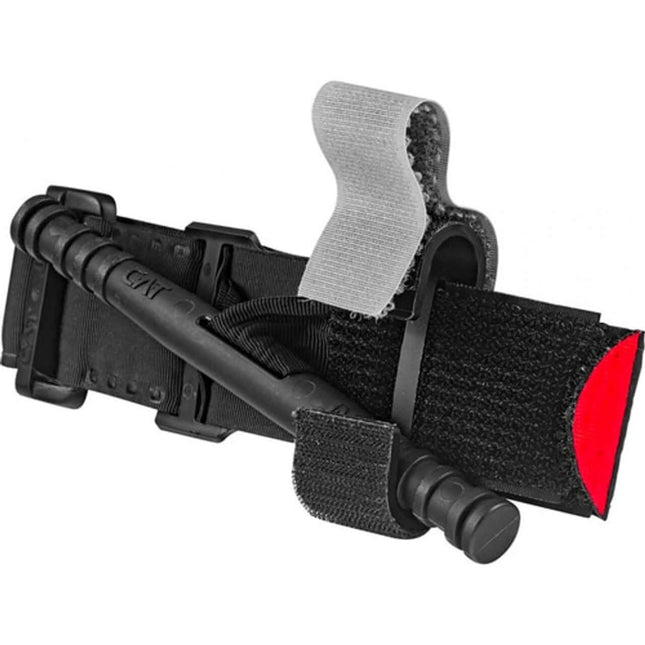
Two CoTCCC-recommended windlass tourniquets belong in any serious kit: the CAT Gen 7 and the SOF Tourniquet Gen 5. The CAT has 4,000+ documented combat applications since 2005 with an 87%+ correct-application survival rate. Both are purpose-built, manufactured devices — CoTCCC is explicit that improvised tourniquets are not an acceptable substitute for limb hemorrhage control.
Apply high and tight, 2–3 inches above the wound on the extremity. Mark the time of application on the windlass or the patient's exposed skin. Do not cover the tourniquet — the treating provider downstream needs to see it immediately.
For a detailed comparison of all three TCCC-approved tourniquet options by carry scenario, see CAT vs. SOF-T vs. SWAT-T: Which Tourniquet Matches Your Mission.
Field Note: Junctional Wounds
Tourniquets control limb hemorrhage. They cannot address junctional wounds — groin, axilla, or neck — where anatomy prevents proper placement. Junctional hemorrhage requires wound packing with hemostatic gauze and sustained direct pressure. Know the difference before you need to apply it.
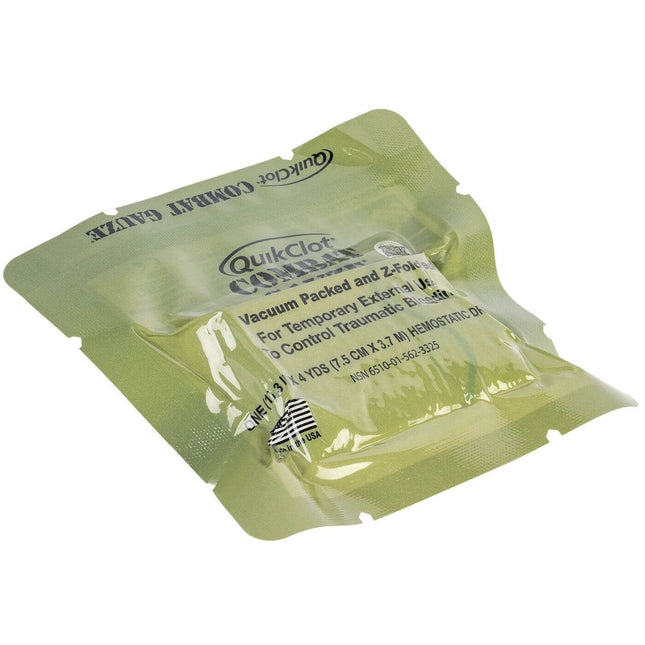
QuikClot Combat Gauze Z-Fold is the CoTCCC hemostatic of record, recommended since April 2008. The kaolin-impregnated gauze clots 5x faster than plain gauze and requires 3 minutes of firm compression to activate. NSN 6510-01-562-3325. The Z-fold configuration allows controlled, progressive packing — feed the gauze from the deepest point of the wound channel outward, then apply direct pressure for the full 3-minute activation window.
Hemostatic gauze handles junctional wounds and penetrating extremity injuries where the tourniquet can't reach. Do not pack the abdominal or chest cavity — this is a field treatment for accessible wound channels: groin, axilla, and extremity. The gauze pairs directly with a pressure dressing: pack first, apply the dressing over the pack to maintain compression.
Every penetrating chest wound — entry and exit — requires an occlusive seal. A gunshot wound to the thorax breaks the pleural seal. Air enters through the wound with each breath, the lung collapses progressively, and tension pneumothorax develops as accumulated pressure compresses the heart and great vessels. Left untreated, it is rapidly fatal. With the right seal applied in time, it's preventable.
The HyFin Compact Vented Chest Seal Twin Pack covers both wounds in a single package. The 3-channel vent design allows air to escape on exhalation while preventing re-entry on inhalation — the correct mechanism for managing open pneumothorax without needle decompression. Wipe the wound dry, apply the seal with vent channels unobstructed, and check the edges for leaks.
Roll the patient and check the back. A chest wound has an exit wound until you confirm otherwise. Sealing the entry and leaving the exit open is an incomplete treatment.
The Israeli Bandage (6") delivers a primary dressing, pressure applicator, secondary dressing, and closure mechanism in a single device. It applies sustained compression over the wound site, slowing external hemorrhage while the body's clotting cascade engages. One-handed self-application is possible with the pressure bar built into the bandage.
Standard application: place the primary pad directly over the wound, wrap circumferentially with firm, even tension, use the pressure bar to increase compression, then secure with the closure clip. Applied over a hemostatic gauze pack, the pressure dressing maintains the compression required for full QuikClot activation. Carry two: one for the primary wound, one for secondary coverage or additional control.
The Nasopharyngeal Airway 28f (4-Pack) maintains airway patency in unconscious or semi-conscious patients without requiring intubation. It bypasses soft tissue obstruction — swelling, blood, loss of muscle tone — that develops when shock or head injury causes loss of consciousness. Soft, flexible construction reduces insertion trauma at the nasal passage.
Insert with lubricant. Route the airway along the floor of the nasal passage — not toward the cranium. Contraindication: mid-face trauma indicating possible basilar skull fracture. If you carry this device, your training must be current. It is not a guess-and-check intervention, and incorrect application causes harm.
Field Note: Chest Decompression Needles
Needle decompression for tension pneumothorax is not part of this kit configuration and should not be added unless you hold formal paramedic-level training with documented clinical hours. Incorrect anatomical placement penetrates major vasculature. Incorrect indication can convert a simple pneumothorax into a tension pneumothorax. It does not belong in this kit until your training supports it without ambiguity.
Two pairs minimum, nitrile, non-latex. Gloves go on before you touch the patient — before the tourniquet, before anything else. Bloodborne pathogen exposure is a real risk in penetrating trauma scenarios and one you can fully prevent. Non-latex matters because you will not know the patient's allergy status in the field, and anaphylaxis from latex contact is a complication nobody needs to manage alongside an active hemorrhage.
A pre-built kit removes decision points and ensures component compatibility inside a purpose-designed pouch. Building your own gives you component-level control when mounting system, weight, or specific brand requirements matter to your setup. Both approaches can be correct depending on the operator.
| Configuration | Kit | Best Fit |
|---|---|---|
| Entry-level pre-built | Premium Tactical IFAK | Range bag, vehicle, first kit |
| Mid-tier pre-built | Enhanced IFAK Pro | Duty belt, plate carrier, EDC |
| Tactical operator pre-built | ViTAC Tactical IFAK | LEO, military, high-risk operations |
For component selection by use case, see the IFAK vs. Trauma Kit Decision Matrix. For technical specs on individual items, see the IFAK Component Deep-Dive.
A kit in the trunk or buried in a bag fails the 10-second access test. Stage it where the threat is: on your person during range sessions, mounted in a vehicle location accessible from the driver's seat, or on your plate carrier during operations. Access time is a functional component of the kit — it matters as much as what's inside.
Hemostatic gauze and vented chest seals carry a 5-year shelf life from manufacture date. Inspect every 90 days: check expiration dates, verify foil packaging is intact, confirm the tourniquet windlass rotates freely and the buckle locks positive. Replace anything showing UV yellowing, moisture penetration, or compromised packaging seal.
A gunshot wound kit is a penetrating-trauma-focused subset of a full IFAK. A complete IFAK may also include burn care, fracture management, and broader airway supplies. For the full breakdown of what an IFAK is and who needs one, see What Is an IFAK?
Tourniquet application and wound packing are accessible to anyone who completes Stop the Bleed certification — a free 2-hour course available at stopthebleed.org in all 50 states. The NPA requires additional airway management training. Chest decompression needles are excluded from this configuration and require formal clinical training.
Yes. The CAT Gen 7, SOF tourniquet, QuikClot Combat Gauze, HyFin chest seals, Israeli bandages, and NPA sold through ViTAC are HSA/FSA eligible. For the complete breakdown of qualifying items and documentation requirements, see ViTAC Kits That Qualify for HSA and FSA.
A gunshot wound kit built to TCCC standard requires six components: tourniquet, hemostatic gauze, chest seals, pressure dressing, NPA, and gloves. Each addresses a specific physiological threat in MARCH sequence order. The component you omit is the gap you won't find until you're in the field and can't fill it with improvisation.
Choose a pre-built option or build component by component — both paths are available through ViTAC's full selection of Individual First Aid Kits and IFAKs.

OSHA minimum workplace kits don't include a tourniquet. Here's how to calculate station count, stock each station, and build bleed control coverage in any public...

One kit at the main entrance fails the 90-second coverage rule for most buildings. Here's how to run a coverage audit and calculate the correct...

Arterial hemorrhage kills in 3 minutes. Urban EMS takes 7–10. Every business needs CoTCCC-standard bleed control kits — here's how to select, deploy, and train...

40+ states mandate bleed control kits in schools — but most deployment plans miss classrooms and buses. Here's the placement standard that actually works.

Most of our trauma kits and first aid supplies qualify for HSA and FSA reimbursement. Don't let your benefits expire — invest them in gear that could save a life.


$124.95


$279.99

$37.49 - $139.46


$299.95 $269.95


$139.95 - $169.95

$49.95


$25.99


$164.95

We've been downrange. We know what it costs to be unprepared. ViTAC was built by U.S. Army Special Operations veterans to make sure the people who run toward the threat — and the families who depend on them — have gear that works when everything is on the line.
— ViTAC Solutions Founders | 40+ years combined Special Operations experience