Where to Carry a Tourniquet: Belt, Bag, Vehicle, and IFAK
8 min reading time
8 min reading time
A tourniquet you cannot reach in three seconds is not a medical tool — it is dead weight. Military and law enforcement after-action data consistently identify delayed access as the failure point in survivable extremity hemorrhage cases. The device was present. The carrier could not get to it fast enough. Placement — not ownership — is the variable that matters.
This post covers where to carry a tourniquet across every common context: on-body, IFAK, vehicle, range bag, and battle belt. Each position has a specific rationale tied to access time, one-handed reach, and rescuer accessibility. Choose your carry position based on those criteria, not convenience.
TCCC and TECC doctrine require a tourniquet to be accessible with one hand, including by the casualty themselves if they are down. That single criterion eliminates most "I have one somewhere" carry arrangements. A tourniquet buried in a center compartment, zipped inside a bag, or clipped to a rear belt loop fails the one-handed reach standard in the scenarios that generate arterial bleed injuries: vehicle accidents, falls, and ballistic events.
The secondary criterion is rescuer access. You may be unconscious. Your tourniquet must be visible and reachable by a bystander who has never seen your kit. Bright color, labeled IFAK pouches, and consistent placement solve this. A tourniquet in a black pouch on a black belt behind your back solves nothing.
The two dominant on-body positions are the belt loop/appendix area (roughly 1 o'clock to 3 o'clock) and the support-side hip (8 o'clock to 10 o'clock for a right-handed carrier). Both allow a seated one-handed draw. Both clear a vehicle door frame without repositioning.
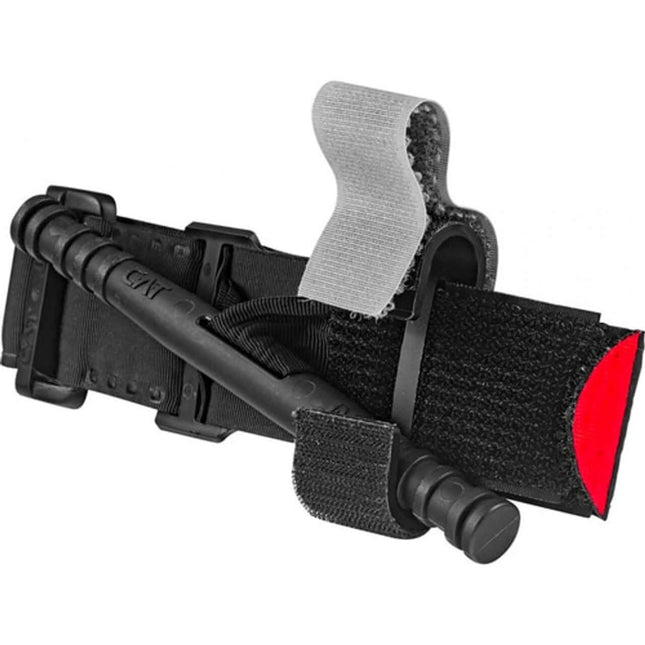
Appendix carry works best with a dedicated tourniquet holder or a slim MOLLE pouch riding inside or just outside the waistband. The CAT Gen 7 and SOF-T Wide both fit standard tourniquet holders without modification. The CAT Gen 7's flat-fold configuration makes it the better choice for appendix and pocket carry — the SOF-T Wide is slightly bulkier but preferred by carriers who wear the tourniquet for extended periods due to its softer junctional contact surface.
Belt loop carry (threading a tourniquet keeper or ranger band through the strap) is the fastest draw for standing confrontations but is the first position compromised when you go to ground. If your primary risk scenario involves vehicle accidents or falls, supplement belt carry with a second tourniquet in the vehicle.
Drop-leg platforms push the tourniquet to the front of the thigh and keep it accessible from both standing and seated positions. The tradeoff is drag on the leg during movement and the tendency to rotate the pouch rearward during a vehicle exit. If you run drop-leg, check pouch rotation after every vehicle transition — rearward rotation negates the access advantage entirely.
An IFAK inside a backpack or range bag is not an individual first aid kit — it is a group kit with inconvenient packaging. IFAK doctrine places the kit on the body at a consistent location so that any team member can call out "his IFAK, left hip" and retrieve it without searching. This only works if every member uses a standardized placement.
The most common IFAK positions in military and law enforcement use are:
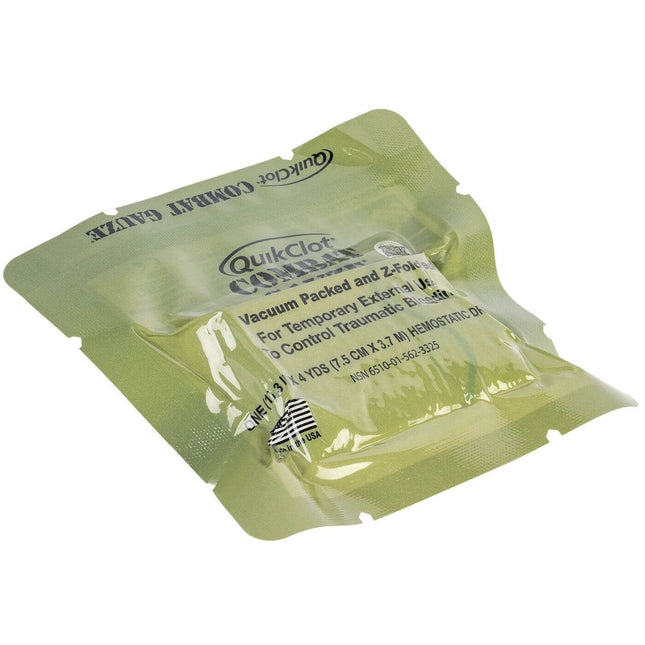
The ViTAC Intermediate Bleeding Control Pack is designed for on-body IFAK use. It contains a tourniquet, hemostatic gauze, pressure bandage, and gloves in a compact footprint that fits standard MOLLE IFAK pouches without overpacking. Overpacked IFAKs close slowly under stress — keep the contents to what you will actually use in the first five minutes.
Law enforcement and EMS data show that vehicle accidents are the most common non-ballistic source of life-threatening extremity hemorrhage for civilians. The implication is direct: every vehicle needs at least one accessible tourniquet, and it cannot be the one on your belt — because in a severe collision, the one on your belt may be inaccessible or your hands may not be working.
Acceptable vehicle staging positions:
If you transport passengers regularly — family, team members, clients — stage a tourniquet for every seating position that carries a person. The passenger-side sun visor is the equivalent of the driver-side mount. Rear passengers present a more complex access problem; a headrest-mounted pouch or a rear-console kit addresses this.
The CAT Gen 7 is the preferred vehicle tourniquet because it can be applied one-handed to a lower leg — the most common vehicle crush injury site — without a second person assisting.
Range bags and backpacks are group-accessible but not individually staged. The rules for these contexts are:
On the range specifically, NSSF and USCCA active shooter and range emergency protocols both recommend that at least one tourniquet per three shooters be staged on the line, not in a bag behind the firing line. A bag behind the firing line requires ceasing fire, clearing weapons, and crossing the line — steps that add 30–60 seconds before the tourniquet is in hand. Stage it forward.
Battle belt setups typically run a tourniquet on the strong-side hip, between the 2 o'clock and 4 o'clock positions, or on the support side at 8–10 o'clock. Either position clears a kneeling or prone draw. The mistake most often seen in training environments is mounting the tourniquet at 6 o'clock (small of back) — this position is inaccessible while prone and difficult to reach while seated in a vehicle or fighting position.
For battle belt setups running a rigid holster and mag pouches on the strong side, the support-side hip is often the only unoccupied MOLLE real estate. This is acceptable — a cross-body one-handed reach to the support-side hip is still within the TCCC accessibility standard for most adult carriers. Verify your own reach geometry before trusting the placement in a training environment, not during an incident.
If your belt runs a wider platform with a kidney pad, ensure the tourniquet pouch sits on the flat section forward of the kidney pad. A pouch riding on the curved kidney section rotates outward and changes the draw angle unpredictably under load.
The only correct carry position for a tourniquet is one you can reach in under three seconds, with one hand, from whatever position you are likely to be in when you need it. For most people, that means one on the body and one staged in the vehicle. An IFAK carries the tourniquet on the body and keeps it rescuer-accessible. Everything in a bag is a group resource — treat it accordingly and supplement with on-body carry.
The CAT Gen 7 and SOF-T Wide are the two field-validated options for every position described in this post. If you are building a complete kit, the ViTAC Intermediate Bleeding Control Pack combines both a tourniquet and the supporting hemorrhage control tools in a single IFAK-ready package.

OSHA minimum workplace kits don't include a tourniquet. Here's how to calculate station count, stock each station, and build bleed control coverage in any public...

One kit at the main entrance fails the 90-second coverage rule for most buildings. Here's how to run a coverage audit and calculate the correct...

Arterial hemorrhage kills in 3 minutes. Urban EMS takes 7–10. Every business needs CoTCCC-standard bleed control kits — here's how to select, deploy, and train...

40+ states mandate bleed control kits in schools — but most deployment plans miss classrooms and buses. Here's the placement standard that actually works.

Most of our trauma kits and first aid supplies qualify for HSA and FSA reimbursement. Don't let your benefits expire — invest them in gear that could save a life.


$124.95


$279.99

$37.49 - $139.46


$299.95 $269.95


$139.95 - $169.95

$49.95


$25.99


$164.95

We've been downrange. We know what it costs to be unprepared. ViTAC was built by U.S. Army Special Operations veterans to make sure the people who run toward the threat — and the families who depend on them — have gear that works when everything is on the line.
— ViTAC Solutions Founders | 40+ years combined Special Operations experience