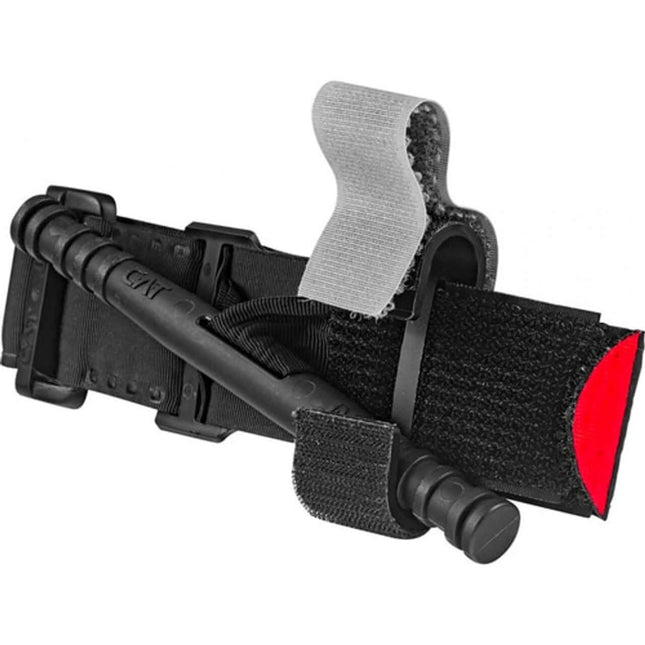
The CAT Gen 7 windlass tourniquet has carried CoTCCC approval since 2005. That is not a marketing claim — it is a procurement fact. Twenty-plus years of combat deployment, six generations of field-driven refinement, and a mandate across U.S. military medical protocols: these are the conditions under which the standard was established. The question is not whether it works. The question is whether you know how to use it — and whether a counterfeit or inferior alternative has made its way into your kit without you realizing it.
How the CAT Gen 7 Works
The Combat Application Tourniquet operates on a proven mechanical principle: a flat, self-adhering strap routes through a friction buckle; a windlass rod cinches an internal band against the limb; a locking clip holds tension after the rod is secured. The sequence — strap, cinch, lock, mark — was designed for one-handed application under duress. It can be executed on yourself, on a patient in body armor, or with degraded fine-motor control in a trauma environment.
The Gen 7 made three documented changes from its predecessor. A wider windlass rod for improved grip with gloved hands. A revised strap attachment point that eliminates strap separation under extreme load — separation in earlier generations was a documented field failure mode. An updated routing buckle geometry that reduces snag during rapid insertion. These are not cosmetic upgrades. Each addresses a specific failure mode identified through real-world use.
Key specifications relevant to kit selection:
- Weight: 2.7 oz (single unit)
- Strap width: 1.5 inches — fits standard IFAK pockets without modification
- Windlass material: solid-core smooth polymer — a hollow or textured rod is a counterfeit indicator
- Origin: manufactured in the USA to MIL-spec under North American Rescue
CAT vs. SOF-T: The Field Comparison
Both the CAT Gen 7 and the SOF Tourniquet GEN 4 carry CoTCCC approval. Choosing between them is a use-case decision, not a quality judgment. The question is which device performs better for your specific scenario — not which one is universally superior.
| Attribute | CAT Gen 7 | SOF-T GEN 4 |
|---|---|---|
| Mechanism | Single-strap polymer windlass | Dual-routing aluminum windlass |
| Self-application | Optimized — one-handed | Possible; two-handed is typical |
| Windlass material | Polymer (solid core) | Aluminum (narrower profile) |
| Weight | 2.7 oz | 1.5 oz |
| Limb versatility | Standard adult extremity | Narrow limb / pediatric capable |
| Price | $37.49 | $35.97 |
| CoTCCC approved | Yes | Yes |
The SOF-T’s aluminum windlass is narrower and lighter. Its dual-routing strap path gives you geometry options on smaller limbs, irregular anatomy, or junction wound approaches where standard placement geometry does not apply. The trade-off: two-handed operation is the norm, which slows self-application speed under fire compared to the CAT.
For high-volume deployments — law enforcement trauma stations, workplace AED cabinets, vehicle first aid bags — the CAT is the practical default. When your protocols include pediatric patients, narrow limbs, or junction wounds, the SOF-T earns its place alongside. Operators who carry both are not being redundant; they are covering known gaps in the single-device scenario.
The windlass is not tightened until you lose sensation in the limb — it is tightened until the bleeding stops. Those are not the same threshold.CoTCCC Application Standard — Tourniquet Use in Tactical Combat Casualty Care
Application: High-and-Tight Protocol
CoTCCC guidance is unambiguous. For extremity hemorrhage, apply the tourniquet high and tight — 2 to 3 inches proximal to the wound. Do not position it over a joint. Do not leave slack in the strap before windlass engagement.
Self-application sequence:
- Slide the limb through the loop, or route the strap through the buckle and pull snug against the limb
- Pass the strap tail through the buckle a second time — this locks the strap and prevents slippage under tension
- Pull the windlass rod upright to begin cinching the internal band against the limb
- Rotate the windlass until hemorrhage ceases — not until pain increases, until the bleeding stops
- Lock the rod in the securing clip
- Write the time of application on the strap time stamp strip or on skin with a permanent marker
The time notation is not optional. Providers at higher levels of care use application time to calculate safe tourniquet duration and determine whether conversion to wound packing is appropriate. An unmarked tourniquet creates a decision gap that can cost the patient minutes they do not have.
Under-tightening is the leading cause of tourniquet failure in the field. If the patient retains a distal pulse below the device, or if active hemorrhage continues, the windlass has not been tightened to occlusion. Tighten until the bleeding stops — not until the patient reports pain. Pain is not the clinical endpoint. Cessation of hemorrhage is.
Properly applied tourniquet on an intact limb is documented as safe for up to two hours in the majority of cases. Beyond two hours, outcomes become patient-dependent. The window exists — but the timer starts at application, not at point of injury. Mark the time. Every time.
Where Tourniquets Fit in MARCH
MARCH stands for Massive hemorrhage, Airway, Respiration, Circulation, Hypothermia. Hemorrhage control is first on the list because uncontrolled arterial bleeding is the fastest path to irreversible shock. Three to five minutes is the established window before an arterial bleed becomes fatal without intervention. No other step in the protocol is relevant if the patient exsanguinates before you reach it.
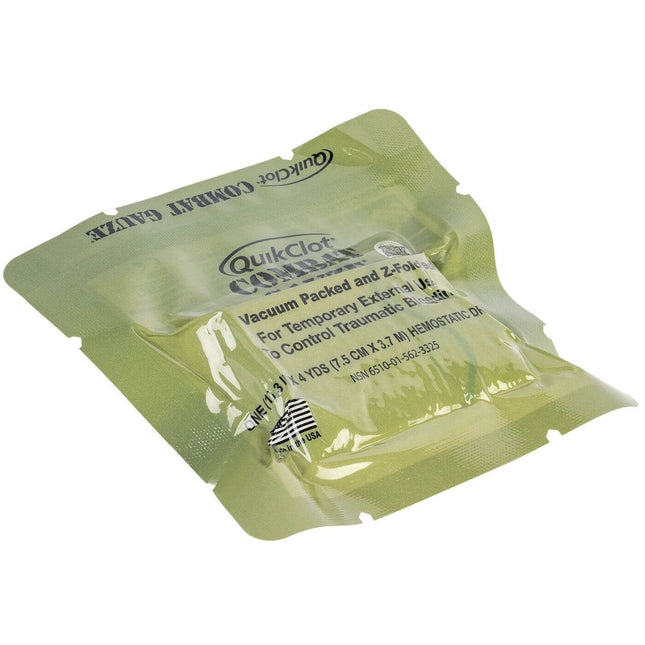
Tourniquet placement addresses extremity hemorrhage at the M step. When the wound location is not amenable to tourniquet — junctional, abdominal, thoracic — you shift immediately to wound packing with hemostatic gauze and direct pressure. The full MARCH protocol breakdown covers each step in sequence and identifies the decision points between tourniquet and wound-packing applications.

Identifying Counterfeit Tourniquets
Counterfeit CAT tourniquets circulate on Amazon and through unauthorized reseller channels. They are priced to compete. They are not manufactured to the same structural standard. A device that fails at the windlass or at the strap attachment point during actual application produces a worse outcome than no device: it burns seconds — sometimes minutes — while the patient continues to hemorrhage.
Four verification points on an authentic CAT Gen 7:
- Manufacturer label: reads “North American Rescue” — not a generic brand name, not unlabeled
- Windlass rod: smooth-surface polymer with solid core — hollow rods and textured surfaces are counterfeit indicators
- Time stamp strip: present on the strap face, functional, and writeable with a standard permanent marker
- Part number: a complete NAR part number in the format 14-XXXX-XXXX printed on the packaging
ViTAC sources exclusively from authorized North American Rescue distributors. Every CAT Gen 7 on this site is genuine.
Frequently Asked Questions
Can I apply a CAT tourniquet to myself with one hand?
Yes. The CAT Gen 7 was designed for one-handed self-application. The friction buckle holds strap tension during the process, freeing the routing hand to operate the windlass. With training, the full sequence — strap, lock, cinch, mark — takes under 30 seconds. See the Tourniquets 101 breakdown for step-by-step application guidance with photos.
How long can a tourniquet stay on safely?
CoTCCC data supports a two-hour window without permanent limb damage in most cases. Beyond two hours, outcomes become more variable based on patient physiology, ambient temperature, and tourniquet tension. Mark the time of application — without exception — so providers at higher levels of care can calculate elapsed duration and decide whether conversion to wound packing is appropriate.
Why is the SWAT-T not the primary choice for arterial bleeding control?
The SWAT-T uses elastic stretch to apply circumferential pressure. That mechanism is effective for wound wrapping, pressure dressing, and secondary hemorrhage management. It does not reliably achieve complete arterial occlusion, which requires lockable, measurable tension that elastic construction cannot consistently deliver. For arterial hemorrhage, the windlass mechanism on a CoTCCC-approved device provides the clinical certainty an elastic tourniquet cannot guarantee.
Bottom Line
The CAT Gen 7 is the standard because it was engineered to be one and validated through two decades of field use across every major U.S. military theater. It occludes arteries. It tolerates self-application. It has a documented performance record that no device in its class has matched. If the tourniquet in your kit is not CoTCCC-approved and sourced from an authorized distributor, it is not a tourniquet — it is a liability.
Browse the full tourniquet lineup, or start with Tourniquets 101 if you need foundational knowledge before choosing a device.