Do Civilians Need Tourniquets? Drivers, Hunters, and Families
7 min reading time
7 min reading time
The Stop the Bleed campaign was launched by the American College of Surgeons after the Hartford Consensus identified uncontrolled hemorrhage as the leading cause of preventable death in civilian mass casualty events. That same hemorrhage pattern — severe limb bleeding within reach of bystanders — shows up in vehicle accidents, hunting incidents, and household tool injuries every day. The case for civilian tourniquet carry is not hypothetical. It is the same data that put tourniquets into every military kit 20 years ago.
Tourniquet indications do not change based on the carrier’s profession. Life-threatening extremity bleeding from any cause — arterial bleed, amputation, deep laceration with uncontrolled hemorrhage — is the clinical threshold. Common civilian scenarios that cross that threshold:
These events do not require a combat zone. They require proximity to a sharp edge or high-energy force and a few seconds of poor outcome. The window for intervention before hemorrhagic shock is 3 to 5 minutes for an arterial bleed.
Motor vehicle accidents are the leading cause of injury-related death in the United States. Limb injuries in high-impact crashes — lacerations from glass, metal impalement, crush injuries from dashboard intrusion — can produce arterial bleeding that direct pressure cannot hold. EMS response time in rural areas averages 14 minutes; in wilderness or highway contexts it is longer.
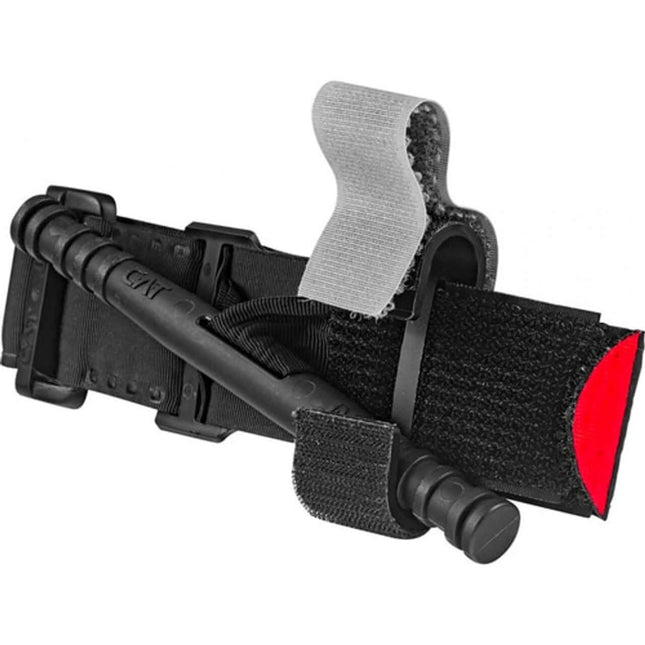
A tourniquet staged in a vehicle trauma kit covers the gap between impact and EMS arrival. It does not need to be complex: a CAT Gen 7 flat-folded in a glove compartment or under-seat pouch and a basic understanding of application is the functional requirement.
| Scenario | Potential Injury Type | Tourniquet Applicable |
|---|---|---|
| High-speed collision | Glass lacerations, limb fracture with arterial damage | Yes — if limb accessible |
| Rollover with entrapment | Crush injury, amputation | Yes |
| Pedestrian strike | Severe lower limb trauma | Yes |
| Power tool / farm equipment | Amputation, deep laceration | Yes |
In a city, an arterial injury is minutes from a trauma center. In the backcountry, it is hours. Hunting accidents, saw injuries at camp, and severe falls on rocks or equipment create the same hemorrhage problem with a drastically different response timeline. The Stop the Bleed protocol is explicit: when EMS cannot arrive in time to prevent hemorrhagic shock, the bystander with a tourniquet is the difference between a survivable outcome and a preventable death.
For outdoor carry, a windlass tourniquet in a belt-mounted or pack-accessible pouch satisfies the requirement. Both the CAT Gen 7 and SOF-T Wide are built to withstand field conditions — rain, cold, and repeated handling — and both are designed for one-handed self-application if you are the injured party.
Urban EMS response is faster than rural, but even a 7-minute response time is too slow for an arterial bleed. A deep kitchen laceration to the palm or wrist, a power saw injury in a home workshop, a lawnmower or wood-splitter accident — all can produce life-threatening limb hemorrhage inside a residential property.
A tourniquet in a home first aid kit requires no more space than a large bandage roll. The skill requirement is a 10-minute training session, not a medical certification. Stop the Bleed courses are offered free through many hospitals, fire departments, and community health organizations.
Carrying a tourniquet without training produces two problems: hesitation at the moment of use, and incomplete application that fails to achieve arterial occlusion. Both are preventable. The Stop the Bleed program teaches the three-step bleeding control sequence — apply pressure, pack the wound, apply tourniquet — in a single session. Military TCCC courses go deeper. At minimum, practice solo application on your own arm until you can place and lock the windlass to bleeding-stopped standard in under 30 seconds.
Key skills to develop:
A tourniquet is a limb-hemorrhage device. It has no application for:
Using a tourniquet when sustained direct pressure would have been sufficient does not cause lethal harm, but it does create unnecessary ischemia. Reserve tourniquet application for the indication: uncontrolled arterial or high-volume hemorrhage from a limb that pressure alone cannot hold.
A tourniquet is a compressive device wrapped tightly around a limb to stop life-threatening bleeding by occluding the arteries supplying blood to the injury site. It is the clinical standard for uncontrolled extremity hemorrhage when direct pressure is insufficient.
A correctly applied tourniquet causes pain and, over time, ischemic tissue stress. These effects are manageable by trained medical personnel. An under-applied or absent tourniquet in an arterial bleed causes death. The risk calculus is not balanced — apply and document, then transfer to EMS.
Drivers, hunters, hikers, anyone working with machinery or sharp tools, parents building a home emergency kit, and anyone who wants to be a functional first responder rather than a bystander. The question is not whether you will ever face a hemorrhage emergency. The question is whether you will have a tool when you do.
Yes. A tourniquet correctly applied without training is possible, but training eliminates hesitation and ensures the device is tightened to arterial occlusion standard, not just discomfort. Stop the Bleed courses take one session. Practice one-handed self-application on your own arm until it is automatic.
Maintain the tourniquet — do not loosen or remove it. Document the time. Keep the patient still and warm. Call for evacuation by whatever means available. A correctly applied tourniquet can safely remain in place for up to two hours; conversion is performed by medical personnel, not by the first responder.
A commercially manufactured, CoTCCC-approved windlass tourniquet — the CAT Gen 7 or SOF-T Wide. Improvised and non-windlass devices carry a documented higher failure rate for arterial occlusion. Carry the right tool for the job.
The civilian case for tourniquet carry is built on the same data that put them into military kits: arterial hemorrhage kills in minutes, bystanders are often first on scene, and a trained responder with a tourniquet can stop the bleed. Drivers, hunters, and families all face that scenario. The CAT Gen 7 fits in a glove compartment, a pack pocket, and a kitchen drawer. Stage one within reach before you need it.

OSHA minimum workplace kits don't include a tourniquet. Here's how to calculate station count, stock each station, and build bleed control coverage in any public...

One kit at the main entrance fails the 90-second coverage rule for most buildings. Here's how to run a coverage audit and calculate the correct...

Arterial hemorrhage kills in 3 minutes. Urban EMS takes 7–10. Every business needs CoTCCC-standard bleed control kits — here's how to select, deploy, and train...

40+ states mandate bleed control kits in schools — but most deployment plans miss classrooms and buses. Here's the placement standard that actually works.

Most of our trauma kits and first aid supplies qualify for HSA and FSA reimbursement. Don't let your benefits expire — invest them in gear that could save a life.


$124.95


$279.99

$37.49 - $139.46


$299.95 $269.95


$139.95 - $169.95

$49.95


$25.99


$164.95

We've been downrange. We know what it costs to be unprepared. ViTAC was built by U.S. Army Special Operations veterans to make sure the people who run toward the threat — and the families who depend on them — have gear that works when everything is on the line.
— ViTAC Solutions Founders | 40+ years combined Special Operations experience