The Home Defense Trauma Kit: What to Stage and Where to Stage It
9 min reading time
9 min reading time
Average EMS response time in U.S. suburban and rural settings runs 10 to 15 minutes. Arterial hemorrhage can be fatal in three. A home staged with a firearm but without trauma supplies assumes the gap between injury and EMS arrival closes on its own. It will not. A home defense trauma kit addresses the interval that determines whether a survivable injury stays survivable.
A trauma kit is not a first aid kit scaled up. It is a purpose-built collection of tools for life-threatening hemorrhage, open thoracic injury, and airway compromise — the three most common causes of preventable death in the pre-hospital window. A standard first aid kit carries bandages, antiseptic, and minor dressings. A trauma kit carries tourniquets, hemostatic gauze, vented chest seals, and pressure bandages. The two are not interchangeable.
The home defense application adds a specific consideration: injuries from defensive firearms use produce the same wound types TCCC protocols address — extremity hemorrhage, penetrating chest trauma, and junctional wounds where a tourniquet cannot be applied. MARCH principles apply in the home as directly as they do downrange.
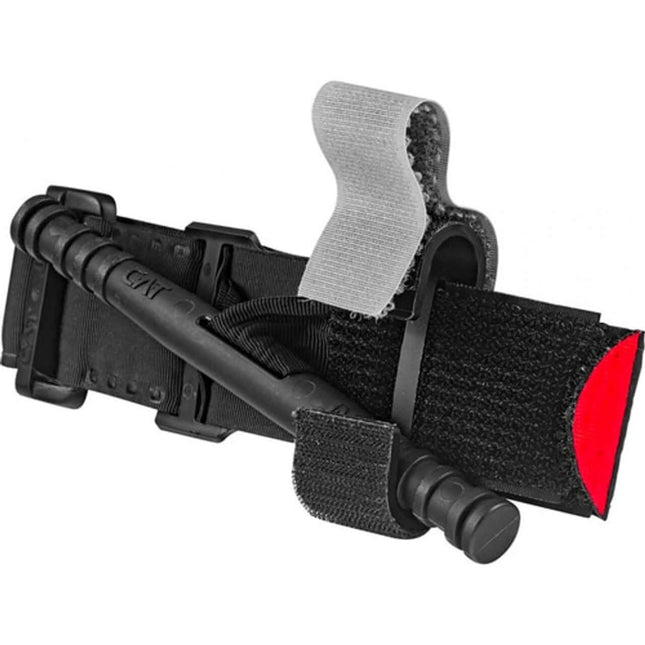
A windlass tourniquet is the primary intervention for life-threatening limb bleeding. The CAT GEN 7 | Combat Application Tourniquet is designed for one-handed self-application and is the current TCCC Committee standard. Stage at least two in any home trauma kit — one dedicated to self-aid, one for a second casualty or backup. Apply within the first minute of injury identification. Record time of application on the casualty's skin or on the tourniquet strap using a permanent marker.
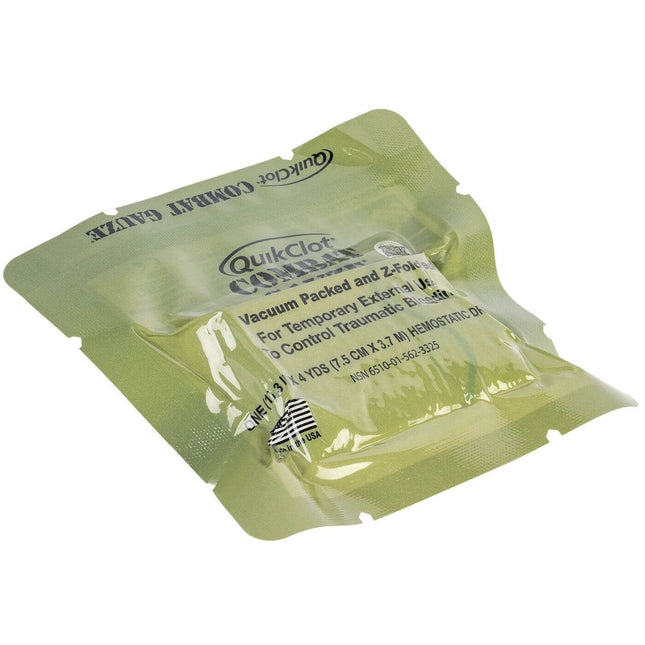
Junctional wounds — groin, axilla, neck — cannot be addressed with a tourniquet. They require direct wound packing with hemostatic gauze. QuikClot Combat Gauze Z-Fold is kaolin-impregnated and Z-fold packaged for single-handed deployment. Pack the wound firmly, apply direct pressure for a minimum of three minutes, then secure with a pressure dressing. Packing too loosely fails to compress the bleeding vessel.
Penetrating chest wounds cause open pneumothorax by allowing air to enter the pleural space. Vented chest seals address this by creating a one-way valve — air exits but cannot re-enter. Apply two seals to any penetrating chest wound: one anterior, one posterior, or both anteriorly if entry only. The Premium IFAK Trauma Kit w/Tourniquet & Chest Seals includes vented chest seals alongside tourniquet and hemostatic components — the full hemorrhage-plus-thoracic configuration in one package.
Nasopharyngeal airways (NPAs) maintain an open airway in unconscious patients with facial trauma or soft tissue swelling. Include an NPA in any home trauma kit if household members have completed training that covers insertion technique. Without that training, the NPA stays in the kit as a hand-off item for arriving EMS. Do not improvise airway management — incorrect NPA placement worsens the situation.
Nitrile gloves (multiple pairs), trauma shears, a permanent marker, an emergency blanket, and medical tape complete the baseline kit. Gloves are universal — no intervention begins without them. Trauma shears cut through clothing without skin contact. The marker records tourniquet application time. The emergency blanket manages heat loss in shock patients. The Bleeding Control Pack – Intermediate consolidates most of these components for household staging.
Field Note: Low Light Changes Everything
A compact flashlight belongs in every staged kit. Defensive incidents frequently involve low-light conditions. You need to see the wound to treat it. A light in the same bag as the kit eliminates one variable when everything else is moving fast.
Select a bag or pouch with durable construction, water resistance, and defined compartments. MOLLE-compatible pouches allow attachment to a range bag, backpack, or fixed mounting point. Soft-sided pouches with color-coded internal organization consistently outperform zipper bags for field-condition access. The container protects supplies from environmental degradation and keeps them organized under stress.
Stage items in the order you will need them. Massive hemorrhage control — tourniquet, hemostatic gauze, pressure dressing — belongs at the top layer or in the most accessible compartment. Airway and respiration items come next. Supporting components fill the remaining space. The goal is zero search time: your hand goes directly to the required item without moving other gear to reach it.
| Priority Layer | Contents |
|---|---|
| Immediate access | Tourniquets, gloves, trauma shears |
| Second layer | Hemostatic gauze, pressure dressings, chest seals |
| Third layer | Medical tape, emergency blanket, NPA, permanent marker |
Label every compartment. In a high-stress scenario under low light, "Tourniquet" printed on the outside of a pocket cuts seconds off access time. Laminated labels or permanent marker on durable tape both work. Labels serve a secondary function: they are use guides for an untrained family member who may need to provide self-aid when the trained operator is the casualty.
Field Note: Practice Under Conditions
Practice opening and using the kit with nitrile gloves on in low light. This is the condition under which it will most likely be needed. Fumbling with zippers or unfamiliar compartments costs time. Familiarity costs nothing except ten minutes of deliberate practice.
The bedroom is the primary defensive position in most residential security plans and the most likely location for nighttime incidents. Stage one kit within arm's reach of the bed — nightstand drawer, under-bed mount, or attached to the bed frame. It must be reachable with one hand without repositioning. The Small Rip Away Tactical Trauma Kit is sized for this role: compact enough for nightstand or under-frame mounting, rip-away design for one-handed retrieval under stress.
Accidents and incidents are not confined to the bedroom. A second kit staged in the primary living area — bookshelf, cabinet, or wall-mounted bracket — provides access from where household members spend the majority of their time. Placement does not need to be conspicuous to visitors, but it must be immediately identifiable to everyone in the household. The Tactical Trauma Kit w/Rip-Away Feature provides full trauma response capability in a format that mounts to a wall bracket or fits a standard cabinet without depth concerns.
Kitchen and workshop environments produce disproportionate rates of traumatic laceration and accidental injury. A focused kit — tourniquet, hemostatic gauze, pressure dressing, gloves — staged in each high-risk area addresses the most likely injury in that specific environment. The full bedroom configuration is not required; a streamlined hemorrhage-control kit is sufficient for most incidental accidents.
For households requiring higher-capacity staging across multiple rooms, the First Responder Jump Bag – 380+ Pieces provides an expandable platform with sufficient depth for multi-room deployment from a central location.
Field Note: Location Awareness Is Not Optional
Every person in the household should know where every kit is staged and what the contents are. The kit staged for self-aid may need to be used by someone with no medical training when the trained operator is the casualty. Location awareness and a labeled kit are the minimum requirements for a staged kit to function under those conditions.
Inspect all kits quarterly. Check expiration dates on hemostatic gauze, chest seals, and gloves. Verify tourniquet strap integrity and windlass function. Replace any item used in training or in the field immediately — the kit must return to full operational configuration before it goes back to its staging position. Track lot numbers on consumable items to support any future product recall response.
Tourniquet application, wound packing, and chest seal placement each require hands-on repetition before an incident. Stop the Bleed courses provide a civilian-accessible baseline. TECC programs provide higher-fidelity skill sets for household members who have the time and interest. For application sequence reference, see Self-Aid and Buddy Aid.
A kit used by an untrained operator is unpredictable. A kit used by someone with muscle memory for every item it contains is a reliable intervention. Training is the variable that determines whether the kit matters.
A firearm ends a threat. A trauma kit addresses the injuries that result — or from any household emergency producing serious hemorrhage. EMS response times in suburban and rural environments routinely exceed 10 minutes. Arterial hemorrhage can be fatal in three. The kit covers the gap.
Tourniquet, hemostatic gauze, vented chest seals, pressure dressing, and nitrile gloves. These address the three leading causes of preventable trauma death: extremity hemorrhage, junctional bleeding, and open pneumothorax. Every other item in the kit is secondary to these five.
Primary bedroom first — within arm's reach of where you sleep. A second kit in the main living area. Focused kits in the kitchen and any workshop environment where accidental traumatic injury is most likely. Every staging point should be immediately known to all household members who may need to access it.
A home defense plan that accounts for the threat but not the aftermath is incomplete. The trauma kit addresses the interval between injury and EMS arrival — the window that determines whether a survivable injury stays survivable. Stage one kit in the bedroom, one in the main living area, and focused kits in high-risk work areas. Train on it. Inspect it quarterly.

OSHA minimum workplace kits don't include a tourniquet. Here's how to calculate station count, stock each station, and build bleed control coverage in any public...

One kit at the main entrance fails the 90-second coverage rule for most buildings. Here's how to run a coverage audit and calculate the correct...

Arterial hemorrhage kills in 3 minutes. Urban EMS takes 7–10. Every business needs CoTCCC-standard bleed control kits — here's how to select, deploy, and train...

40+ states mandate bleed control kits in schools — but most deployment plans miss classrooms and buses. Here's the placement standard that actually works.

Most of our trauma kits and first aid supplies qualify for HSA and FSA reimbursement. Don't let your benefits expire — invest them in gear that could save a life.


$124.95


$279.99

$37.49 - $139.46


$299.95 $269.95


$139.95 - $169.95

$49.95


$25.99


$164.95

We've been downrange. We know what it costs to be unprepared. ViTAC was built by U.S. Army Special Operations veterans to make sure the people who run toward the threat — and the families who depend on them — have gear that works when everything is on the line.
— ViTAC Solutions Founders | 40+ years combined Special Operations experience