What Is an IFAK— and Which Trauma Kit Is Right for You?
Professional-grade trauma readiness without the guesswork. Understand exactly what an IFAK is, what goes inside, and which kit matches your carry method, environment, and mission.
Authentic CAT®, QuikClot®, & NAR Components — No Knockoffs
23+ Law Enforcement Agencies Supplied
HSA/FSA Eligible — Use Pre-Tax Funds
The Basics
What Is an IFAK?
IFAK stands for Individual First Aid Kit. The name comes from the U.S. military — specifically from the demand that every soldier carry a standardized trauma kit on their person at all times. The premise is simple: if you go down, the person next to you can find your kit immediately and use it to treat you. No searching. No guessing. One kit, one carrier, organized for speed under stress.
In practice, an IFAK is purpose-built to address the leading causes of preventable death from traumatic injury: uncontrolled hemorrhage, open chest wounds, and airway obstruction. These three account for the majority of deaths that occur before emergency services arrive — which is why an IFAK is not a general-purpose first aid kit. It doesn't have aspirin or cold packs. It has tourniquets and hemostatic gauze.
The civilian IFAK is a direct translation of the military concept: a compact, organized trauma kit you carry on your person, in your vehicle, or staged in your environment — so you can stop life-threatening bleeding in the minutes before EMS arrives. That window is called the Golden Hour. What you do in it determines whether someone survives.
At ViTAC, we use "IFAK" and "trauma kit" interchangeably in some contexts — but there are meaningful distinctions depending on size, capacity, and intended use. The section below breaks them down.
The IFAK Principle
Carried on the individual — not stored, not stashed
Organized for immediate access under stress
Built to address the three most preventable causes of traumatic death
Usable by someone other than the carrier
Sized for the carry method (body, vehicle, bag)
Contains real bleeding control — not bandages and antiseptic
By the Numbers
90% of preventable combat deaths — and most preventable civilian trauma deaths — are caused by uncontrolled bleeding.
3–5 minutes is how long you have to act on a major arterial bleed before irreversible damage occurs.
Average EMS response: 7–14 minutes. The first responder is you.
Side-by-Side Breakdown
IFAK vs. Trauma Kit vs. First Aid Kit
These three categories sound similar. They aren't. Understanding the difference prevents you from buying the wrong thing — and from carrying something that won't actually help when it matters.
Feature
First Aid Kit
IFAK (Individual First Aid Kit)
Trauma Kit
Primary Purpose
Minor injuries — cuts, burns, blisters, sprains
Life-threatening trauma — major bleeding, chest wounds, airway
Life-threatening trauma — single to multiple casualties
△ Partial capability — depends on specific kit configuration. Always review the product page for included components.
Component Breakdown
What Should Be in an IFAK?
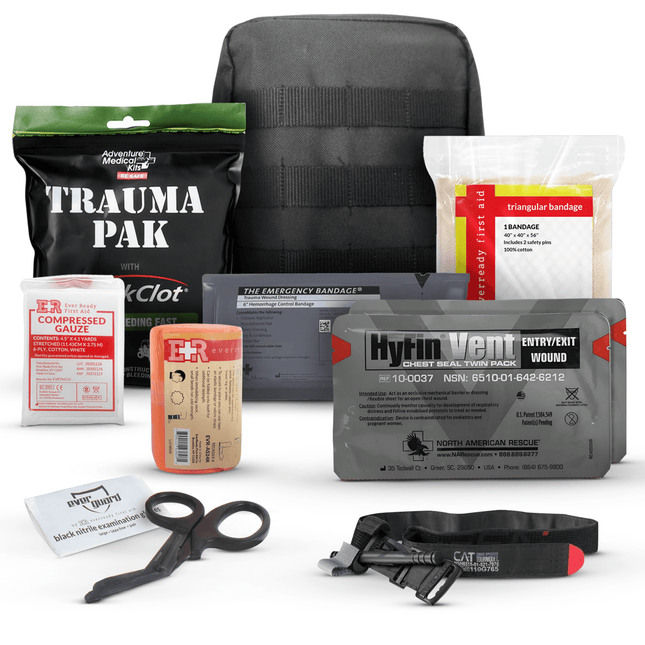
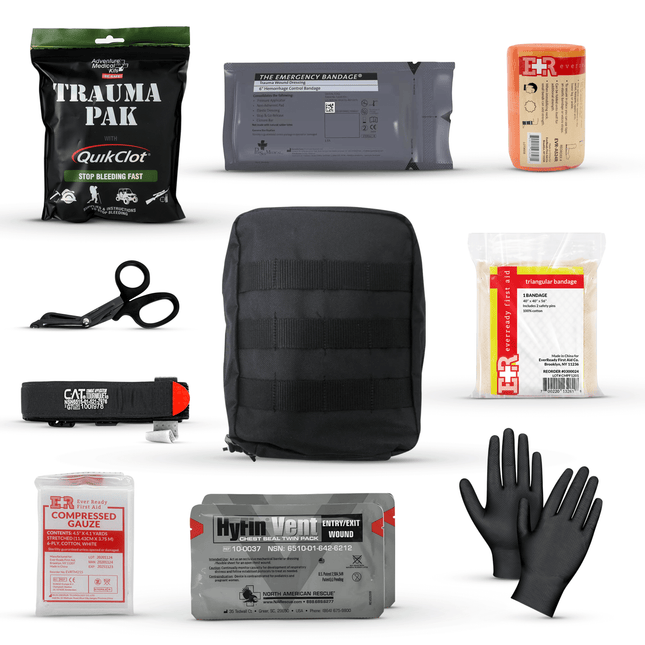
A real IFAK isn't a random assortment of supplies. It follows a logical priority sequence — the same MARCH framework used by military and tactical medicine. Here's what matters and why.
Tourniquet
The single most important item. Stops arterial bleeding from an extremity wound when direct pressure won't work. Must be applied within minutes. One-handed application is essential.
Look for: CAT® Gen 7 or SOFTT-W Gen 4/5
Hemostatic Gauze
Used to pack wounds in body areas where a tourniquet can't be applied — junctions, neck, torso. The hemostatic agent accelerates clotting and stops hemorrhage faster than plain gauze.
Look for: QuikClot® Combat Gauze or Celox
Pressure Dressing
Applied over wound packing to maintain pressure. Secures hemostatic gauze in place and helps control bleeding through consistent compression. Modern designs allow one-handed application.
Look for: NAR ETD, Israeli Bandage 6"
Chest Seals (Vented, Twin Pack)
Covers open chest wounds that collapse a lung if left untreated. Vented seals allow air to escape and prevent tension pneumothorax. Always buy a twin pack for entry and exit wounds.
Look for: HyFin® Vented Chest Seal Twin Pack
Nitrile Gloves
Protect the responder from bloodborne pathogens. Non-negotiable for any kit. Always include at least two pairs — one for putting on fast, one spare in case the first tears.
Look for: Nitrile, not latex
Trauma Shears
Cuts through clothing, gear, seat belts, and boots to expose a wound for treatment. Essential for access — you can't treat what you can't see. Spring-action design works in one hand.
Look for: Lister-style, spring-loaded
Nasopharyngeal Airway (NPA)
A soft rubber tube inserted through the nostril to maintain an airway in an unconscious patient. Found in advanced IFAKs. Requires basic training — included in most Stop the Bleed courses.
Advanced kits only — verify training before purchasing
Wound Packing / Compressed Gauze
Used with or without hemostatic agents to pack a deep wound and apply internal pressure. A skill, not just a supply — learn wound packing technique alongside this kit component.
Pair with: hemostatic gauze for major bleeds
⚠️
The ViTAC Standard: Authentic Components Only
Counterfeit tourniquets fail when tightened. Knockoff hemostatic gauze doesn't clot. A $25 "IFAK" on Amazon isn't a trauma kit — it's a liability. Every kit ViTAC sells uses authenticated CAT®, QuikClot®, NAR, and other mission-proven components. When the alternative is dying, buy once, buy right. Read: Why Cheap IFAKs Can Get You Killed →
Who This Is For
The First Responder Is You.
EMS arrives in 7–14 minutes on average. A major bleed can be fatal in 3–5. An IFAK is not a professional tool — it's a civilian responsibility. Here's who needs one.
Civilian Protectors & Families
Dads, husbands, prepared parents — anyone who refuses to be helpless if something happens to the people they love. A kit in the vehicle, staged in the home.
Law Enforcement & Security
Officers, deputies, SROs, and armed professionals who need duty-belt or patrol bag capability. Personal standardization beyond issued gear.
Outdoorsmen & Overlanders
Hunters, hikers, backcountry campers, and overland travelers who operate miles from the nearest ER. Delayed EMS means you are the medic.
Range Users & CCW Carriers
Anyone who trains with firearms understands the injury risk. A range bag without trauma capability is an oversight — not a choice.
First Responders (Personal Kit)
EMTs, paramedics, and fire personnel who supplement issued gear with their own personal IFAK — standardized to their preferences, not department minimums.
Vehicle Owners
Motor vehicle accidents are one of the most common causes of traumatic injury. A vehicle kit isn't paranoia — it's the same logic as a fire extinguisher.
Church & School Safety Teams
Volunteer security and safety teams at houses of worship, schools, and community organizations. Bleed control capability belongs anywhere people gather.
Construction & High-Risk Workplaces
Worksites with power tools, heavy machinery, or confined spaces need real trauma capability on-site — not a wall-mounted bandage kit.
Match to Your Mission
Choose the Right Kit for Your Carry Method
The best IFAK is the one you'll actually have with you. Start with your carry method, then match to your risk level and environment.
Not sure where you fall? Use the ViTAC Kit Selector → to get a matched recommendation in under a minute.
Why ViTAC
Built by the People Who've Used This Gear.
ViTAC was founded by U.S. Army Special Forces veterans with 40+ years of combined operational experience. Every kit we sell is curated — not assembled by a purchasing algorithm.
01
No Knockoff Components
Every kit is built with authenticated brand-name components — CAT® tourniquets, QuikClot® combat gauze, HyFin® chest seals, NAR products. Not generic "CAT-style" — the real thing. We verify every SKU we carry.
02
Operator-Curated Selection
Our founders used this gear in combat. They know what fails under stress, what organizes well under pressure, and what civilian buyers actually need — translated from the battlefield into practical readiness.
03
Organized for Speed, Not Just Stocked
A kit that fumbles in your hands isn't a kit — it's a liability. We evaluate every product for layout logic: how fast can you access the tourniquet? Where are the chest seals? How does it open under stress?
04
No Guesswork. No Junk. No Filler.
We don't pad kit contents with 40 bandages to inflate piece counts. We curate for mission relevance. If an item is in the kit, it's there for a reason. 87+ verified five-star reviews from real buyers confirm the difference.
Real questions from real buyers. If you don't find what you need, contact us directly — we answer fast.
What's the difference between an IFAK and a trauma kit? +
The terms overlap, but generally: an IFAK (Individual First Aid Kit) is designed for a single person and built to be carried on the body or close to it. A trauma kit is broader — it may serve multiple casualties, live in a vehicle or bag, and carry more capability. The overlap is significant. If a kit has a tourniquet, hemostatic gauze, and chest seals, it's doing IFAK work regardless of the label. Focus on components, not names.
Do I need training to use an IFAK? +
You don't need to be a medic — but you do need to practice. A tourniquet applied wrong is nearly as bad as no tourniquet. The good news: bleeding control training is accessible. ViTAC's Life Saver Seminar teaches the essentials in a few hours. Stop the Bleed courses are available nationwide. At minimum, watch walkthrough videos and practice with your specific kit before an emergency. The muscle memory matters.
Can I use my HSA or FSA to buy an IFAK? +
Yes — most trauma kits and IFAKs qualify as HSA/FSA-eligible medical expenses. ViTAC has one of the most complete tagged HSA/FSA catalogs in the category. Pay at checkout with your HSA/FSA card and keep your itemized receipt for documentation. Some flex plans may require a Letter of Medical Necessity for reimbursement on specific items — ViTAC provides full contents lists upon request. See our HSA/FSA eligibility guide for details.
Is the CAT tourniquet really that different from a cheaper one? +
Yes. The Combat Application Tourniquet (CAT®) Gen 7 is the most tested windlass tourniquet in history — used by U.S. military and law enforcement because it works under stress with one hand, every time. Knockoff tourniquets often fail at the windlass or strap when tightened maximally — the exact moment that matters. Counterfeits are common on Amazon and mass-market sites. Every tourniquet in a ViTAC kit is authenticated. We don't sell "CAT-style" products.
What's the shelf life of IFAK components? +
Tourniquets don't expire if stored properly (away from UV, heat, and physical compression). Hemostatic gauze like QuikClot® typically carries a 5-year shelf life. Chest seals generally last 3–5 years in sealed packaging. Most kits display or include expiration dates on consumables. ViTAC recommends annual kit inspection and restocking any expired components — we carry individual refill supplies for this exact reason.
What's the difference between vented and non-vented chest seals? +
Vented chest seals (like HyFin® Vented) include a one-way valve that allows air to escape from the chest cavity while sealing the wound. This prevents tension pneumothorax — a life-threatening condition that occurs when air builds up and collapses the lung. Non-vented seals create a fully occlusive seal. The field consensus now strongly favors vented seals as the default. ViTAC's recommended kits use HyFin® Vented as the standard.
How big is an IFAK? Will it actually fit in a bag or on my belt? +
Modern IFAKs are purpose-built for real-world carry. EDC options like the NAR Wallet Kit fit in a jacket pocket. Standard MOLLE IFAKs are roughly the size of a large paperback book. Rip-away IFAKs attach to a MOLLE platform or vest and draw off in a single pull. Vehicle kits mount behind a seat or in a door pocket. If carry size is your primary concern, start with an EDC kit and move up as your readiness grows — the kit you'll actually carry is always better than the one you leave at home.
Can I order IFAKs for my team or organization? +
Yes. ViTAC handles team, agency, and institutional orders of all sizes. Custom kit builds are available for groups of 15 or more — spec your components, pouch type, and quantity, and we build to spec with a minimum 2-week lead time. Government and law enforcement agencies can submit through our RFQ portal. Corporate safety programs and organizations can contact us at orders@vitacsolutions.com or call (307) 202-8426.
Is QuikClot safe to use? I've heard concerns. +
Modern QuikClot® Combat Gauze uses a kaolin-based clotting agent — the same mineral found in porcelain clay. Earlier generations used zeolite, which generated heat. Kaolin-based QuikClot does not heat up and is safe for wound packing. It is the hemostatic gauze of choice for the U.S. military, TCCC protocol, and most law enforcement agencies. ViTAC sells only current-generation QuikClot® products.
What is TCCC and should my IFAK be TCCC-compliant? +
TCCC stands for Tactical Combat Casualty Care — the evidence-based trauma care protocol developed for the U.S. military and now adopted widely in law enforcement and civilian trauma training. A TCCC-compliant IFAK contains: CAT® or SOFTT-W tourniquet, hemostatic gauze (QuikClot® or Celox), chest seals, pressure dressing, NPA airway. For civilians without advanced training, "TCCC-aligned" is sufficient — it means the components are right even if you're not running the full protocol.
What is the MARCH protocol and why does it matter for IFAK selection? +
MARCH stands for Massive hemorrhage, Airway, Respiration, Circulation, Hypothermia — the priority sequence for treating traumatic injuries. A well-organized IFAK follows this logic: the tourniquet and hemostatic gauze (M) are most accessible, followed by airway tools (A), chest seals (R), and then circulation and warming supplies. When evaluating any IFAK, ask whether the layout matches this treatment priority. If the tourniquet is buried under wound dressings, it's not a good kit.
What's your return policy if the kit doesn't work for me? +
ViTAC offers a 30-day satisfaction guarantee. If your kit isn't right for your use case, contact us at info@vitacsolutions.com or call (307) 202-8426. We'll work with you to find the right kit — or process a return. Our goal isn't the transaction. It's that you're actually prepared.
Shop by Category
Find Your Kit. Get Ready.
Every kit ViTAC sells is curated for real use — not assembled to hit a price point. Start with your use case and build from there.
Individual First Aid Kits (IFAKs)
Single-person trauma kits for body carry, duty belt, vehicle, or bag. Tourniquet + hemostatic + chest seals in a compact, organized package.