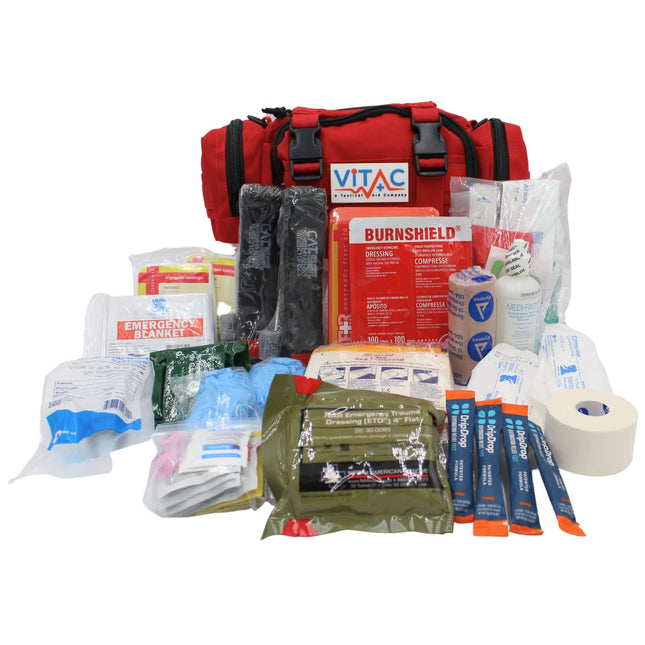
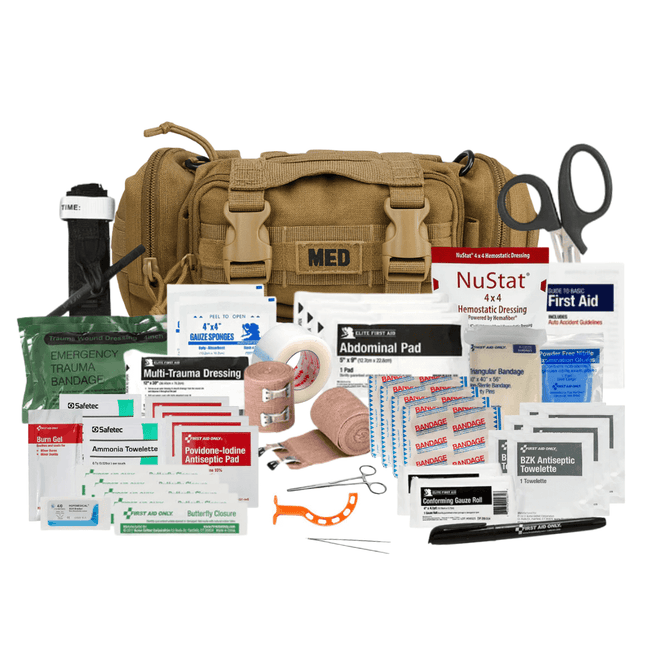
Trusted by Law Enforcement & Tactical Professionals
First Aid Kit Checklist - What to Pack for Real-Life Emergencies
9 min reading time
Uncontrolled bleeding is the leading preventable trauma killer. Build a first aid kit in layers — basic care, trauma essentials, and environment-specific add-ons.
Uncontrolled bleeding is the leading cause of preventable death after traumatic injury — and the average severe arterial bleed gives you 3 to 5 minutes before the outcome is decided. That window closes whether EMS is 6 minutes away or 30.
Most pre-packaged first aid kits can't address that. They're designed for regulatory compliance and price points, not for the emergencies that actually kill people. This guide shows you how to build a kit in layers — matched to your actual risk profile — from everyday injuries to life-threatening trauma.
Why Most First Aid Kits Fall Short
Walk into any big-box store and you'll find kits packed with band-aids, aspirin, and antiseptic wipes. Those items handle about 90% of minor incidents. They do nothing for the 10% that kills.
The problem is structural: commercial kits are built to hit a price point, not to address the mechanism of injury that matters most — severe, uncontrolled hemorrhage. A tourniquet, hemostatic gauze, and a chest seal don't come standard in a $15 kit. They should be standard in yours.
A real first aid kit checklist covers three layers:
Basic care — cuts, burns, blisters, minor pain management
Trauma care — severe bleeding, airway compromise, penetrating injuries
Use-case specifics — environmental hazards, allergic reactions, extended care
If your kit can't cover all three, it's incomplete for real-world use.
The Layered Approach — Build a Kit That Fits Your Risk
Skip the one-size-fits-none approach. Build in layers: start with a solid foundation, add trauma capability, then customize for environment and activity.
Layer 1: Basic Core
Your foundation — supplies for everyday injuries and minor medical issues. Every kit, regardless of use case, needs these:
Adhesive bandages (assorted sizes)
Sterile gauze pads (2×2, 4×4)
Medical tape
Antiseptic wipes and ointment
Nitrile gloves (multiple pairs)
Tweezers and trauma shears
Pain relievers (ibuprofen, acetaminophen)
Antihistamine (diphenhydramine)
Burn gel or dressing
Elastic bandage wrap
Instant cold pack
CPR face shield
Layer 2: Trauma Core
This is where the kit becomes capable of handling life-threatening injury. Every person carrying this kit should understand the MARCH framework — the CoTCCC-standard sequence for trauma care: Massive hemorrhage, Airway, Respiration, Circulation, Hypothermia. These items address the first three priorities directly.
CAT Gen 7 tourniquet — CoTCCC-recommended windlass tourniquet with 4,000+ documented combat applications since 2005. Don't improvise this. The CAT or SOFTT-W are the only two field-proven windlass options.
QuikClot Combat Gauze — Kaolin-based hemostatic gauze, CoTCCC-recommended since 2008. Five times faster clotting than plain gauze. NSN 6510-01-562-3325. Apply with 3 minutes of direct pressure.
Vented chest seals — for penetrating chest trauma. Two seals per wound (entry and exit).
Pressure dressing — Israeli-style ETD for wound packing and sustained direct pressure.
Nasopharyngeal airway (NPA) — for airway management in an unconscious or semi-conscious patient.
Compressed gauze — for wound packing in conjunction with hemostatic gauze.
Field Note: Counterfeit Tourniquets
Counterfeit CAT and SOFTT-W tourniquets flood online marketplaces. A sub-standard windlass fails under load — exactly when you need it most. Buy from authorized distributors only. See what to verify before buying any IFAK or trauma kit.
Layer 3: Use-Case Add-Ons
Customize based on where you'll use the kit. Different environments require different supplies.
Home First Aid Kit
Your home kit can be larger and more comprehensive — build it for the whole household. Add beyond the core:
Thermometer
Eye wash and eye pads
SAM splint
Larger gauze and bandage quantities
EpiPen (if prescribed)
Emergency contact list and medical history cards
A complete family and home kit should support at minimum 4 people for 72 hours of care without EMS support.
Vehicle First Aid Kit
Motor vehicle crashes are among the leading causes of traumatic injury in the U.S. Your vehicle kit should prioritize trauma, not bandage variety. Stage it where you can reach it — not buried in the trunk.
CAT or SOFTT-W tourniquet (within reach of the driver)
Hemostatic gauze
Vented chest seals
Pressure dressings
Emergency blanket
Seatbelt cutter
Flashlight
ViTAC's Vehicle Trauma Response Kit and Vehicle First Aid Kit (104-piece) are purpose-built for this — trauma components plus everyday wound care in one organized package. Inspect seasonally: vehicle interiors reach 140°F+ in summer, degrading adhesives and shortening shelf life.
Range / Shooting Sports Kit
Firearms training and competition environments produce predictable, severe injuries. Your range kit should be labeled, staged, and accessible within 30 seconds from any position on the line.
Two CAT Gen 7 tourniquets (one on your person, one in the kit)
Hemostatic gauze
Vented chest seals
Pressure dressings
Trauma shears
Nitrile gloves (multiple pairs)
Outdoor / Hiking / Camping Kit
Backcountry kits must balance weight against capability. Rural EMS response averages 14+ minutes nationally — in remote terrain, help may be 30 minutes out or more. Build for extended care until extraction.
Blister treatment (moleskin, Second Skin)
Insect sting relief
Tick removal tool
Water purification tablets
Emergency shelter (space blanket)
SAM splint
Tourniquet, hemostatic gauze, and pressure dressing
Wilderness medicine reference card
ViTAC's Lightweight Campers First Aid Kit is purpose-configured for backcountry use — compact enough to carry, stocked for the injuries trails actually produce.
Travel First Aid Kit
TSA-compliant and compact. Focus on common travel ailments plus lightweight trauma basics.
Adhesive bandages and gauze
Pain relievers and anti-diarrheal medication
Antihistamine
Antibiotic ointment
Tweezers and small scissors (confirm TSA rules before travel)
Prescription medications in original containers
If traveling internationally, research local regulations on medical supplies. Some hemostatic agents and airway devices require documentation or are restricted at customs.
Pet / K9 First Aid Add-Ons
Working dogs and pets get injured. Supplement your kit with:
An EDC kit isn't comprehensive — it's what you have right now when seconds count. Browse EDC kits and components built for daily carry without bulk.
First Aid Kit Best Practices
The kit alone does nothing. Maintenance and training complete the system:
Check expiration dates twice a year — Hemostatic gauze and chest seals carry a 5-year shelf life from manufacture date. Adhesives and medications degrade faster. Set the calendar reminder now.
Train with your gear — A tourniquet you've never applied is one you can't apply under stress. Stop the Bleed certification is free, two hours, and available in all 50 states.
Stage it where it's needed — A kit in the garage doesn't help during a kitchen emergency. A kit in the trunk doesn't help if you can't reach it after a crash.
Label everything — In a crisis, you don't have time to inventory. Color-code by layer on large kits.
Restock immediately after use — Don't wait for the next incident to discover you're short on gauze.
Common Mistakes to Avoid
Buying counterfeit tourniquets — Sub-standard windlass mechanisms fail under the pressure required to occlude arterial flow. The CAT Gen 7 and SOFTT-W are the only CoTCCC-recommended options. Everything else is a liability.
Overpacking the wrong items — More band-aids don't make the kit better. A bloated basic layer slows access to the trauma layer when it counts.
Skipping training — Supplies without skills are expensive props. The gear doesn't save the life — the person using it does.
Building one kit for all environments — A vehicle kit and a trail kit have different requirements. Build to the use case.
Letting it expire in the field — Expired hemostatic agents and degraded adhesives fail when called upon. Inspection is part of the standard.
FAQ
What's the difference between a first aid kit and a trauma kit?
A first aid kit handles minor injuries — cuts, burns, blisters, common ailments. A trauma kit is purpose-built for life-threatening injury: severe hemorrhage, airway compromise, penetrating trauma. The best kits combine both. For the clinical framework behind trauma response priorities, see the MARCH trauma care protocol.
What tourniquet belongs in a civilian first aid kit?
The CAT Gen 7 and the SOFTT-W are the two CoTCCC-recommended windlass tourniquets with thousands of documented combat applications. Do not substitute improvised tourniquets, elastic bands, or off-brand alternatives — they fail under the pressure required to stop arterial bleeding.
How often should I replace kit components?
Inspect twice yearly. Replace hemostatic gauze and chest seals at the 5-year mark from manufacture date (not purchase date). Replace adhesives and medications annually or when packaging is compromised. Replace any component immediately after use — never deploy with a partial kit.
Bottom Line
A first aid kit built for real emergencies — not regulatory checkboxes — requires layers. Basic care handles the daily incidents. Trauma capability covers the 10% that kills. Use-case customization ensures you're carrying the right gear for your environment. All of it requires training to activate.
Start with a foundation already loaded for the trauma layer. The General Purpose First Aid Kit – Med Pro includes a CAT Gen 7, QuikClot Combat Gauze, HyFin chest seals, NPA, and 70+ wound care components — organized and ready to carry. Customize for your environment from there.
In Stock. Ready to Ship.
Domestic Shipping (USA - Lower 48 Only) Orders are processed within 24 hours and typically ship within 1–2 business days. Once shipped, delivery takes an estimated 3–7 days, with most orders arriving in just 5 days. Please Note: We currently do not ship to Alaska, Hawaii, or international destinations. Questions? Contact us anytime at support@vitacsolutions.com or call 307-202-8426.
In Stock. Ready to Ship.
Domestic Shipping (USA - Lower 48 Only) Orders are processed within 24 hours and typically ship within 1–2 business days. Once shipped, delivery takes an estimated 3–7 days, with most orders arriving in just 5 days. Please Note: We currently do not ship to Alaska, Hawaii, or international destinations. Questions? Contact us anytime at support@vitacsolutions.com or call 307-202-8426.
In Stock. Ready to Ship.
Domestic Shipping (USA - Lower 48 Only) Orders are processed within 24 hours and typically ship within 1–2 business days. Once shipped, delivery takes an estimated 3–7 days, with most orders arriving in just 5 days. Please Note: We currently do not ship to Alaska, Hawaii, or international destinations. Questions? Contact us anytime at support@vitacsolutions.com or call 307-202-8426.
In Stock. Ready to Ship.
Domestic Shipping (USA - Lower 48 Only) Orders are processed within 24 hours and typically ship within 1–2 business days. Once shipped, delivery takes an estimated 3–7 days, with most orders arriving in just 5 days. Please Note: We currently do not ship to Alaska, Hawaii, or international destinations. Questions? Contact us anytime at support@vitacsolutions.com or call 307-202-8426.
What are you preparing for? On-duty response, family preparedness, outdoor adventure... Answer 5 quick questions and we'll match you with the right gear.
Stop the Bleed: Training, Gear, and How to Get Certified
Uncontrolled hemorrhage kills in 3–5 minutes. Stop the Bleed certification is free, two hours, and available in all 50 states. This is the gear that...
First Aid Kit Checklist - What to Pack for Real-Life Emergencies
Uncontrolled bleeding is the leading preventable trauma killer. Build a first aid kit in layers — basic care, trauma essentials, and environment-specific add-ons.
Are you making the right choice when buying IFAK trauma kits? This post highlights the crucial differences between budget and quality options, focusing on components...
We've been downrange. We know what it costs to be unprepared. ViTAC was built by U.S. Army Special Operations veterans to make sure the people who run toward the threat — and the families who depend on them — have gear that works when everything is on the line.
— ViTAC Solutions Founders | 40+ years combined Special Operations experience
Most of our trauma kits and first aid supplies qualify for HSA and FSA reimbursement. Don't let your benefits expire — invest them in gear that could save a life.
Hello thank you for putting out a affordable kit we were spending a lot of money on MYMEDIC kits but I think you changed my mind
Hi Joey, thank you so much for taking the time to leave us a review. We're thrilled to hear that our kit has made a positive impression on you. We strive to provide high-quality, affordable options for our customers, and we're happy to have changed your mind about other brands. Stay safe out there!