Trusted by Law Enforcement & Tactical Professionals
EDC IFAK: Four Carry Methods and the Components That Matter
4 min reading time
EMS averages 14 minutes. Severe bleeding kills in 3–5. Four carry methods, one MARCH-compliant component set — here's how to build an EDC IFAK that actually works.
National EMS response averages 14 minutes or more; rural counties regularly exceed 30. Severe arterial bleeding can cause death in 3–5 minutes. On-person trauma gear closes that gap. The problem: most people who carry a firearm don't have a plan for their medical carry.
An EDC IFAK isn't a bag you reach for later — it's the kit on your body at the moment it's needed. If you're new to the concept, start with What Is an IFAK? for the baseline definitions. Carry method determines what fits. Components are determined by MARCH. Build it backward: start with the standard, then fit the method to your carry profile.
Four Carry Methods
1. Pocket Carry
A pocket IFAK keeps essentials accessible without printing. Useful in environments where a visible med pouch isn't practical. Limitation: you have to strip the kit to basics — at minimum a CAT tourniquet and hemostatic gauze. Most cargo pockets accommodate this. Standard dress pockets do not.
2. Belt Carry
A belt-mounted med pouch gives more room for a full component set — tourniquet, gauze, chest seal, pressure dressing. Trade-off: it adds to your waistline footprint. Position the pouch so it does not interrupt your draw stroke. Best for individuals already running a duty belt or dedicated EDC belt setup.
3. Ankle Carry
Ankle carry is discreet and does not affect draw. Works well for plain-clothes situations where printing is a concern. Limitation: you are restricted to a compact kit — a SWAT-T or CAT tourniquet, one or two chest seals, and basic gauze. Recheck any ankle-mounted kit after patient movement.
4. Off-Body (Bag, Pack, Vehicle)
A bag or vehicle kit lets you carry a full IFAK without any on-body compromise. Limitation: it requires retrieval. If you can't reach the bag, you can't use the kit. Off-body carry supplements on-person carry — it doesn't replace it. Keep a minimum kit on you and a fully stocked backup in the vehicle.
Field Note: Tourniquet First
Whatever carry method you choose, the tourniquet never comes off the kit. If you're reducing components to fit a pocket or ankle pouch, cut elsewhere first. Hemorrhage is the leading cause of preventable death after traumatic injury — every build starts at M.
Minimum Viable Component Set
The non-negotiables for a concealed EDC IFAK, mapped to MARCH:
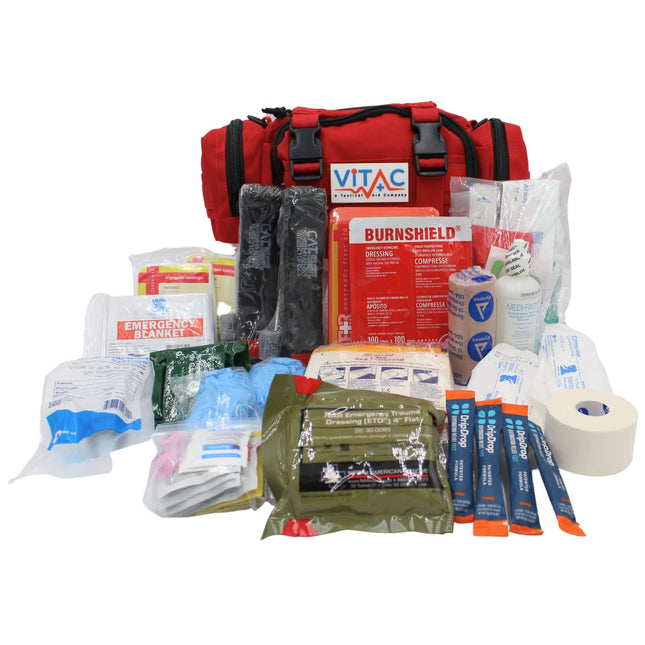
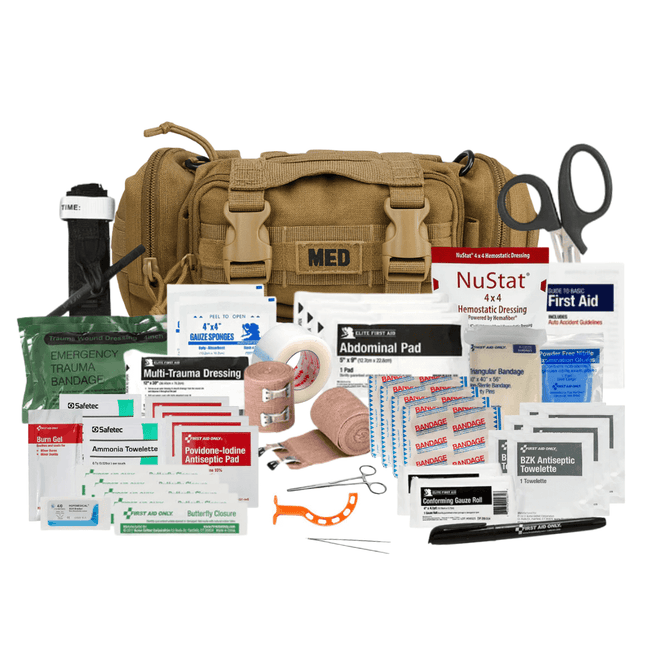
Massive Hemorrhage: TCCC-approved tourniquet — CAT Gen 7 for adult limbs, SWAT-T for K9 or pediatric — plus QuikClot Combat Gauze for junctional wounds the tourniquet can't reach
Airway: NPA (nasopharyngeal airway) if trained. Omit if untrained.
Circulation:Israeli bandage for wound management after tourniquet application or packing
Hypothermia: Mylar blanket if space permits. Optional in a pocket kit. Standard in a full IFAK build.
Nitrile gloves and a permanent marker (for tourniquet time notation) complete the set. For a full breakdown of what each component does and why it belongs, see The Civilian IFAK: What Belongs Inside.
Buy vs. Build
Pre-configured kits eliminate sourcing errors and ship ready to carry. The risk: sourcing from unverified retailers. Counterfeit tourniquets and cloned gauze products look identical to TCCC-approved equipment until the moment they fail. Source from authorized distributors only. For a full breakdown of counterfeit risk, see Buying IFAK Trauma Kits: The Real Risks Revealed.
FAQ
Do I need a tourniquet if I already carry pepper spray or a firearm?
Yes. Firearms and defensive tools address threat response. A tourniquet addresses injury response — for you, a bystander, or your attacker. They are not interchangeable. Carry both.
Can I build a compliant EDC IFAK from parts?
Yes, provided every component comes from a verified manufacturer. Buy the CAT Gen 7 from a North American Rescue-authorized distributor. Buy QuikClot directly from Z-Medica or Teleflex-authorized suppliers. Avoid third-party marketplace listings. A kit is only as good as its worst component.
Bottom Line
EMS response time defines the gap between an injury and help that can intervene. On-person trauma gear closes that gap regardless of location or how fast help is coming. Carry method is a logistics problem. The components are defined by MARCH — a standard with 20+ years of validated combat application.
Build the kit. Mount it where you can reach it. Practice deploying it before you need to. That's the whole decision.
In Stock
Domestic Shipping (USA - Lower 48 Only) Orders are processed within 24 hours and typically ship within 1–2 business days. Once shipped, delivery takes an estimated 3–7 days, with most orders arriving in just 5 days. Please Note: We currently do not ship to Alaska, Hawaii, or international destinations. Questions? Contact us anytime at support@vitacsolutions.com or call 307-202-8426.
In Stock
Domestic Shipping (USA - Lower 48 Only) Orders are processed within 24 hours and typically ship within 1–2 business days. Once shipped, delivery takes an estimated 3–7 days, with most orders arriving in just 5 days. Please Note: We currently do not ship to Alaska, Hawaii, or international destinations. Questions? Contact us anytime at support@vitacsolutions.com or call 307-202-8426.
In Stock
Domestic Shipping (USA - Lower 48 Only) Orders are processed within 24 hours and typically ship within 1–2 business days. Once shipped, delivery takes an estimated 3–7 days, with most orders arriving in just 5 days. Please Note: We currently do not ship to Alaska, Hawaii, or international destinations. Questions? Contact us anytime at support@vitacsolutions.com or call 307-202-8426.
In Stock
Domestic Shipping (USA - Lower 48 Only) Orders are processed within 24 hours and typically ship within 1–2 business days. Once shipped, delivery takes an estimated 3–7 days, with most orders arriving in just 5 days. Please Note: We currently do not ship to Alaska, Hawaii, or international destinations. Questions? Contact us anytime at support@vitacsolutions.com or call 307-202-8426.
What are you preparing for? On-duty response, family preparedness, outdoor adventure... Answer 5 quick questions and we'll match you with the right gear.
Cold environments demand deliberate gear decisions. This guide covers the three-layer system — base, mid, and shell — from a preparedness standpoint: how each layer...
Identify Fake Gear: Ensuring Your Trauma Kits Meet TCCC Standards
Counterfeit CAT tourniquets fail under pressure. TCCC-standard gear has specific markings, materials, and testing — here's how to verify before your kit is tested for...
Uncontrolled bleeding is the leading cause of preventable trauma death. EMS averages 14 minutes nationally. A firearm stops the threat — only a trauma kit...
We've been downrange. We know what it costs to be unprepared. ViTAC was built by U.S. Army Special Operations veterans to make sure the people who run toward the threat — and the families who depend on them — have gear that works when everything is on the line.
— ViTAC Solutions Founders | 40+ years combined Special Operations experience
Most of our trauma kits and first aid supplies qualify for HSA and FSA reimbursement. Don't let your benefits expire — invest them in gear that could save a life.
The item was as promised. Everything in the kit was high-quality and I’m pleased with that. The only problem I have is I’m not sure it’s worth the cost. I found all of the contents individually for significantly less money. The only thing I didn’t find on my own was the pouch everything came in and that was a perfect fit so I would give it an A plus on quality, but a C on value.