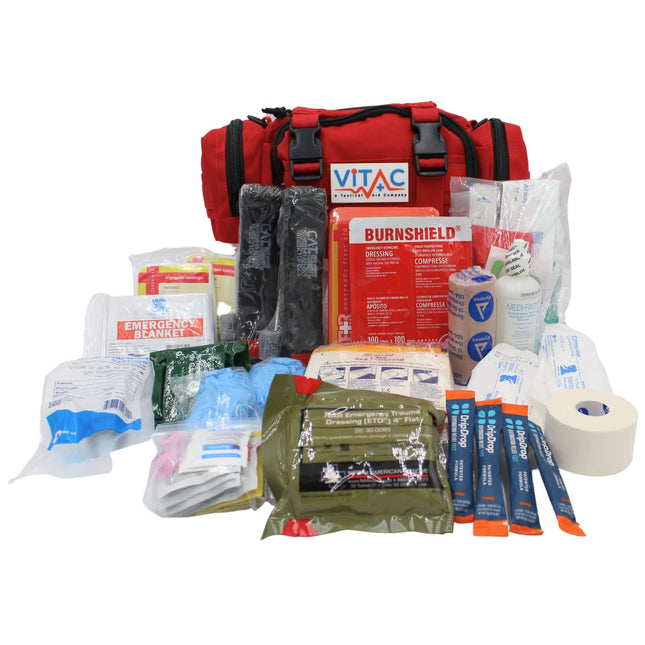
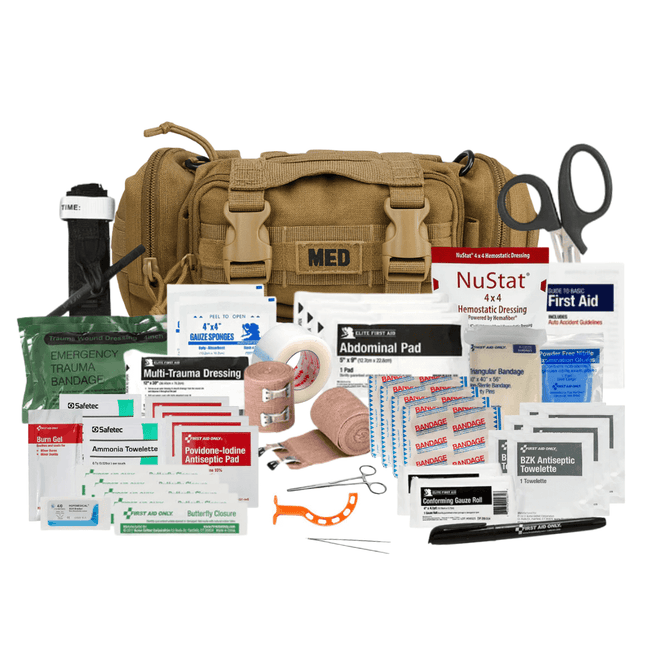
Trusted by Law Enforcement & Tactical Professionals
Trauma Kit Essentials: Five Items and Nothing Else
4 min reading time
Uncontrolled hemorrhage kills in 3–5 minutes. A trauma kit should carry exactly five items — nothing more. Here's what they are and why everything else slows you down.
Uncontrolled hemorrhage kills in 3–5 minutes. The gear that stops it needs to be accessible in the first seconds after injury — not buried under items that serve no trauma function. Every item in a trauma kit competes for space with the items that matter.
The Problem Is What's Already In There
Open the average first aid kit sold online and you'll find lip balm, antacid tablets, moleskin, and tweezers. Those items aren't wrong — they're just not trauma gear. The problem starts when a trauma kit gets the same treatment: packed with everything that might be useful instead of the few things that keep someone alive.
An overpacked trauma kit fails under stress. When your hands are shaking and someone is bleeding out, the tourniquet buried under four packages of bandages doesn't exist. Location time is treatment delay. Treatment delay at the wrong moment is a preventable death.
Less is more because less is faster.
What a Trauma Kit Is
A trauma kit has one job: treat injuries that threaten life, limb, or eyesight. That is the complete scope. Anything that doesn't serve that function does not belong in the kit.
This includes items that seem helpful: suture kits, OTC medications, instant cold packs, alcohol wipes. None of those address the injuries that kill people in the first minutes after trauma — hemorrhage, tension pneumothorax, airway compromise. The MARCH protocol defines exactly what those threats are and the order to address them. Build your kit against that standard, not against a general notion of "useful."
The Five Items That Cover the Life Threats
1. Tourniquet
Extremity hemorrhage from a limb wound is survivable when controlled immediately. The CAT Gen 7 is the CoTCCC-recommended standard: one-handed application in under 60 seconds, a windlass mechanism with over 4,000 documented battlefield applications and an 87%+ hemorrhage control rate. One tourniquet per kit at minimum. Two is not excessive for a vehicle or range bag build.
2. Nitrile Gloves
Bloodborne pathogen protection for whoever is providing care. Non-allergenic, thick enough for debris and sharp materials. Keep them accessible at the top of the kit — not buried. Treating without gloves creates a second problem while addressing the first.
3. Hemostatic Gauze
Tourniquets cannot address wounds to the neck, groin, or torso. QuikClot Combat Gauze is impregnated with kaolin-based hemostatic agent that controls high-volume junctional bleeding up to 5x faster than standard gauze. Z-fold design allows controlled packing with one hand. It is the correct tool for wounds in locations a tourniquet cannot reach — and the CoTCCC-recommended hemostatic for those scenarios.
4. Pressure Bandage
Hemostatic gauze packed into a wound must be secured to maintain pressure on the bleed. The Israeli bandage applies direct pressure, wraps, and self-secures in a single unit — no additional tape required. It is also the right tool for standalone pressure application on wounds that don't require hemostatic gauze packing.
5. Chest Seal
A penetrating chest wound creates a tension pneumothorax that can be fatal faster than blood loss. The HyFin Vented Chest Seal closes the wound while the vented design prevents dangerous pressure buildup inside the pleural cavity. Two per pack — one for entry, one for exit. Improvised dressings do not handle this effectively. Carry the purpose-built tool.
The Audit Question
Every item in a trauma kit should pass one test: does this treat a life-threatening injury in the first minutes after trauma?
Suture kit: no — sutures close wound edges, they don't control hemorrhage. Ibuprofen: no — pain management doesn't stop a bleed. Instant cold pack: no — cold addresses none of the primary mechanisms of preventable traumatic death. Alcohol wipes: no — sterility is irrelevant at point of injury; infection is a hospital problem.
If an item doesn't pass, it belongs in a separate bag. A trauma kit is not a general first aid kit. Keep the distinction absolute — it matters when you're moving fast and thinking slow.
Frequently Asked Questions
Can I add items if I have more training?
Yes — with discipline. An NPA (nasopharyngeal airway) belongs in the kit if you're trained in airway management. A chest decompression needle belongs only if you're trained and authorized to use it. Add capabilities that match your skill level, not items that seem useful in theory.
Do I need a full IFAK or just these five items?
A purpose-built IFAK organizes these items for speed and adds the pouch system that keeps them protected and accessible. For most carriers, a pre-built IFAK is the right starting point — it removes the selection and organization decision from the equation.
How often should I replace trauma kit items?
Inspect every 90 days. Replace hemostatic gauze and chest seals every 5 years from manufacture date (per manufacturer specs) or immediately after any use. Replace tourniquets annually under heavy training use or per manufacturer guidance.
Bottom Line
A trauma kit built around five items — tourniquet, gloves, hemostatic gauze, pressure bandage, chest seal — covers the life threats that kill people in the first minutes after traumatic injury. Everything added beyond that competes for space and access time with the gear that matters. Keep it lean. Keep it organized. Train until the sequence is automatic.
In Stock
Domestic Shipping (USA - Lower 48 Only) Orders are processed within 24 hours and typically ship within 1–2 business days. Once shipped, delivery takes an estimated 3–7 days, with most orders arriving in just 5 days. Please Note: We currently do not ship to Alaska, Hawaii, or international destinations. Questions? Contact us anytime at support@vitacsolutions.com or call 307-202-8426.
In Stock
Domestic Shipping (USA - Lower 48 Only) Orders are processed within 24 hours and typically ship within 1–2 business days. Once shipped, delivery takes an estimated 3–7 days, with most orders arriving in just 5 days. Please Note: We currently do not ship to Alaska, Hawaii, or international destinations. Questions? Contact us anytime at support@vitacsolutions.com or call 307-202-8426.
In Stock
Domestic Shipping (USA - Lower 48 Only) Orders are processed within 24 hours and typically ship within 1–2 business days. Once shipped, delivery takes an estimated 3–7 days, with most orders arriving in just 5 days. Please Note: We currently do not ship to Alaska, Hawaii, or international destinations. Questions? Contact us anytime at support@vitacsolutions.com or call 307-202-8426.
In Stock
Domestic Shipping (USA - Lower 48 Only) Orders are processed within 24 hours and typically ship within 1–2 business days. Once shipped, delivery takes an estimated 3–7 days, with most orders arriving in just 5 days. Please Note: We currently do not ship to Alaska, Hawaii, or international destinations. Questions? Contact us anytime at support@vitacsolutions.com or call 307-202-8426.
What are you preparing for? On-duty response, family preparedness, outdoor adventure... Answer 5 quick questions and we'll match you with the right gear.
Cold environments demand deliberate gear decisions. This guide covers the three-layer system — base, mid, and shell — from a preparedness standpoint: how each layer...
Identify Fake Gear: Ensuring Your Trauma Kits Meet TCCC Standards
Counterfeit CAT tourniquets fail under pressure. TCCC-standard gear has specific markings, materials, and testing — here's how to verify before your kit is tested for...
Uncontrolled bleeding is the leading cause of preventable trauma death. EMS averages 14 minutes nationally. A firearm stops the threat — only a trauma kit...
We've been downrange. We know what it costs to be unprepared. ViTAC was built by U.S. Army Special Operations veterans to make sure the people who run toward the threat — and the families who depend on them — have gear that works when everything is on the line.
— ViTAC Solutions Founders | 40+ years combined Special Operations experience
Most of our trauma kits and first aid supplies qualify for HSA and FSA reimbursement. Don't let your benefits expire — invest them in gear that could save a life.
The item was as promised. Everything in the kit was high-quality and I’m pleased with that. The only problem I have is I’m not sure it’s worth the cost. I found all of the contents individually for significantly less money. The only thing I didn’t find on my own was the pouch everything came in and that was a perfect fit so I would give it an A plus on quality, but a C on value.