Trusted by Law Enforcement & Tactical Professionals
Range Medical Kit: Two Tiers of Gear and What Each Covers
4 min reading time
EMS response to remote ranges can run 14+ minutes. A two-tier range kit handles minor injuries and fills the trauma gap — here's what belongs in each tier.
Most injuries at the range are minor — cuts, abrasions, brass burns, an occasional splinter from a prop. But the range is also where accidental discharges happen. What distinguishes a range that can handle both scenarios from one that can only handle the first is a two-tier medical setup.
EMS response to remote or rural shooting ranges can exceed 14 minutes. That response gap is where survivable injuries become fatalities. The solution isn't a bigger kit — it's the right kit, organized for the threat environment you're actually in.
Tier 1: Minor Injuries
Cuts and abrasions from equipment contact are the most common range injuries. Extended handling of metal and polymer surfaces, combined with a dirty environment, produces predictable injury patterns. Basic wound care stops minor injuries from becoming infections.
Stock:
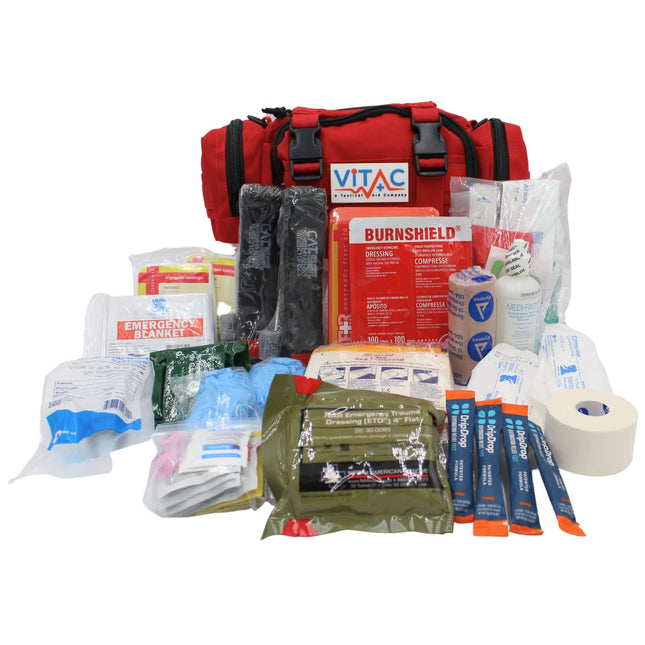
Nitrile gloves — at least 2 pairs per kit, for the person rendering aid and a swap-out pair
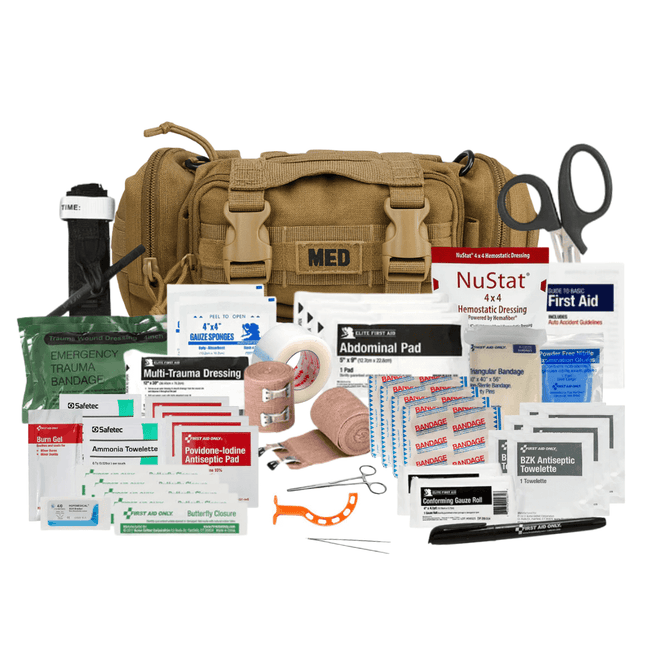
Butterfly bandages — for lacerations that need edge approximation without a suture
4×4 sterile gauze pads — the most-used item on most range kits. Absorbent, sterile, re-applicable.
Medical tape — cloth athletic tape holds dressings on sweating hands and forearms
Topical antiseptic — Betadine spray, not hydrogen peroxide. Hydrogen peroxide damages the healthy cells that promote wound healing.
Eye wash — saline flush for carbon particulate or debris in the eye
Field Note: Contamination Risk
The debris environment at an outdoor range — dust, carbon, unburned powder — makes wound contamination a real risk. Clean minor wounds before covering them. Cover them before returning to the line.
Tier 2: Traumatic Emergencies
Accidental discharges, ricochet fragments, and structural injuries from falls are low-probability and high-consequence. The trauma tier of your range kit bridges the EMS response gap using the MARCH protocol — the treatment priority sequence used in military and tactical medicine.
Massive Hemorrhage
CAT Gen 7 Tourniquet — minimum one per person on the range. Limb hemorrhage from a gunshot wound is the primary cause of preventable death in this context. Keep one on your person, not just in the bag.
QuikClot Combat Gauze — for junctional wounds (armpit, groin, neck) where a tourniquet cannot be applied. Clots 5x faster than standard gauze and is the CoTCCC-recommended hemostatic.
Israeli Bandage — pressure dressing for post-packing wound management
NPA (nasopharyngeal airway) — include only if at least one person present is trained in deployment
Circulation and Hypothermia
Mylar emergency blanket — hypothermia is a factor even at moderate temperatures when a patient is on bare ground losing blood volume
Trauma shears — to cut clothing and access wounds without repositioning the patient
Kit Placement Rules
A dedicated range kit lives in your bag or on the line — not across the parking lot in your vehicle trunk. If the kit requires retrieval, it requires time you won't have. At minimum, every person on the range should have a tourniquet on their body. The bag handles the rest of Tier 2 and all of Tier 1.
For organized range events or training days with multiple shooters, stage a Tier 2 bag at the firing line and designate one person per relay as the medical point of contact. Don't assume the kit will find its way to the right hands — assign it before the first round goes downrange.
Frequently Asked Questions
Does the range kit replace my personal IFAK?
No. Your personal IFAK lives on your body — it's the first tool that reaches the injury. The range bag backs up the individual carry, handles Tier 1 wound care, and provides additional Tier 2 supplies for multi-person response. Both are necessary; they serve different functions.
How often should I inspect the range kit?
Every 90 days. Confirm tourniquet windlass tension, verify hemostatic gauze packaging is intact (no punctures, no discoloration), and replace any item that's been opened or field-used. Shelf life on hemostatic gauze and chest seals is 5 years from manufacture date.
What's the minimum setup for a solo shooter?
On-body: one CAT Gen 7 tourniquet, accessible without removing your outer layer. In your bag: one QuikClot Combat Gauze, one Israeli bandage, one HyFin vented chest seal twin pack. If you're shooting alone, the kit has to be on your person and within reach of your non-dominant hand — no one else is running it for you.
Bottom Line
A two-tier range kit covers the full injury spectrum: minor wound care for the day-to-day, trauma gear for the emergency that closes the EMS gap. The tier distinction matters because the tools for each are different, and under stress you need the right tool accessible immediately — not buried in the wrong compartment.
In Stock
Domestic Shipping (USA - Lower 48 Only) Orders are processed within 24 hours and typically ship within 1–2 business days. Once shipped, delivery takes an estimated 3–7 days, with most orders arriving in just 5 days. Please Note: We currently do not ship to Alaska, Hawaii, or international destinations. Questions? Contact us anytime at support@vitacsolutions.com or call 307-202-8426.
In Stock
Domestic Shipping (USA - Lower 48 Only) Orders are processed within 24 hours and typically ship within 1–2 business days. Once shipped, delivery takes an estimated 3–7 days, with most orders arriving in just 5 days. Please Note: We currently do not ship to Alaska, Hawaii, or international destinations. Questions? Contact us anytime at support@vitacsolutions.com or call 307-202-8426.
In Stock
Domestic Shipping (USA - Lower 48 Only) Orders are processed within 24 hours and typically ship within 1–2 business days. Once shipped, delivery takes an estimated 3–7 days, with most orders arriving in just 5 days. Please Note: We currently do not ship to Alaska, Hawaii, or international destinations. Questions? Contact us anytime at support@vitacsolutions.com or call 307-202-8426.
In Stock
Domestic Shipping (USA - Lower 48 Only) Orders are processed within 24 hours and typically ship within 1–2 business days. Once shipped, delivery takes an estimated 3–7 days, with most orders arriving in just 5 days. Please Note: We currently do not ship to Alaska, Hawaii, or international destinations. Questions? Contact us anytime at support@vitacsolutions.com or call 307-202-8426.
What are you preparing for? On-duty response, family preparedness, outdoor adventure... Answer 5 quick questions and we'll match you with the right gear.
Cold environments demand deliberate gear decisions. This guide covers the three-layer system — base, mid, and shell — from a preparedness standpoint: how each layer...
Identify Fake Gear: Ensuring Your Trauma Kits Meet TCCC Standards
Counterfeit CAT tourniquets fail under pressure. TCCC-standard gear has specific markings, materials, and testing — here's how to verify before your kit is tested for...
Uncontrolled bleeding is the leading cause of preventable trauma death. EMS averages 14 minutes nationally. A firearm stops the threat — only a trauma kit...
We've been downrange. We know what it costs to be unprepared. ViTAC was built by U.S. Army Special Operations veterans to make sure the people who run toward the threat — and the families who depend on them — have gear that works when everything is on the line.
— ViTAC Solutions Founders | 40+ years combined Special Operations experience
Most of our trauma kits and first aid supplies qualify for HSA and FSA reimbursement. Don't let your benefits expire — invest them in gear that could save a life.
The item was as promised. Everything in the kit was high-quality and I’m pleased with that. The only problem I have is I’m not sure it’s worth the cost. I found all of the contents individually for significantly less money. The only thing I didn’t find on my own was the pouch everything came in and that was a perfect fit so I would give it an A plus on quality, but a C on value.