Trusted by Law Enforcement & Tactical Professionals
Bleeding Control Kit Buyer's Guide: Match the Kit to the Threat
6 min reading time
Uncontrolled bleeding kills in 3-5 minutes. A buyer's guide to matching tourniquets, hemostatic gauze, and trauma kits to where you actually face risk.
Uncontrolled bleeding is the leading cause of preventable death after traumatic injury. A severe arterial bleed can empty the body in three to five minutes. That is the window you are buying against when you choose a bleeding control kit, and it closes faster than help arrives.
National rural EMS response averages over 14 minutes, and crosses 30 minutes in some counties. The kit on your belt, in your vehicle, or in your range bag is the only medical capability that exists during those minutes. Buying the right one is a decision about matching real injuries to proven tools, not stacking up the longest parts list.
What a bleeding control kit actually does
A bleeding control kit exists to solve a short list of life threats: arterial bleeding from an arm or leg, bleeding from a wound EMS calls "junctional" or deep, and a penetrating chest injury that lets air into the chest cavity. Everything in a serious kit maps to one of those problems. If a component does not, it is filler.
This is the logic behind the MARCH framework — Massive hemorrhage, Airway, Respiration, Circulation, Hypothermia — the same sequence trained on by military and tactical medics. Massive hemorrhage comes first because it kills first. A buyer's guide is really a question of how completely your kit answers each MARCH letter, in order.
The non-negotiable components
Five items carry the load. Anything you buy should be built around these, and you should be able to name the job each one does.
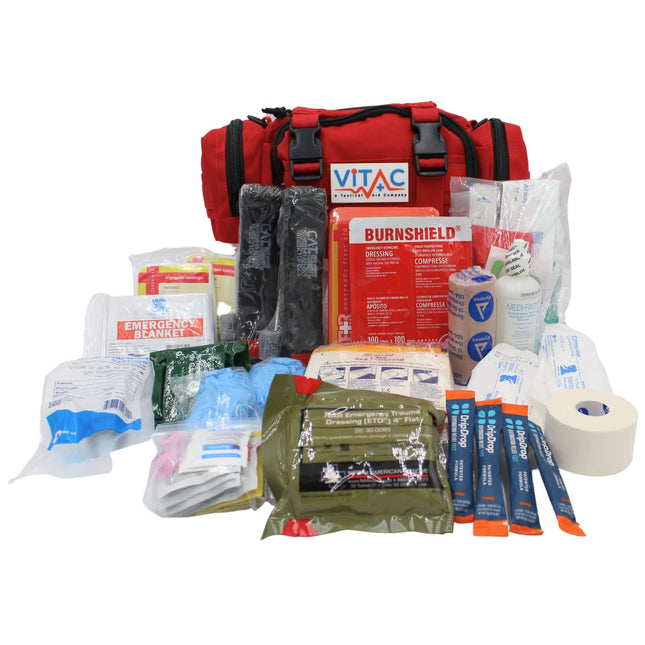
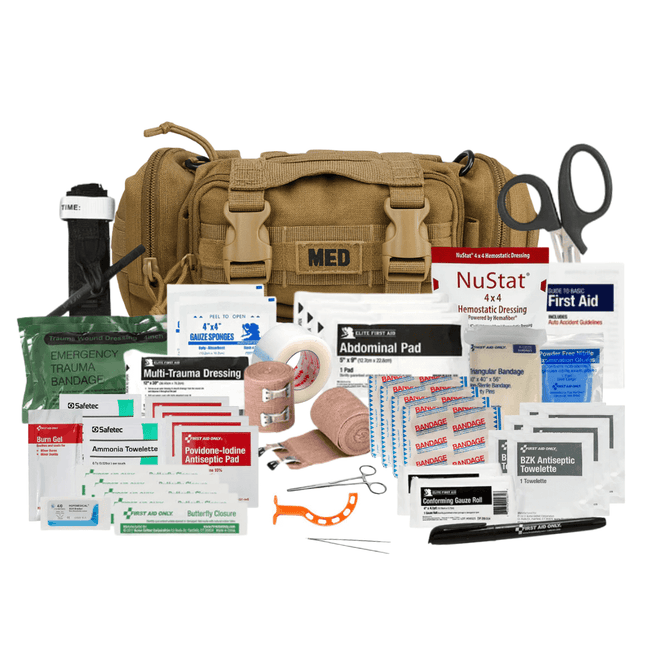
A windlass tourniquet. For arterial bleeding from a limb, nothing else works as fast or as reliably. The CAT GEN 7 has over 4,000 documented combat applications and an 87%+ correct-application survival rate in field data. Improvised tourniquets and non-windlass bands do not generate the pressure to stop an arterial bleed. Buy a real one, and buy a backup — see the full range in tourniquets.
Hemostatic gauze. For bleeding you cannot tourniquet, like a shoulder, hip, or groin wound, you pack the wound by hand. QuikClot Combat Gauze has been CoTCCC-recommended since April 2008 and clots roughly five times faster than plain gauze. Compare your options in hemostatics.
A pressure bandage. An Israeli Bandage holds packed gauze in place and applies focused pressure. It is the component that frees your hands.
A vented chest seal. For a penetrating chest wound, a HyFin Vented Chest Seal seals the entry and prevents air from collapsing the lung. Buy them in twin packs — entry and exit wounds are common.
Gloves and a marker. Nitrile gloves protect you. A marker records tourniquet time on the patient's skin, which is the first thing EMS asks for.
Field Note: Verify the gear, not the label
Counterfeit tourniquets and off-brand "QuikClot" gauze flood online marketplaces. A windlass that snaps or gauze without the kaolin agent fails when it matters. Buy hemostatics that name CoTCCC and tourniquets from a known source. Hemostatic gauze and chest seals carry a five-year shelf life from manufacture — check the date before you trust it.
Match the kit to the threat
The right kit is the one matched to where you will use it and how much room you have to carry it. Use this to find your tier.
An EDC or Tactical IFAK is built to treat one casualty — usually yourself or the person next to you. That is the right tool on your body. It is not enough for a vehicle accident with multiple injured, or a workplace incident.
Is a tourniquet by itself enough? No. A tourniquet only addresses arterial bleeding from a limb. It does nothing for a wound to the torso, shoulder, or groin, which is what hemostatic gauze and a pressure bandage are for. A complete kit covers all three.
Do I need training to use one? The gear works best with a few hours of instruction. Stop the Bleed offers free, roughly two-hour certification courses available in all 50 states. It is the fastest way to turn a kit you own into a capability you can use under stress.
Am I exposed legally if I help a stranger? Good Samaritan laws exist in all 50 U.S. states to protect people who render reasonable aid in good faith. They are written specifically to encourage bystanders to act.
Bottom Line
A bleeding control kit is judged by one standard: can it stop the three bleeds that kill before EMS arrives — a limb arterial bleed, a deep wound you have to pack, and a penetrating chest injury. Buy a windlass tourniquet, hemostatic gauze, a pressure bandage, and a vented chest seal, then size the package to where you will carry it. Match the kit to the threat, not to the parts count.
Browse purpose-built options across every tier in our emergency medical trauma kits and pick the one that fits where you stand the most risk.
In Stock
Domestic Shipping (USA - Lower 48 Only) Orders are processed within 24 hours and typically ship within 1–2 business days. Once shipped, delivery takes an estimated 3–7 days, with most orders arriving in just 5 days. Please Note: We currently do not ship to Alaska, Hawaii, or international destinations. Questions? Contact us anytime at support@vitacsolutions.com or call 307-202-8426.
In Stock
Domestic Shipping (USA - Lower 48 Only) Orders are processed within 24 hours and typically ship within 1–2 business days. Once shipped, delivery takes an estimated 3–7 days, with most orders arriving in just 5 days. Please Note: We currently do not ship to Alaska, Hawaii, or international destinations. Questions? Contact us anytime at support@vitacsolutions.com or call 307-202-8426.
In Stock
Domestic Shipping (USA - Lower 48 Only) Orders are processed within 24 hours and typically ship within 1–2 business days. Once shipped, delivery takes an estimated 3–7 days, with most orders arriving in just 5 days. Please Note: We currently do not ship to Alaska, Hawaii, or international destinations. Questions? Contact us anytime at support@vitacsolutions.com or call 307-202-8426.
In Stock
Domestic Shipping (USA - Lower 48 Only) Orders are processed within 24 hours and typically ship within 1–2 business days. Once shipped, delivery takes an estimated 3–7 days, with most orders arriving in just 5 days. Please Note: We currently do not ship to Alaska, Hawaii, or international destinations. Questions? Contact us anytime at support@vitacsolutions.com or call 307-202-8426.
What are you preparing for? On-duty response, family preparedness, outdoor adventure... Answer 5 quick questions and we'll match you with the right gear.
Cold environments demand deliberate gear decisions. This guide covers the three-layer system — base, mid, and shell — from a preparedness standpoint: how each layer...
Identify Fake Gear: Ensuring Your Trauma Kits Meet TCCC Standards
Counterfeit CAT tourniquets fail under pressure. TCCC-standard gear has specific markings, materials, and testing — here's how to verify before your kit is tested for...
Uncontrolled bleeding is the leading cause of preventable trauma death. EMS averages 14 minutes nationally. A firearm stops the threat — only a trauma kit...
We've been downrange. We know what it costs to be unprepared. ViTAC was built by U.S. Army Special Operations veterans to make sure the people who run toward the threat — and the families who depend on them — have gear that works when everything is on the line.
— ViTAC Solutions Founders | 40+ years combined Special Operations experience
Most of our trauma kits and first aid supplies qualify for HSA and FSA reimbursement. Don't let your benefits expire — invest them in gear that could save a life.
The item was as promised. Everything in the kit was high-quality and I’m pleased with that. The only problem I have is I’m not sure it’s worth the cost. I found all of the contents individually for significantly less money. The only thing I didn’t find on my own was the pouch everything came in and that was a perfect fit so I would give it an A plus on quality, but a C on value.