
-
Free Shipping
On All Orders $100+
-
HSA/FSA Eligible
First Aid Kits & Supplies
-
Satisfaction Guarantee
Money-Back, 30-Days
-
GOVX Discounts
Military, LEO, & More
Custom to Your MissionBuilt from your threat, environment, and kit
Built on Current GuidelinesTCCC & TECC
On-Site DeliveryAt your facility or range
Two Standards, One Goal
TCCC and TECC teach the same priority: keep the casualty alive until they reach care.
Both come from lessons learned treating trauma under threat. One was written for the battlefield. The other adapts it for civilian high-threat incidents. The standard you choose shows up in your lesson plans, your training records, and your after-action reviews. We build on whichever fits your mission — or both.
TCCC
Tactical Combat Casualty Care
Developed by the U.S. Department of Defense through the Joint Trauma System and the Committee on TCCC. It is the standard U.S. and most coalition military personnel train to for battlefield trauma.
- Built for
- Military service members and military medical personnel.
- Phases of care
- Care Under Fire/Threat · Tactical Field Care · Tactical Evacuation Care
- Assessment
- MARCH-PAWS
TECC
Tactical Emergency Casualty Care
Guidelines from the Committee for Tactical Emergency Casualty Care (C-TECC). They adapt combat casualty care to high-threat civilian incidents and the civilian setting.
- Built for
- EMS clinicians, law enforcement officers, and other first responders working civilian high-threat incidents.
- Phases of care
- Direct Threat Care · Indirect Threat Care · Evacuation Care
- Assessment
- Same priority order as TCCC, applied to civilian resources and scope of practice.
Which fits your team?
Military and military-support units start from TCCC. Law enforcement, fire, EMS, security, schools, and churches start from TECC. Many teams need parts of both. We match the program to your mission, your threats, and your scope of practice.
Our programs are custom courses built on current TCCC and TECC guidelines. They are not NAEMT courses and are not endorsed by the Committee on TCCC, the Joint Trauma System, or C-TECC.
Phases of Care
What your team does depends on how close the threat still is.
Both standards break care into three phases. The skills don't change much. The priorities do.
1 · Threat is active
TCCC Care Under Fire/Threat
TECC Direct Threat Care
- Stop or escape the threat first.
- Move the casualty to cover.
- Stop life-threatening limb bleeding with a tourniquet.
- Nothing else until it's safe.
2 · Threat is contained
TCCC Tactical Field Care
TECC Indirect Threat Care
- Run a full head-to-toe assessment.
- Treat in MARCH-PAWS priority order.
- Reassess every intervention you made under threat.
- Prevent heat loss.
3 · Moving to care
TCCC Tactical Evacuation Care
TECC Evacuation Care
- Prepare and package the casualty to move.
- Keep monitoring and reassessing.
- Request evacuation and pass a clear report.
- Hand off to EMS or the next level of care.
The Assessment Sequence
MARCH-PAWS: treat what kills fastest first.
M
Massive bleeding
A
Airway
R
Respiration
C
Circulation
H
Hypothermia / Head injury
P
Pain
A
Antibiotics
W
Wounds
S
Splinting
PAWS items are taught only to the level your team's scope of practice and medical direction allow.
When help is far away, care doesn't stop.
Rural agencies, remote sites, and teams with long transport times can't count on a fast handoff. For those teams we add prolonged-care considerations: ongoing reassessment, monitoring, keeping the casualty warm, and recording what you did for the clinicians who take over.
Capabilities
Twelve capability blocks. Every one maps to a phase of care.
We weight each block to your mission, your threat, and your scope of practice. Training hours go where your team needs them, not where a canned course puts them.
Massive hemorrhage control
Limb tourniquets, applied fast, on yourself and on others. Wound packing with hemostatic gauze. Pressure dressings. When a limb tourniquet won't work: junctional bleeding at the groin, armpit, and neck.
Airway
Recognize an airway problem. Position the casualty. Use the recovery position. Nasopharyngeal airway insertion where your scope allows.
Respiration
Find and seal penetrating chest wounds with vented chest seals. Watch for a worsening chest injury after the seal goes on. Needle decompression only for teams whose scope and medical direction permit it.
Circulation and shock
Recheck every bleeding control measure. Recognize the signs of shock. Know what to report and when to move.
Hypothermia prevention
Prevent heat loss from the moment bleeding is controlled. Get the casualty off the ground, covered, and kept warm through evacuation.
Casualty movement
Drags, carries, and extraction from vehicles and tight spaces. One-person and team moves. Moving a casualty under threat with your gear on.
Triage and mass casualty
Sort multiple casualties fast. Put the right care on the right person. Track who has been treated and hand off a clear picture to arriving EMS.
Low-light care
Find and treat injuries in darkness, smoke, and bad lighting. Work by feel. Manage white light around an active threat.
Team-level drills
Who covers, who treats, who calls it in. Clear roles and short commands, rehearsed until they hold up under pressure.
Your issued kits
Train with the gear your people actually carry. Know what's in it, where it rides, and how to reach it with either hand. We'll point out any gaps.
Prolonged care
For teams far from help: reassessment over time, monitoring, keeping the casualty warm, and documenting care for handoff.
After-action review
Every scenario ends with an honest debrief. What worked. What didn't. What changes before the next rep.
Scenario-Based Training
Skills only count if they hold up under stress. So we train under it.
Classroom time stays short. Most of the program happens on the floor, with hands on gear and casualties to treat. Each drill adds pressure until your people can do the work when it counts.
Every scenario is run against the standard and debriefed before the next rep.
- Skills first, then scenariosEach skill is broken down, practiced, and checked before it goes into a drill.
- Realistic stressNoise, time pressure, physical exertion, and incomplete information.
- Gear on, lights downDuty gear, vests, and gloves on. Drills in low light when your mission calls for it.
- Your environmentYour building, your vehicles, your range. The places your team will actually respond.
- Repetition with feedbackShort reps, honest coaching, and an after-action review at the end of every scenario.
Custom Program Build
We start with your mission, not a slide deck.
Your threats, your gear, and your scope aren't anyone else's. Every program follows the same four steps, and the last one feeds the next.
1
ASSESS
We learn how your team operates.
- Mission and environment
- Likely threats and injuries
- Current gear and training
- Scope of practice and medical direction
2
DESIGN
We build the program around what we found.
- Skills to cover and to what depth
- Scenarios set in your spaces
- Your issued kits worked in
- Schedule that fits your shifts
3
TRAIN
Hands-on and progressive.
- Skill stations
- Team drills
- Full scenarios under stress
- AAR after every scenario
4
EVALUATE
You get a clear picture of where your team stands.
- Skills checks
- Scenario performance
- Training and equipment gaps
- Written recommendations
Evaluate feeds the next assess. Refresher training starts from what your last AAR found.
Training Formats
Fit the training to your shifts, your schedule, and your training hours.
We come to you. Your people train where they work, without losing a week off-site.
On-Site
Multi-Day Program
Refresher & Sustainment
At your facility or range
We bring the training to your building, range, or training site. Your team trains in the spaces they'll respond in, with the gear they carry.
Best for agencies, schools, churches, and security teams that want core skills and team drills without pulling people off-site.
- LocationYour facility, range, or training site
Multi-day program
More time means more scenarios, more reps, and deeper skills. Days build on each other: skills, then team drills, then full scenarios under stress, with an evaluation at the end.
Best for tactical teams, security details, and units that need full phase-of-care capability.
- LocationYour facility, range, or training site
- IncludesSkills checks, scenarios, final evaluation, AAR
Refresher and sustainment
Perishable skills need regular reps. Refresher sessions start from your last after-action review and focus on what slipped. Good for new hires, too.
Best for teams that have trained before and want to stay sharp between full programs.
- LocationYour facility, range, or training site
- FocusGaps from your last AAR
Custom programs do not issue an NAEMT provider card.
Who We Train
Built for the people accountable for their team's readiness.
Training officers, team leaders, tactical commanders, fire and EMS training chiefs, security directors, and school safety leads. Same core skills. Different threat, environment, and gear.
Law Enforcement
Patrol officers who arrive before EMS.
Self-aid and buddy aid, officer-down drills, vehicle extraction, and care for the public at the scene.
SWAT & Tactical Teams
Operators who work inside the threat.
Care under threat, team movement with a casualty, low-light care, and integration with your tactical medic.
Fire & EMS
Crews entering warm zones.
Rescue task force concepts, indirect threat care, mass-casualty triage, and handoff alongside law enforcement.
Security Teams
Teams protecting a site every day.
Bleeding control, casualty movement, and holding the line until EMS reaches your facility.
Armed Security
Officers who carry and may face a shooting.
Gunshot wound care, self-aid with either hand, and care under threat before police arrive.
Schools & SROs
Staff and resource officers responsible for kids.
Bleeding control, triage for multiple injured, and staging kits where staff can reach them.
Range & Firearms Instructors
Instructors running live fire.
A range medical plan, gunshot wound care, and casualty evacuation from the line.
Executive Protection
Details far from a trauma center.
Care in vehicles and on the move, prolonged care when transport takes time, and kit planning for travel.
Church Safety Teams
Volunteers protecting a congregation.
Bleeding control, moving the injured, mass-casualty basics, and working with arriving police and EMS.
Equip · Train · Stage · Sustain
Train on the gear you'll carry. Then make it standard.
Training shows where gear falls short. Mismatched kits slow a team down. When every member carries the same IFAK, set up the same way, anyone can reach into a teammate's kit and find what they need.
We'll help you standardize the kits your people train with, stage them where they'll be needed, and keep them stocked between training cycles.
15Unit minimum for custom kits
2 wksMinimum lead time from approval
10%ID.me discount for military & first responders
A quote is a quote. No commitment until a PO is issued.
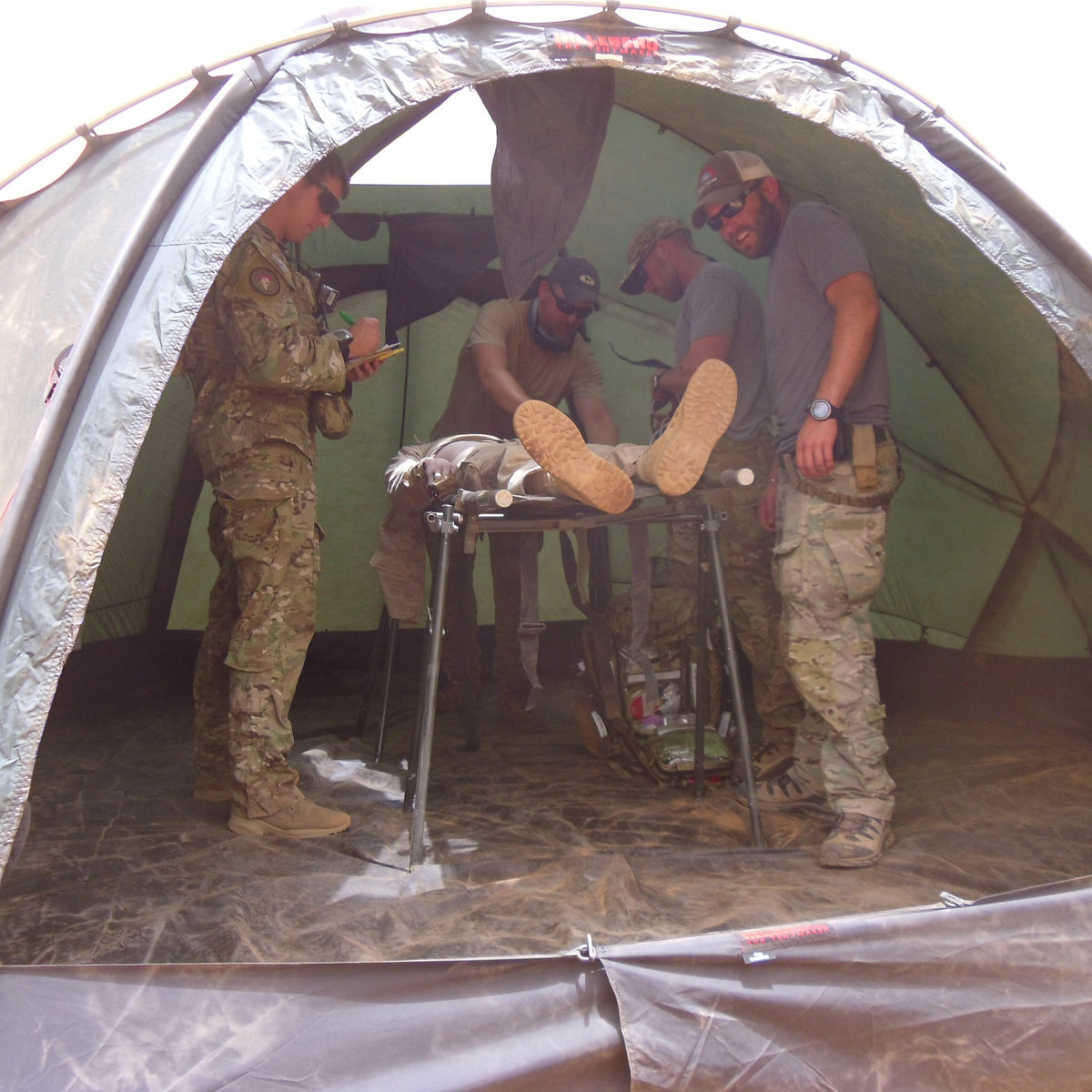
Why Trust Our Training
We teach what we've had to do when help wasn't coming quickly.
Our team learned trauma care in places where evacuation took time and the threat didn't stop. That experience shapes what we teach, how we run scenarios, and what we leave out.
We train your people to your standard, inside your protocols, and tell you plainly where they stand.
4Green Beret co-founders
40+Years combined Special Operations experience
25+Deployments
23+Law enforcement agencies served
Questions
What teams ask before they book.
Is this a certified TCCC or TECC course?
No. These are custom programs built on current TCCC and TECC guidelines and tailored to your team. They are not NAEMT courses and do not issue an NAEMT provider card. If your agency requires a specific certification, tell us when you reach out and we'll talk through options.
What's the difference between TCCC and TECC?
TCCC is the Department of Defense standard for battlefield trauma care. TECC adapts those lessons for civilian high-threat incidents and civilian responders. Both use three phases of care and the same priority order. Military units usually start from TCCC; civilian teams usually start from TECC.
Do our people need medical experience?
No. We build the program to your team's starting point — from people with no medical background to EMS clinicians. The skills and depth change with the audience.
Can we train with our own issued kits?
Yes, and we recommend it. Your people should practice with the gear they'll actually reach for. If we find gaps in your kits, we'll tell you.
Do you teach needle decompression and other advanced skills?
Only for teams whose scope of practice and medical direction allow it. We confirm scope with you during the assessment step before any advanced skill goes into a program.
Does this replace our protocols or our medical director?
No. We train inside your protocols and your medical director's guidance. We confirm scope of practice with you during the assessment, before any skill goes into the program.
Where does training take place?
At your facility, range, or training site.
Can we buy kits for the whole team at the same time?
Yes. Custom kits start at 15 units with a minimum 2-week lead time from approval. Request a quote and we'll help you match the kits to the training. A quote is a quote — no commitment until a PO is issued.
How do we get started?
Fill out the training request below. Tell us who you're training, how many people, and what they face. We'll follow up to start the assessment.
More Training
Building readiness beyond the tactical team?
Not everyone on your staff needs tactical casualty care. Most need the basics done well.
CPR, AED & First Aid
Private, on-site AHA Heartsaver® First Aid CPR AED sessions for organizations in Central Florida.
See CPR & First Aid Training →STOP THE BLEED®
Take the free online STOP THE BLEED® course or find a class near you. Hands-on STOP THE BLEED® certification is part of our Life Saver Seminar.
See Stop the Bleed Training →Life Saver Seminar
A full day. AHA Heartsaver® and STOP THE BLEED® certifications in the morning. Two hours of hands-on scenarios in the afternoon. Lunch and a trauma kit provided.
See the Life Saver Seminar →Start Here
Tell us who you're training and what they face.
Team size, mission, current gear, and training history. We'll use it to start your assessment and build a program around your mission, your scope, and your training hours.
Need kits for the team too? Equip Your Team →
Prefer to talk? Call (307) 202-8426. Government and agency inquiries: gov@vitacsolutions.com.