The $25 IFAK and the $200 IFAK look nearly identical hanging off a plate carrier. Same pouch shape. Same red cross patch. Both say they have a tourniquet.
One of them can stop arterial bleeding. The other one might not.
This isn't a debate about brand loyalty or budget-shaming. It's a breakdown of where price actually matters in a trauma kit and where it doesn't — sourced from CoTCCC research, documented failure data, and the perspective of people who've used this gear when a life was on the line.
The answer to "are expensive IFAKs worth it" isn't yes or no. It depends on which part of the kit you're asking about. The pouch: price matters less. The components inside it: price is a direct proxy for whether the gear will work under pressure. Read both parts before you make a decision.
First, understand what you're actually buying
An IFAK has two distinct parts that should be evaluated separately: the pouch — the bag, the attachment system, the organization layout — and the components — the tourniquet, hemostatic gauze, chest seal, and supporting gear inside it.
Most marketing confusion — and most bad purchasing decisions — happen because buyers treat these as a single product. They're not. A high-quality pouch with budget components is dangerous gear. A basic pouch loaded with CoTCCC-approved components is a legitimate trauma kit. Start with the components. Everything else is secondary.
Tourniquets: where cheap kills
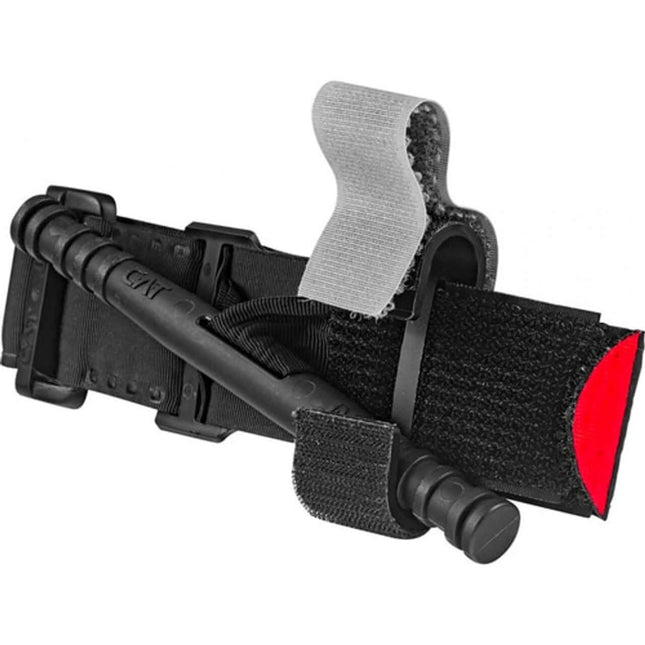
The counterfeit tourniquet market is one of the most documented and dangerous equipment problems in tactical medicine. Fraudulent CAT-style tourniquets — manufactured predominantly in China and widely available through budget kit assemblers — have failed in documented emergencies and are the subject of FDA warnings, Interpol Orange Notices, and multiple law enforcement safety bulletins.
The data is specific: in controlled testing, counterfeit CAT-style tourniquets generated less than 25% of the occlusion force of a genuine 7th-generation CAT tourniquet. Counterfeit units showed a 4% catastrophic breakage rate during application testing — the genuine Gen 7 CAT had zero breakage. In 2013, New Hampshire first responders experienced documented catastrophic failure of two counterfeit tourniquets at a motorcycle accident scene. The windlass rods on counterfeit units are known to bend under load, snap in the hand, or fail to lock — rendering the tourniquet useless at maximum pressure.
A genuine CAT Gen 7 from an authorized dealer costs $25–30. A genuine SOFTT-W runs $35–40. If a tourniquet in any kit implies it costs less than $15, it is almost certainly counterfeit or an untested knockoff. The price of a real tourniquet is publicly known. There is no legitimate way to sell one for $8.
How to verify a genuine CAT Gen 7: The windlass has deep ribbing and raised "CAT" lettering — not smooth or stenciled. The buckle is sonically welded to the strap, not sewn — look for fused material, not thread. It requires 2–3 windlass turns to achieve full occlusion; counterfeits can require 8–10 or never achieve it. Purchase from an authorized dealer, not Amazon marketplace third parties or bulk 3-packs.

Hemostatic gauze: the second non-negotiable
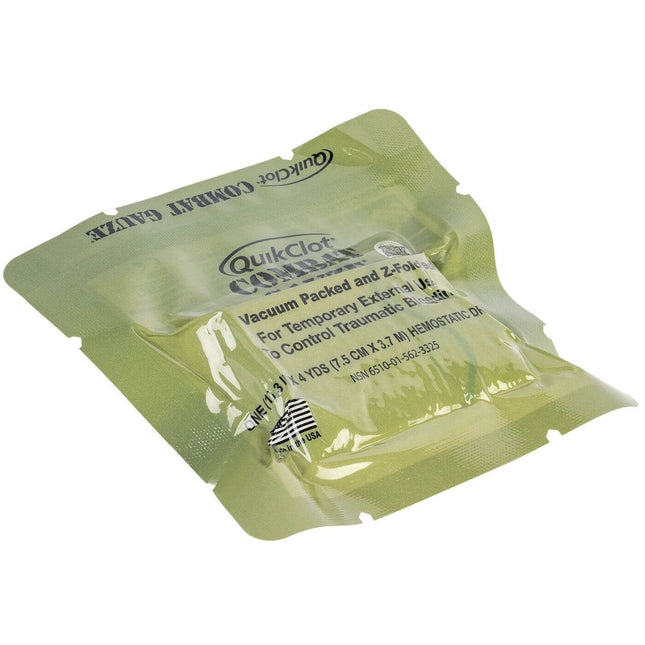
CoTCCC-recommended hemostatic gauze — QuikClot Combat Gauze (kaolin-impregnated), ChitoGauze, and Celox Gauze — has FDA clearance and documented clinical efficacy. Generic hemostatic gauze sold in budget kits often uses inferior hemostatic agents, thinner gauze material, and less effective packaging.
The hemostatic agent matters. Chitosan-based gauze (ChitoGauze) and kaolin-based gauze (QuikClot Combat Gauze) have documented superiority in clot formation speed and strength. Budget kits that include hemostatic gauze rarely disclose the active agent or the CoTCCC recommendation status. If a kit's description doesn't name the hemostatic agent or the CoTCCC recommendation, assume it isn't certified. See Hemostatic vs. Traditional Gauze for the full breakdown on why the active agent determines outcome.
Chest seals: vented or nothing
An unvented chest seal can accelerate tension pneumothorax — the leading preventable cause of death from penetrating chest wounds. Budget kits frequently include unvented (occlusive) chest seals because they're cheaper to produce. Legitimate trauma kits include vented chest seals: HyFin Vent, SAM Chest Seal, or equivalent. If a kit description doesn't specify "vented," it may include the wrong type for tactical use.
"The CAT is the one I generally recommend because it's the most popular. If someone finds a TQ anywhere, it will probably be a CAT, so I want everyone familiar with how to use one." — Brian McLaughlin, Director of Training, Mountain Man Medical. Consistency of brand matters in training and in field use. When you've practiced on a specific tourniquet, that's the one you want in your pouch.
The pouch: where you have more flexibility
Once your components are locked in — genuine tourniquet, CoTCCC-approved gauze, vented chest seals — the pouch decision has more room for trade-offs. What actually matters in a pouch: one-handed access; rip-away or pull-tab deployment; 500D or 1000D Cordura nylon with reinforced stitching and YKK zippers; interior organization with elastic loops or shock cord panels that keep items in a fixed, predictable location; and MOLLE/PALS-compatible mounting.
A $40 pouch with quality construction and clear organization is a better tool than a $120 pouch with a complex layout that slows access under stress. The pouch's job is to protect the components and get you to them in seconds. It doesn't need to cost $150 to do that.

Color options, hydration pockets, admin pouches, and bonus compartments. In a trauma scenario you need two things: the items you're reaching for, and the ability to reach them fast. Complexity works against you. An IFAK with 12 interior pockets is not a trauma kit — it's a first aid cabinet that happens to attach to a vest.
The high item count trap
Kits marketing 150-, 200-, or 300-piece counts are almost always padding their numbers with items that have no place in a trauma kit: alcohol wipes, antiseptic towelettes, cold packs, adhesive bandages, moleskin, and anti-itch cream. These items aren't worthless — they're useful in a separate general first aid kit. In an IFAK, they're noise. They create a search problem when you're reaching for a tourniquet under stress with shaking hands in low light. More doesn't mean better.
Cheap vs. quality IFAK: where the differences actually live
| Component | Budget Kit Risk | Quality Kit Standard |
|---|---|---|
| Tourniquet | Counterfeit or untested knockoff; generates <25% occlusion force; windlass breakage documented | CoTCCC-approved CAT Gen 7 or SOFTT-W; sonically welded; zero breakage rate in testing |
| Hemostatic gauze | Unspecified hemostatic agent; non-FDA-cleared; unknown efficacy under field conditions | QuikClot Combat Gauze, ChitoGauze, or Celox — CoTCCC-recommended, FDA-cleared, clinically validated |
| Chest seal | Often unvented (occlusive) — can accelerate tension pneumothorax | Vented chest seal (HyFin Vent, SAM) with one-way valve; pressure-tested adhesive |
| Pouch construction | Thin polyester, generic zippers, no rip-away, inconsistent interior layout | 500D–1000D Cordura nylon, YKK zippers, rip-away or pull-tab deployment, elastic loop interior |
| Item count | 150–300 items padded with non-trauma supplies; creates access confusion under stress | 15–25 focused trauma items; each item has a defined, accessible location |
Build your own vs. pre-built
There are two legitimate paths to a quality IFAK. Both can work. Neither involves buying a 200-piece kit off a marketplace.
A pre-built kit from a reputable supplier eliminates the sourcing burden — you know every item is verified, in-date, and assembled with a consistent layout. Sourcing components individually gives you full control over brand, configuration, and quantity. Buy your CAT directly from an authorized distributor. Authenticate every component. Keep receipts and documentation. Price each component against the known retail cost — if anything is significantly below market, it's likely counterfeit or expired.
If someone offers a complete IFAK for under $40 with a tourniquet, hemostatic gauze, and chest seals included — walk away. A genuine CAT alone costs $30. A single roll of QuikClot Combat Gauze costs $25+. A HyFin vent chest seal twin pack costs $20+. The math on a sub-$40 kit doesn't work unless the components are fake, expired, or substituted.
Four questions to answer before buying
- Does the kit list the specific tourniquet brand and model — CAT Gen 7, SOFTT-W, or equivalent CoTCCC-approved?
- Does the kit specify the hemostatic gauze type — QuikClot Combat Gauze, ChitoGauze, or Celox Gauze?
- Does the kit include vented (not just "occlusive") chest seals?
- Is the total kit price consistent with known component costs? If not, something has been substituted.
Answer yes to all four: the price of the overall kit is a secondary consideration. Can't answer all four: the kit isn't ready for real use regardless of cost.
FAQ
Is a $200+ IFAK always better than a $100 kit?
Not necessarily. A $100 kit with a genuine CAT, QuikClot Combat Gauze, and vented chest seals from an authorized dealer is more capable than a $250 kit with an unlabeled tourniquet and a high piece count. Evaluate component specifications, not the price tag.
Can I buy a RATS tourniquet instead of a CAT to save money?
No. The RATS tourniquet is not CoTCCC-recommended. The Committee on Tactical Combat Casualty Care does not include it on the approved list of limb tourniquets. The CAT and SOFTT-W are the field-proven standards. There is no approved budget substitution for a tourniquet.
How do I tell if my existing kit has a counterfeit tourniquet?
Check the windlass: a genuine Gen 7 CAT has deep ribbing and raised "CAT" lettering, and the buckle is sonically welded to the strap — not sewn. Genuine CATs require 2–3 windlass turns to achieve full occlusion. If the tourniquet cost less than $20, replace it.
What's the minimum budget for a complete, functional IFAK?
Sourcing individually from authorized dealers: CAT Gen 7 ($30), QuikClot Combat Gauze ($25), HyFin Vent Chest Seal Twin Pack ($20), nitrile gloves ($3), trauma shears ($8), Israeli pressure bandage ($10). Total components: approximately $96–110. Add a quality pouch for $30–50. A fully capable, CoTCCC-aligned IFAK runs $130–160.
Is it worth buying a high-end pouch if I'm on a budget?
Spend the budget on components first. A $30 pouch of decent nylon with a functional rip-away and interior loops is adequate. Put saved money toward a genuine tourniquet and name-brand hemostatic gauze. The pouch is a container. The tourniquet is a medical device.
The expensive IFAK isn't worth it because of the brand name or the item count. It's worth it when the money pays for verified, CoTCCC-approved components with documented field performance — a genuine tourniquet that generates full occlusion force, hemostatic gauze with a named active agent, and a vented chest seal that holds under patient movement.
The cheap IFAK isn't worth considering when it puts a counterfeit tourniquet in your kit — a device that generates less than a quarter of the force you need, with a documented history of catastrophic breakage. You'll carry it, feel prepared, and if you ever reach for it, you may find out it doesn't work when it needs to. Buy the right components from verified sources.