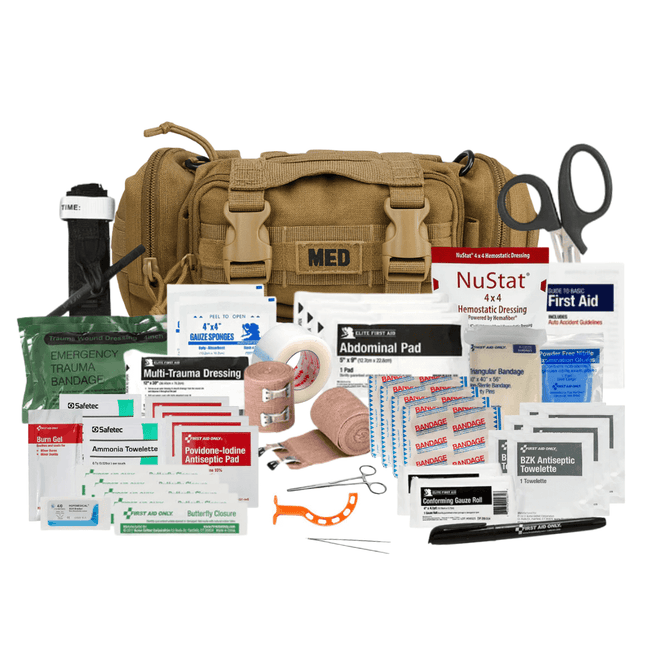
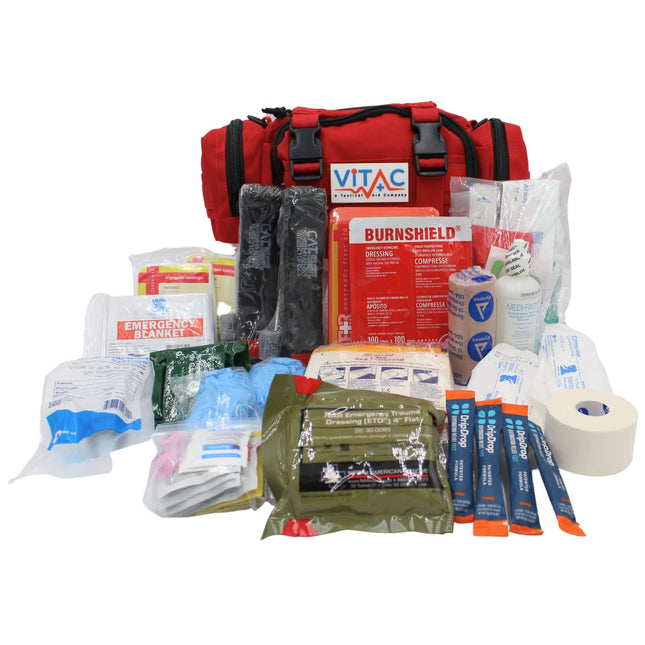
Custom emergency kits are essential for specific scenarios, such as tornadoes and vehicle accidents. This guide helps you select the right gear for your needs.
Sixty percent of Americans live within 50 miles of a major fault line, flood zone, or tornado corridor — yet most households stock one generic kit built for none of those environments specifically. That gap is a decision problem, not a budget problem. This guide maps kit requirements to scenario type so you build once, correctly.
How to Use This Guide
Each scenario below identifies the primary injury threat, the minimum kit requirements to address it, and the ViTAC product that meets those requirements. If your environment spans multiple scenarios, start with the highest-casualty risk and build from there.
FIELD NOTE: Every scenario in this table assumes you or someone nearby has completed Stop the Bleed or an equivalent hands-on trauma course. Gear without trained hands does not save lives.
Regardless of environment, field care follows the MARCH protocol — Massive hemorrhage, Airway, Respiration, Circulation, Hypothermia. The scenario determines which phase you are most likely to reach first and how long you hold that phase before EMS arrives.
Tornado debris fields and rural accident scenes average 20–30 minute EMS response times in most counties. Urban environments average 7–10 minutes — but active threat situations require moving the casualty before treating. Build your kit with that response window in mind.
Consumables That Cross Every Scenario
Three items perform across every column in the matrix above. Keep multiples of each regardless of your primary threat profile:
Nitrile gloves (size L minimum) — non-negotiable across all scenarios; single-use, replace annually
Start with Your Most Likely Scenario
The scenario you are most likely to face in the next 12 months is your starting point — not the worst-case you can imagine. If you live in tornado country, start with the storm row. If you commute 40,000 miles per year, start with the vehicle row. Worst-case-only planning produces overpacked kits that never get carried.
Build to your actual risk profile. Add from there.
In Stock
Domestic Shipping (USA - Lower 48 Only) Orders are processed within 24 hours and typically ship within 1–2 business days. Once shipped, delivery takes an estimated 3–7 days, with most orders arriving in just 5 days. Please Note: We currently do not ship to Alaska, Hawaii, or international destinations. Questions? Contact us anytime at support@vitacsolutions.com or call 307-202-8426.
In Stock
Domestic Shipping (USA - Lower 48 Only) Orders are processed within 24 hours and typically ship within 1–2 business days. Once shipped, delivery takes an estimated 3–7 days, with most orders arriving in just 5 days. Please Note: We currently do not ship to Alaska, Hawaii, or international destinations. Questions? Contact us anytime at support@vitacsolutions.com or call 307-202-8426.
In Stock
Domestic Shipping (USA - Lower 48 Only) Orders are processed within 24 hours and typically ship within 1–2 business days. Once shipped, delivery takes an estimated 3–7 days, with most orders arriving in just 5 days. Please Note: We currently do not ship to Alaska, Hawaii, or international destinations. Questions? Contact us anytime at support@vitacsolutions.com or call 307-202-8426.
In Stock
Domestic Shipping (USA - Lower 48 Only) Orders are processed within 24 hours and typically ship within 1–2 business days. Once shipped, delivery takes an estimated 3–7 days, with most orders arriving in just 5 days. Please Note: We currently do not ship to Alaska, Hawaii, or international destinations. Questions? Contact us anytime at support@vitacsolutions.com or call 307-202-8426.
What are you preparing for? On-duty response, family preparedness, outdoor adventure... Answer 5 quick questions and we'll match you with the right gear.
We've been downrange. We know what it costs to be unprepared. ViTAC was built by U.S. Army Special Operations veterans to make sure the people who run toward the threat — and the families who depend on them — have gear that works when everything is on the line.
— ViTAC Solutions Founders | 40+ years combined Special Operations experience
Most of our trauma kits and first aid supplies qualify for HSA and FSA reimbursement. Don't let your benefits expire — invest them in gear that could save a life.
Good quality products. The free items were also nice. Great med kit for alot of travel situations
Thank you for the 5-star review. We’re glad the med kit and added items delivered value and that it’s serving you well for travel. Stay prepared and safe out there.
The item was as promised. Everything in the kit was high-quality and I’m pleased with that. The only problem I have is I’m not sure it’s worth the cost. I found all of the contents individually for significantly less money. The only thing I didn’t find on my own was the pouch everything came in and that was a perfect fit so I would give it an A plus on quality, but a C on value.
Thank you for the honest feedback. We’re glad the kit quality and pouch met the mark. We understand your point on value, our pricing reflects not only the components, but careful sourcing, organization, and readiness in one dependable setup. We appreciate your support.