Trusted by Law Enforcement & Tactical Professionals
Law Enforcement Trauma Kits for Patrol and Tactical Roles
9 min reading time
Officers have 3–5 minutes before arterial hemorrhage becomes fatal. EMS averages 8+ in active-threat scenarios. Here is the MARCH-configured kit for every patrol role.
Twenty percent of preventable trauma deaths in the United States involve external hemorrhage that could be controlled before EMS arrival. That finding — established by the Hartford Consensus and reinforced by federal Stop the Bleed data — sets the operational baseline for every law enforcement agency issuing trauma kits. In active-threat scenarios, EMS response times routinely exceed eight minutes. The interval between injury and treatment belongs to the officer on scene.
Trauma Kit vs. First Aid Kit: The Operational Distinction
A standard first aid kit handles minor injuries: cuts, sprains, minor burns. A trauma kit handles survivable life threats. The two are not interchangeable. Trauma kits carry tourniquets for catastrophic limb hemorrhage, hemostatic gauze for junctional and deep wound packing, chest seals for penetrating thoracic injuries, and pressure dressings for controlled compression. A first aid kit does not.
Officers encountering shooting victims, vehicle trauma, or self-inflicted injury scenarios need the contents of a trauma kit — not a bandage roll. Point-of-injury care with a properly stocked IFAK addresses the injuries that kill before an ambulance arrives.
TCCC and TECC: The Clinical Basis for LE Trauma Protocols
Tactical Combat Casualty Care (TCCC) was developed by the U.S. military to address preventable battlefield deaths. Its civilian and law enforcement adaptation — Tactical Emergency Casualty Care (TECC) — applies the same three-phase framework to LE operations: Direct Threat Care, Indirect Threat Care, and Evacuation Care. Both prioritize massive hemorrhage control above all other interventions.
The MARCH protocol operationalizes TCCC and TECC priorities: Massive hemorrhage, Airway, Respiration, Circulation, Hypothermia. Trauma kits configured around MARCH address threats in the sequence that determines survival outcomes. Kits that are not MARCH-organized introduce delay at the worst possible moment.
Field Note: Train Before the Incident
Training is the force multiplier. A CAT tourniquet applied correctly in under 30 seconds requires repetition before the incident. TECC-adopting departments require officers to demonstrate one-handed application before fielding the kit — not after.
Kit Configurations for Patrol Officers
Vehicle-Mounted Kits for Immediate Access
A vehicle-mounted trauma kit provides the highest supply capacity for patrol. Larger kits — sufficient for multiple patients or extended care — belong in the vehicle, mounted where the officer can access them in a hasty dismount. The kit should follow MARCH organization, be inspected on the same schedule as the patrol vehicle, and have a designated compartment in the trunk or seat-back, not buried under other gear.
Organizational priority: hemorrhage control first, airway second. Everything else is secondary to the first four minutes of care. Specify durable outer shell construction, color-coded compartments by MARCH phase, and quick-release hardware.
Duty Belt IFAKs for Individual Readiness
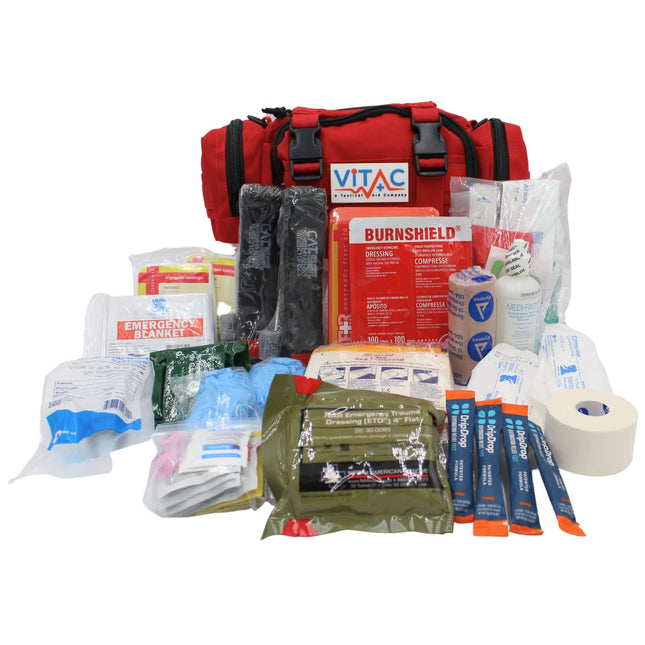
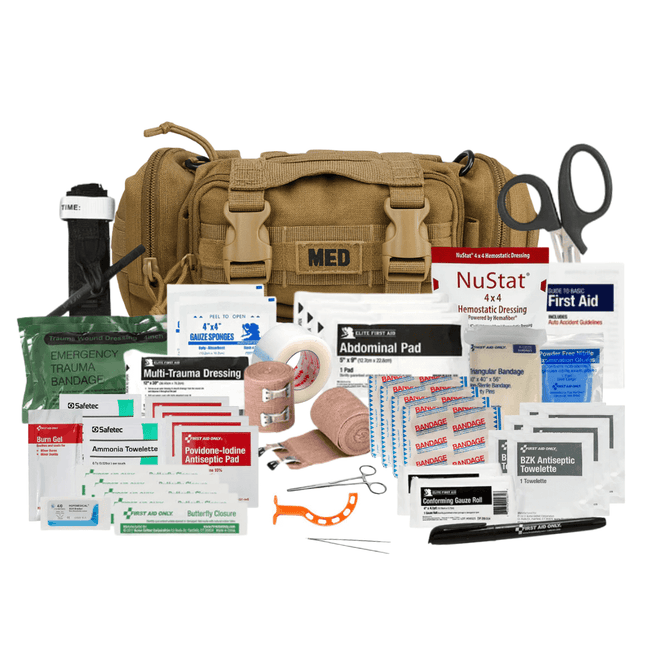
An Individual First Aid Kit on the duty belt or vest ensures an officer can initiate care when separated from the vehicle — the scenario most likely to produce a preventable death. The Trauma Kit – Patrol Pro w/CAT Tourniquet is configured for this role: compact enough for belt carry, fast enough for one-hand access, and stocked with CAT Gen 7 tourniquet, hemostatic gauze, and pressure dressing.
IFAKs on the body serve self-aid first. When an officer is the casualty, their kit must be reachable with the non-dominant hand. Carry position and access drills are not optional.
Field Note: Layered Readiness Is the Minimum Standard
Layered readiness — vehicle kit plus body-worn IFAK — is the minimum standard in TECC-trained departments. Neither substitutes for the other. A vehicle kit does not help an officer who is down 200 meters from the car.
Tactical and SRO Configurations
School Resource Officers
SROs operate in high-occupancy environments where a single incident can produce multiple casualties simultaneously. Standard patrol IFAKs are configured for individual care. SROs should carry a kit capable of treating at least two patients — additional tourniquets and gauze packs beyond the single-patient IFAK load.
The Enhanced IFAK – Pro Trauma Kit w/Tourniquet & Chest Seals adds vented chest seal capability to the base hemorrhage control configuration — relevant in school environments where penetrating trauma from rifle rounds requires immediate thoracic management before evacuation is possible.
Tactical Teams and Multi-Casualty Response
Backpack-platform trauma kits serve tactical teams operating in environments where casualties may be inaccessible to EMS for extended periods. These platforms carry supplies for three or more patients and include advanced airway adjuncts, splinting material, and hypothermia mitigation. Team kits are organized around MARCH and should be pre-assigned to a designated medical role within the element — not distributed across all members in a way that slows access under fire.
Component Standards: What to Verify in Any Kit
Tourniquets: One Standard, No Substitutes
The CAT GEN 7 | Combat Application Tourniquet is the current TCCC Committee-approved windlass tourniquet and the standard issued to U.S. military personnel. It is designed for one-handed self-application, features a stabilizing plate that prevents rod slip under arterial pressure, and has a documented failure rate near zero when applied correctly. Counterfeit CAT tourniquets circulate widely — purchase only from verified distributors. A failed tourniquet is worse than no tourniquet because it creates false confidence while hemorrhage continues.
Hemostatic Agents: Gauze, Not Granules
QuikClot Combat Gauze Z-Fold is the TCCC Committee-recommended hemostatic dressing and is impregnated with kaolin to accelerate clotting without the exothermic reaction associated with earlier hemostatic granule products. Z-fold format allows single-handed deployment from a pouch. Granule-based hemostatic agents are not recommended for wound packing in LE trauma kits. Wound packing with hemostatic gauze is the standard intervention for junctional hemorrhage — groin, axilla, and neck wounds where a tourniquet cannot be applied. See How QuikClot Gauze Stops Bleeding Fast for application protocol detail.
Chest Seals and Airway Management
Vented chest seals manage open pneumothorax by allowing air to exit the pleural space while preventing re-entry. They are required for any penetrating thoracic wound. The Premium IFAK Trauma Kit w/Tourniquet & Chest Seals includes vented chest seals alongside tourniquet and hemostatic components — a complete hemorrhage-plus-thoracic response in one package. Nasopharyngeal airways (NPAs) are appropriate in higher-tier kits where department training covers airway management for unconscious patients.
Counterfeit tourniquets fail under arterial pressure loads. Expired hemostatic gauze loses clotting efficacy. Every item in a trauma kit carries a manufacturer expiration date. Inspect kits on a documented quarterly schedule for active-duty kits. Any item deployed in training or in the field must be replaced before the kit returns to service. Restock with the same TCCC-approved brands — substituting for availability introduces untested variables at the worst possible time.
Training for Application Under Stress
Muscle memory for tourniquet application degrades without repetition. Departments training TECC quarterly see measurably shorter application times than those that train annually. For technique reference, Self-Aid and Buddy Aid covers application sequence for both self-aid and buddy-aid scenarios. Document training records — both for liability and to maintain the operational standard the kit is intended to support.
Field Note: The Kit Doesn't Perform the Intervention
Any agency adopting TECC-aligned kits should pair that decision with a matching training program. The kit does not perform the intervention — the officer does. Training is the variable that determines whether the equipment matters.
Frequently Asked Questions
What distinguishes a trauma kit from a standard first aid kit for law enforcement?
A standard first aid kit addresses minor injuries: cuts, sprains, and minor burns. A trauma kit is configured for life-threatening hemorrhage and penetrating injury. It carries windlass tourniquets, hemostatic gauze for wound packing, vented chest seals, and pressure dressings — items absent from a first aid kit and non-optional in LE trauma response.
Why do officers need a trauma kit if EMS is dispatched to the same call?
EMS response times in active-threat scenarios frequently exceed eight minutes. Arterial hemorrhage can be fatal in three. The officer on scene occupies the window that determines survival. Point-of-injury care with a properly stocked IFAK closes that gap.
What are the most critical items in a law enforcement IFAK?
A TCCC-aligned IFAK requires: a CAT GEN 7 or equivalent windlass tourniquet, hemostatic gauze (kaolin-impregnated, Z-fold format), vented chest seals (two), and a pressure dressing. These address catastrophic limb hemorrhage, junctional wounds, and open pneumothorax — the primary causes of preventable trauma death.
Bottom Line
A law enforcement trauma kit configured to TCCC and TECC standards addresses the three most common causes of preventable death at the point of injury: extremity hemorrhage, junctional bleeding, and tension pneumothorax. The kit does not replace training — but no amount of training substitutes for having the right components when seconds are the margin. ViTAC's Law Enforcement collection covers patrol IFAKs, vehicle kits, and component refills.
In Stock
Domestic Shipping (USA - Lower 48 Only) Orders are processed within 24 hours and typically ship within 1–2 business days. Once shipped, delivery takes an estimated 3–7 days, with most orders arriving in just 5 days. Please Note: We currently do not ship to Alaska, Hawaii, or international destinations. Questions? Contact us anytime at support@vitacsolutions.com or call 307-202-8426.
In Stock
Domestic Shipping (USA - Lower 48 Only) Orders are processed within 24 hours and typically ship within 1–2 business days. Once shipped, delivery takes an estimated 3–7 days, with most orders arriving in just 5 days. Please Note: We currently do not ship to Alaska, Hawaii, or international destinations. Questions? Contact us anytime at support@vitacsolutions.com or call 307-202-8426.
In Stock
Domestic Shipping (USA - Lower 48 Only) Orders are processed within 24 hours and typically ship within 1–2 business days. Once shipped, delivery takes an estimated 3–7 days, with most orders arriving in just 5 days. Please Note: We currently do not ship to Alaska, Hawaii, or international destinations. Questions? Contact us anytime at support@vitacsolutions.com or call 307-202-8426.
In Stock
Domestic Shipping (USA - Lower 48 Only) Orders are processed within 24 hours and typically ship within 1–2 business days. Once shipped, delivery takes an estimated 3–7 days, with most orders arriving in just 5 days. Please Note: We currently do not ship to Alaska, Hawaii, or international destinations. Questions? Contact us anytime at support@vitacsolutions.com or call 307-202-8426.
What are you preparing for? On-duty response, family preparedness, outdoor adventure... Answer 5 quick questions and we'll match you with the right gear.
Cold environments demand deliberate gear decisions. This guide covers the three-layer system — base, mid, and shell — from a preparedness standpoint: how each layer...
Identify Fake Gear: Ensuring Your Trauma Kits Meet TCCC Standards
Counterfeit CAT tourniquets fail under pressure. TCCC-standard gear has specific markings, materials, and testing — here's how to verify before your kit is tested for...
Uncontrolled bleeding is the leading cause of preventable trauma death. EMS averages 14 minutes nationally. A firearm stops the threat — only a trauma kit...
We've been downrange. We know what it costs to be unprepared. ViTAC was built by U.S. Army Special Operations veterans to make sure the people who run toward the threat — and the families who depend on them — have gear that works when everything is on the line.
— ViTAC Solutions Founders | 40+ years combined Special Operations experience
Most of our trauma kits and first aid supplies qualify for HSA and FSA reimbursement. Don't let your benefits expire — invest them in gear that could save a life.
The item was as promised. Everything in the kit was high-quality and I’m pleased with that. The only problem I have is I’m not sure it’s worth the cost. I found all of the contents individually for significantly less money. The only thing I didn’t find on my own was the pouch everything came in and that was a perfect fit so I would give it an A plus on quality, but a C on value.