Car First Aid Kit vs. Trauma Kit: The Critical Difference
10 min reading time
A car first aid kit manages minor injuries. A vehicle trauma kit prevents death in the minutes before EMS. They are not interchangeable — here's how to choose the right one.
A standard car first aid kit and a vehicle trauma kit are not interchangeable. One is designed for minor injuries. The other is designed to prevent death in the minutes before EMS arrives. Using the wrong kit in a life-threatening situation does not help the patient — it wastes time. Knowing which kit applies to which scenario is foundational preparedness.
Core Differences: Purpose, Contents, and Skill Requirements
Purpose and Scope
A standard first aid kit is calibrated for the high-frequency, low-severity injuries that occur in daily life: minor lacerations, abrasions, small burns, and common travel ailments. Professional medical help is typically nearby, and the kit's function is to manage the injury until the patient can reach a clinic or the minor wound resolves on its own.
A vehicle trauma kit is built for a different problem set entirely — the injuries that kill in the minutes before emergency services arrive. Severe arterial hemorrhage, penetrating chest wounds, and major fractures are not manageable with adhesive bandages and antiseptic wipes. The trauma kit's function is hemorrhage control and life-threat stabilization, buying time until definitive medical care is available.
Contents Comparison
Item Category
Car First Aid Kit
Vehicle Trauma Kit
Wound coverage
Adhesive bandages, sterile gauze, tape
Pressure dressings, wound packing gauze
Hemorrhage control
Basic gauze (insufficient for arterial bleed)
Tourniquet, hemostatic gauze
Chest trauma
Not addressed
Vented occlusive chest seals
Antiseptic/infection prevention
Antiseptic wipes, antibiotic ointment
Gloves, secondary wound dressings
Medications
Pain relievers, antihistamines, antacids
Not typically included
Airway management
Not addressed
Nasopharyngeal airway (NPA) in full kits
Skill Requirements
Standard first aid kit components require minimal training to apply correctly — most items are straightforward, and packaging instructions are adequate for routine wound care. Trauma kit components are different. A tourniquet applied too distal, cinched insufficiently, or placed over a joint does not stop hemorrhage. Wound packing performed without proper technique does not form the clot needed to control a junctional bleed. Chest seals must be applied over the correct wound to function. These are teachable skills that require hands-on practice, not intuitive improvisation under stress.
Field Note: Stabilization, Not Replacement of Care
The trauma kit's purpose is not to replace professional medical care — it is to stabilize a life-threatening situation during the interval between injury and EMS handoff. The goal is preventing the patient from dying in that window. Training transforms the supplies from theoretical capability into applied capability.
When Each Kit Applies
Reach for the First Aid Kit
Minor lacerations from broken glass or packaging, abrasions from falls, minor burns from hot engine components or cooking, insect stings, headache or motion sickness during travel — these are first aid kit scenarios. The patient is stable. The injury is painful but not life-threatening. Cleaning, covering, and transporting to further care is the appropriate response.
Reach for the Trauma Kit
Severe hemorrhage from a motor vehicle crash, penetrating wound from road debris or a tool, thoracic injury producing respiratory distress, major fracture with suspected internal bleeding — these are trauma kit scenarios. The patient's life is at risk in the current moment. Standard bandages will not address the rate or volume of blood loss involved. Immediate application of a tourniquet or hemostatic wound packing is required.
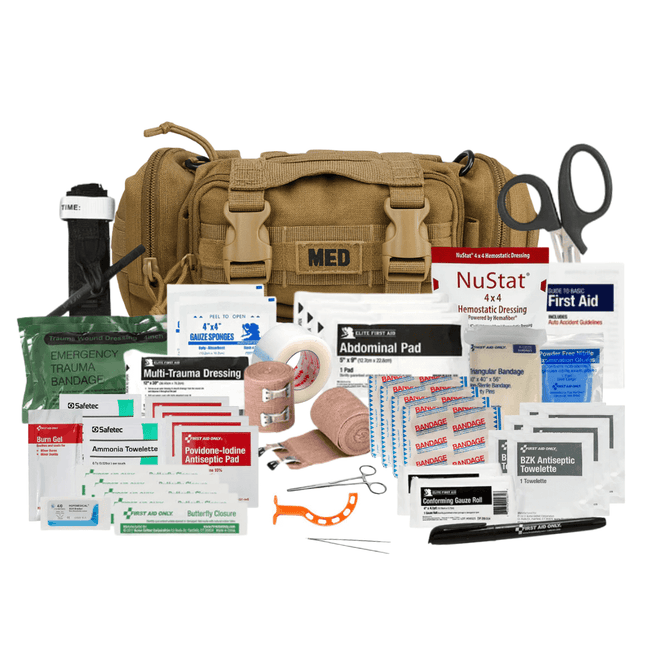
The Rip-Away Tactical Trauma Kit is configured for exactly these scenarios — tourniquet, hemostatic gauze, chest seals, pressure dressing, and airway tools staged in a vehicle-ready form factor.
Responding to Severe Bleeding
Arterial hemorrhage from a femoral or brachial vessel can cause fatal blood loss in under five minutes. A tourniquet applied proximal to the wound stops limb hemorrhage. For junctional wounds at the groin, axilla, or neck — where a tourniquet cannot be applied — hemostatic gauze packed tightly into the wound cavity with sustained pressure is the correct intervention. Both techniques are drawn from military battlefield medicine and are now standard in civilian trauma response.
Addressing Penetrating Chest Injuries
A penetrating chest wound creates a pathway for air to enter the pleural space. The resulting tension pneumothorax collapses the affected lung and, untreated, compresses the heart. Vented occlusive chest seals allow accumulated air to escape while preventing further entry, stopping progression to a fatal outcome. This is a trauma kit item. It is not in a standard first aid kit.
Choosing the Right Configuration for Your Vehicle
Assess Your Risk Profile
Kit selection should match actual exposure. Urban commuters with short routes and rapid EMS access have lower trauma risk than rural drivers, construction workers, or anyone operating in remote terrain. Carry equipment appropriate to the realistic worst-case scenario for your typical driving environment.
Driving Profile
Recommended Configuration
Rationale
Urban, short routes, EMS nearby
First aid kit
Minor injuries most likely; EMS response fast
Frequent highway or long-distance
First aid kit + trauma kit
Higher crash severity; longer EMS response windows
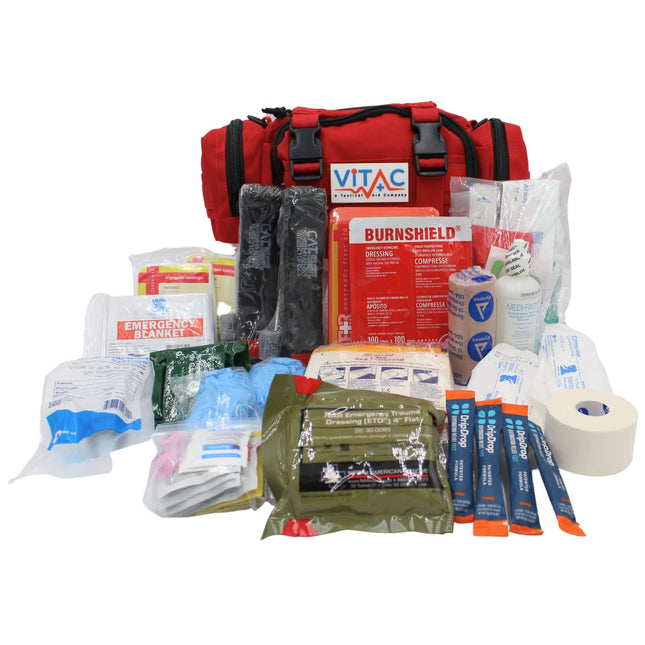
Hybrid configurations combine standard wound care components with core trauma items in a single package. For drivers who want one kit that covers both minor injuries and life-threatening emergencies without maintaining two separate kits, a hybrid configuration is the practical choice. The ViTAC Vehicle First Aid Kit covers general vehicle first aid. Pairing it with a Rip-Away Tactical Trauma Kit provides full-spectrum coverage from minor wound care through hemorrhage control.
Quality and Accessibility
Kit quality matters most when the kit is in use. Medical-grade, certified components — particularly tourniquets — perform consistently under the force and stress of real application. Consumer-grade alternatives may fail. Equally important is accessibility: a trauma kit staged in an accessible, known location can be retrieved in under 30 seconds. One buried in cargo or locked in a storage box cannot. Organize the kit so critical items — tourniquet and hemostatic gauze — are at the top or in a dedicated pocket.
Inspect all kit contents every three to six months. Check expiration dates on medications, sterile gauze, and hemostatic agents. Examine packaging integrity — torn or moisture-compromised sterile packaging invalidates the item. Vehicle interiors reach extreme temperatures in summer and winter; heat degrades medications and adhesives ahead of labeled expiration dates. Restock any used item immediately after each incident, regardless of quantity consumed.
Storage
Store kits away from direct sun and areas of extreme heat. A sealed, durable container provides protection against dust, moisture, and compression. Accessibility takes priority over concealment — a kit that cannot be found in 30 seconds under stress is a kit that will not be used effectively.
Training
Equipment without trained technique is incomplete preparedness. Complete a Stop the Bleed course to build hands-on proficiency with tourniquet application, wound packing, and direct pressure technique. Refresher training every two years maintains currency and rebuilds muscle memory that degrades without practice.
Field Note: You Default to Your Training
In an emergency, you will default to your training, not your intentions. A driver who has applied a tourniquet in a controlled training environment applies one correctly under stress. A driver who only read the instructions may not.
Frequently Asked Questions
What is the main difference between a car first aid kit and a vehicle trauma kit?
A first aid kit is designed for minor injuries — cuts, scrapes, and common travel ailments. A trauma kit is designed for life-threatening emergencies: severe hemorrhage, penetrating wounds, chest trauma, and major fractures. The kits are built for different scenarios and are not interchangeable.
Do I need a trauma kit if I already have a first aid kit?
Yes. A first aid kit does not contain the components required to control arterial hemorrhage or manage a penetrating chest wound. If you are involved in or respond to a serious crash, only a trauma kit carries the tools needed to act in the window before EMS arrives.
What injuries does a vehicle trauma kit address?
Severe limb hemorrhage, junctional bleeding (groin, axilla, neck), penetrating chest wounds, airway compromise, and major fractures. These are the injury categories where early intervention has the greatest impact on survival outcomes.
How do I determine which kit is right for my vehicle?
Base the decision on your realistic risk profile: driving environment, typical route length, proximity to emergency services, and occupant needs. Urban commuters with fast EMS access have lower trauma risk than rural or remote drivers. Higher risk exposure warrants a full trauma kit in addition to a standard first aid kit.
Do I need training to use a trauma kit?
Training is essential for trauma kit components. A tourniquet applied incorrectly does not stop hemorrhage. Wound packing without proper technique does not form an effective clot. The Stop the Bleed program teaches the core skills in a two-hour, hands-on course.
How often should I inspect my vehicle kits?
Inspect every three to six months. Check expiration dates on medications and sterile supplies, examine packaging integrity, and restock any items used since the last inspection. Perform an additional check after any use, regardless of the interval.
Bottom Line
A car first aid kit addresses the injuries that happen every day. A vehicle trauma kit addresses the injuries that kill before professional help arrives. The distinction is not academic — it is the difference between equipment that fits the problem and equipment that does not. Carry both. Train with the trauma kit. Inspect both on a regular schedule.
In Stock
Domestic Shipping (USA - Lower 48 Only) Orders are processed within 24 hours and typically ship within 1–2 business days. Once shipped, delivery takes an estimated 3–7 days, with most orders arriving in just 5 days. Please Note: We currently do not ship to Alaska, Hawaii, or international destinations. Questions? Contact us anytime at support@vitacsolutions.com or call 307-202-8426.
In Stock
Domestic Shipping (USA - Lower 48 Only) Orders are processed within 24 hours and typically ship within 1–2 business days. Once shipped, delivery takes an estimated 3–7 days, with most orders arriving in just 5 days. Please Note: We currently do not ship to Alaska, Hawaii, or international destinations. Questions? Contact us anytime at support@vitacsolutions.com or call 307-202-8426.
In Stock
Domestic Shipping (USA - Lower 48 Only) Orders are processed within 24 hours and typically ship within 1–2 business days. Once shipped, delivery takes an estimated 3–7 days, with most orders arriving in just 5 days. Please Note: We currently do not ship to Alaska, Hawaii, or international destinations. Questions? Contact us anytime at support@vitacsolutions.com or call 307-202-8426.
In Stock
Domestic Shipping (USA - Lower 48 Only) Orders are processed within 24 hours and typically ship within 1–2 business days. Once shipped, delivery takes an estimated 3–7 days, with most orders arriving in just 5 days. Please Note: We currently do not ship to Alaska, Hawaii, or international destinations. Questions? Contact us anytime at support@vitacsolutions.com or call 307-202-8426.
What are you preparing for? On-duty response, family preparedness, outdoor adventure... Answer 5 quick questions and we'll match you with the right gear.
We've been downrange. We know what it costs to be unprepared. ViTAC was built by U.S. Army Special Operations veterans to make sure the people who run toward the threat — and the families who depend on them — have gear that works when everything is on the line.
— ViTAC Solutions Founders | 40+ years combined Special Operations experience
Most of our trauma kits and first aid supplies qualify for HSA and FSA reimbursement. Don't let your benefits expire — invest them in gear that could save a life.
Good quality products. The free items were also nice. Great med kit for alot of travel situations
Thank you for the 5-star review. We’re glad the med kit and added items delivered value and that it’s serving you well for travel. Stay prepared and safe out there.
The item was as promised. Everything in the kit was high-quality and I’m pleased with that. The only problem I have is I’m not sure it’s worth the cost. I found all of the contents individually for significantly less money. The only thing I didn’t find on my own was the pouch everything came in and that was a perfect fit so I would give it an A plus on quality, but a C on value.
Thank you for the honest feedback. We’re glad the kit quality and pouch met the mark. We understand your point on value, our pricing reflects not only the components, but careful sourcing, organization, and readiness in one dependable setup. We appreciate your support.