What is the difference between a CAT tourniquet and a SOFTT-W?
Both the C-A-T® Gen 7 and the SOFTT-W are military-standard windlass tourniquets trusted by U.S. military and law enforcement. The CAT is slightly wider and features a red tip for one-handed application — it's the most commonly issued tourniquet in the world. The SOFTT-W uses a tri-ring buckle and is preferred by some operators for its lower profile when worn. Either is an excellent choice. Avoid any tourniquet not from an authenticated manufacturer — counterfeit windlass mechanisms fail under the torque required to stop arterial bleeding.
Is QuikClot hemostatic gauze safe for civilians to use?
Yes. QuikClot® Combat Gauze uses a kaolin clay-based clotting agent — the same mechanism your body uses naturally, accelerated. It is non-toxic, does not generate significant heat, and is safe for use in any severe wound packing scenario. It does not require special training to apply — though Stop the Bleed training is strongly recommended so you can apply it effectively under stress.
How long can a tourniquet safely stay on before causing permanent damage?
Current military and civilian trauma guidance supports tourniquet application for up to two hours without permanent nerve or muscle damage in most cases. Beyond two hours, the risk of compartment syndrome and permanent injury increases. This is why documenting time-of-application (with a marker, on the patient's skin) is a critical step. Never remove a tourniquet in the field once applied — that decision belongs to a medical professional.
What is the difference between a vented and non-vented chest seal?
Vented chest seals (like the HyFin® Vented) have a one-way valve that allows air to escape from the chest cavity but prevents air from entering. This prevents tension pneumothorax — a condition where air accumulates in the chest and compresses the heart and lungs. Non-vented seals simply close the wound. Current TCCC protocol strongly recommends vented chest seals. ViTAC carries HyFin® Vented — the military standard.
Do I need training to use a bleeding control kit?
You don't need formal medical training to apply a tourniquet or pressure dressing — but you do need to practice before the moment of crisis. A tourniquet you've never touched is far less effective than one you've applied twenty times in training. ViTAC strongly recommends a Stop the Bleed class or our own
Life Saver Seminar. Pair your kit purchase with hands-on practice.
How do I know if the CAT tourniquet in a kit is authentic?
Authentic C-A-T® Gen 7 tourniquets are manufactured by North American Rescue under license from Combat Medical Systems. When purchased from ViTAC, authenticity is guaranteed — we source directly from North American Rescue and authorized distributors. If you buy from generic marketplaces, verify the product page shows NAR as the brand — not a generic reseller listing.
When should I buy a complete kit vs. individual supplies?
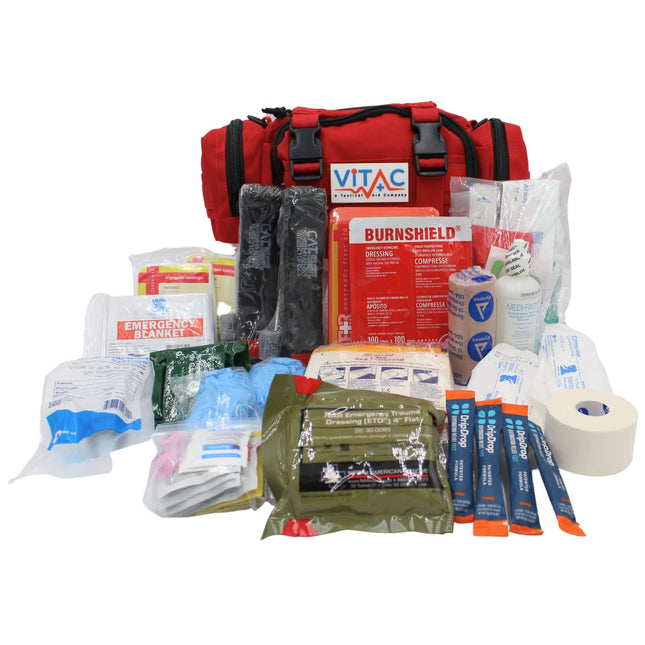
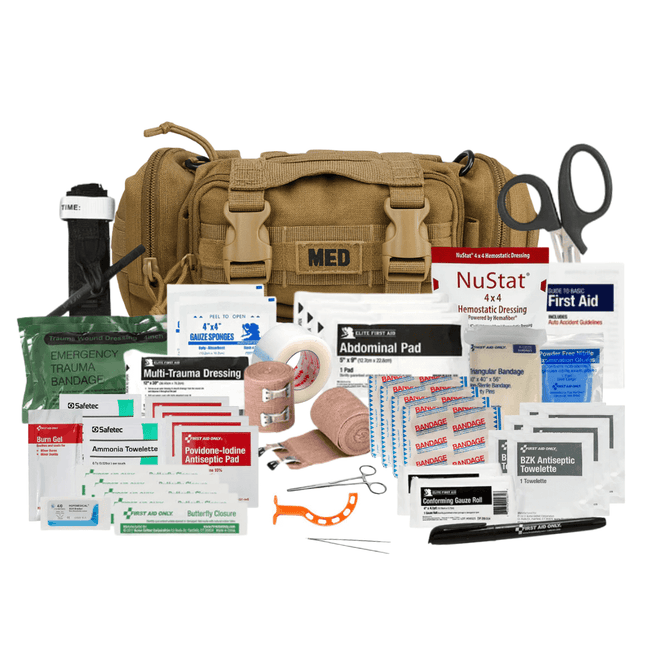
Buy a complete kit if you're starting from zero, equipping a new location, or buying for someone else. Kits are pre-organized — you don't have to research component compatibility or worry about missing a critical item. Buy individual supplies when restocking expired components, upgrading specific items, or building a custom IFAK around a pouch you already own.
Are bleeding control kits and supplies HSA/FSA eligible?
Yes — most ViTAC trauma kits, IFAKs, and individual supplies including tourniquets, hemostatic gauze, and pressure dressings are HSA/FSA eligible. You can pay at checkout with your HSA/FSA card directly. Some plans may require a Letter of Medical Necessity for certain items — ViTAC provides itemized receipts upon request. See the
HSA/FSA Eligibility Guide for details.
How often should I replace kit components?
Check expiration dates on hemostatic gauze, gloves, and dressings — most have a 3–5 year shelf life from manufacture. Tourniquets and shears don't expire but should be inspected annually for UV degradation, strap integrity, and windlass function. Establish a twice-yearly inspection routine. ViTAC stocks all major refill components individually so you can restock specific items without replacing the whole kit.
Can I use a tourniquet on a child?
Yes — tourniquet application is appropriate for children with severe extremity bleeding, though technique must account for smaller limb diameter. A SWAT-T tourniquet is often recommended for pediatric applications because its stretch-wrap design conforms better to irregular shapes. The CAT® is still usable on children over approximately 5–6 years old with proper technique.
What's the difference between a Stop the Bleed kit and a trauma kit (IFAK)?
A Stop the Bleed kit covers core hemorrhage control — a tourniquet, hemostatic gauze, and a pressure dressing. A trauma kit (IFAK) is more comprehensive and may also include chest seals, an NPA airway, needle decompression, a SAM splint, burn care, and additional wound care items. If your priority is hemorrhage control only and kit size is a constraint, a dedicated Stop the Bleed kit works. For full-spectrum trauma capability, choose an IFAK.
Does ViTAC offer bulk or institutional orders for bleeding control supplies?
Yes. ViTAC supplies law enforcement agencies, school districts, corporate safety programs, faith-based security teams, and government entities with bulk trauma supplies. Minimum order for custom kits is 15 units. We accept purchase orders and Net 30 terms for qualifying agencies. Submit an
RFQ here — no commitment until a PO is issued.