Uncontrolled bleeding is the leading cause of preventable death after traumatic injury, according to DHS Stop the Bleed. A severed artery in an arm or leg can drain enough blood to kill in three to five minutes. That's faster than most people can dial 911, explain the situation, and get an address out. A tourniquet is the tool that buys the time EMS needs to arrive.
This isn't a device reserved for medics and soldiers. It's a piece of equipment any adult can learn to use correctly in under ten minutes of practice. The gap between "having one" and "using one right" is what this guide covers.
What a tourniquet actually does
A tourniquet is a constricting band applied above a wound on an arm or leg. It compresses the tissue enough to shut off arterial blood flow below the point of application. That's the entire mechanism: mechanical pressure, applied circumferentially, tight enough to stop flow rather than just slow it.
Direct pressure and pressure dressings work for venous bleeding and most cuts. They don't reliably stop arterial bleeding, where blood is under enough pressure to spurt with each heartbeat. When pressure alone isn't controlling the bleed, a tourniquet is the next step, not the last resort.
CAT vs. SOF-T: the two designs worth knowing
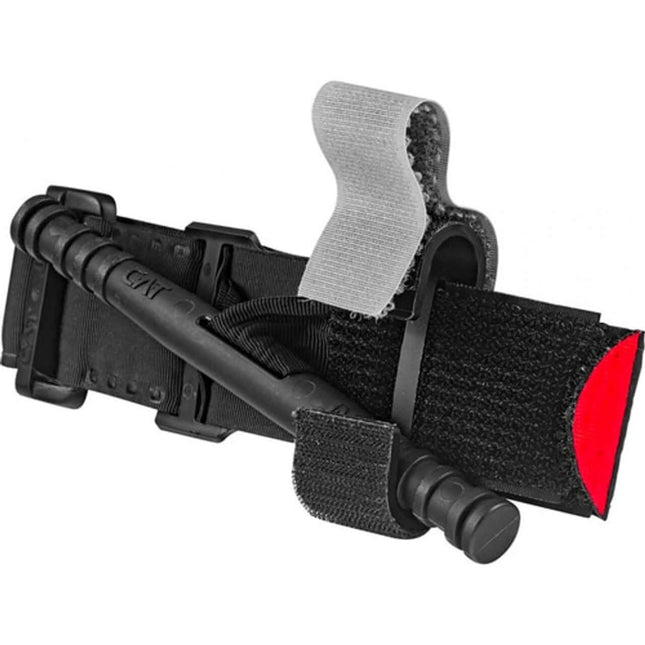
Nearly every credible commercial tourniquet on the market today is a windlass design: a rod that you rotate to tighten a strap until bleeding stops, then lock in place. Two names dominate this category.
The CAT (Combat Application Tourniquet) is built for one-handed self-application under stress, which is why it's the standard issue across U.S. military branches. The SOF-T (Special Operations Forces Tactical Tourniquet) uses a similar windlass mechanism with a different buckle and locking system, favored by some tactical and EMS units for its grip under wet or gloved conditions. Both are windlass tourniquets. Neither is a "better" tool in the abstract — they're different mechanical solutions to the same problem, and either one, applied correctly, works.
Elastic or Velcro-only bands without a windlass mechanism can't generate enough circumferential pressure to fully occlude arterial flow in most adults. If a tourniquet doesn't have a rigid tightening mechanism, it's not reliable for arterial bleeding control. Verify that before you buy, not after you need it.
When to apply a tourniquet
Apply a tourniquet immediately when any of these are true:
- Bleeding is bright red, spurting, or pulsing — signs of arterial involvement
- Direct pressure for 60+ seconds hasn't controlled the bleeding
- The wound is on a limb and severe enough that you can't maintain pressure while also getting help or moving the person
- You're dealing with a mass casualty situation and can't stay with one patient
Tourniquets are for limb injuries only — arms and legs. They don't work on the neck, torso, or junctional wounds (groin, armpit), which require different techniques like wound packing.
You can remove a tourniquet under medical supervision. You can't undo blood loss.TCCC Guidelines
How to apply a tourniquet
The application sequence is nearly identical across CAT and SOF-T models:
- Place the tourniquet 2-3 inches above the wound, high and tight, avoiding the joint
- Pull the strap through the buckle and cinch it as tight as it will go by hand
- Twist the windlass rod until the bleeding stops completely — this will hurt, and that's the sign it's working
- Lock the windlass into the clip or holder built into the device
- Secure the windlass with the strap or tape provided
- Write the time of application on the tourniquet itself, or on the patient's forehead if nothing else is available
- Do not loosen or remove it until trained medical personnel take over
Tourniquet application is one piece of a larger framework. Every trauma response should follow MARCH — Massive hemorrhage, Airway, Respiration, Circulation, Hypothermia — in that order. Massive hemorrhage control, including tourniquet application, comes first because it's the fastest-killing problem on the list.
Common myths that get people killed
| Myth | Reality |
|---|---|
| Tourniquets are a last resort | For arterial bleeding, they're first-line. Waiting to try other methods first costs time you don't have. |
| Tourniquets always cause amputation | Limbs tolerate a properly applied tourniquet for up to two hours with minimal permanent damage risk. Delayed bleeding control is far more dangerous than tourniquet time. |
| You need medical training to use one | Application takes minutes to learn. Stop the Bleed courses teach civilians with no medical background to apply one correctly in a single session. |
Who needs one in their kit
If you're responsible for other people at any point in your week — coworkers, family, a range group, a congregation — you should have a tourniquet within reach, not buried in a bag. That means vehicle kits, range bags, workplace trauma stations, and everyday carry setups. Our full breakdown of what belongs in a build-out is in this IFAK buying guide.
FAQ
How tight should a tourniquet be?
Tight enough that bleeding stops completely and a distal pulse is no longer palpable. Partial tightening that only slows bleeding doesn't count and needs to be tightened further immediately.
Can I use a belt as a tourniquet?
Only as a last resort with nothing else available. Belts lack a windlass mechanism and rarely generate enough pressure to fully stop arterial bleeding. A purpose-built tourniquet in your kit removes the guesswork.
How long can a tourniquet stay on?
Up to two hours is generally considered safe with minimal risk of permanent tissue damage, per TCCC guidelines. The goal is always to get the patient to definitive care well before that window closes.
Bottom line
A tourniquet stops arterial bleeding in a limb by mechanical compression, full stop. Apply it high and tight, twist until the bleeding stops, lock it, note the time, and don't touch it again until EMS or a higher level of care takes over. Practice the motion now, while it doesn't matter, so it's automatic when it does.
Shop verified, combat-proven tourniquets in the ViTAC Tourniquets collection.