Trusted by Law Enforcement & Tactical Professionals
The Best Vehicle Trauma Kit for Families, Road Trips, and Long Drives
9 min reading time
Find the best vehicle trauma kit for road trips. Compare top kits for families, long drives, and emergencies. Stay prepared on the go.
Motor vehicle crashes are the leading cause of injury death for Americans ages 1–54. Families spend more consecutive hours in a vehicle than in almost any other environment, often hundreds of miles from the nearest trauma center. The kit in your vehicle is the only medical resource available between the moment of injury and EMS arrival. Selecting the right configuration — and understanding what that means for a family versus a solo driver — is the decision this guide addresses.
What a Family Vehicle Kit Must Cover
The Minor-Injury Category
Families with children generate a higher frequency of minor injury events: abrasions from outdoor activity, small lacerations, insect stings, minor burns, motion sickness, and common travel ailments. A family kit must have sufficient supply depth in the standard wound care category — more bandage variety, more antiseptic wipes, over-the-counter medications, and pediatric-appropriate supplies — than a solo driver's kit requires.
The Trauma Category
Minor-injury frequency does not reduce major-injury risk. A high-speed crash produces the same injury profile whether a family of five or a single driver is involved. Arterial hemorrhage, penetrating chest trauma, and major fracture with internal bleeding are the injury categories that kill before EMS arrives — and they are the categories a standard first aid kit cannot address. A family vehicle kit that lacks a tourniquet, hemostatic gauze, and chest seals is not a complete kit. It is a well-stocked minor-injury kit with a gap in the part that matters most.
Field Note: Cover Both Categories, Not Just the Common One
The common mistake in family kit selection is optimizing for what happens most often (minor injuries) and not for what kills most quickly (uncontrolled hemorrhage). Both categories require coverage. A two-kit approach — a general first aid kit for daily use and a trauma kit staged for emergencies — addresses both without compromise.
Selection Criteria: What Actually Matters
Trauma-Capable Components
Any vehicle kit covering highway or remote driving must include, at minimum: a windlass tourniquet, hemostatic gauze, a pressure dressing, and vented occlusive chest seals. These are not optional upgrades — they are the tools that address the leading causes of preventable death at roadside incidents. The absence of any one of them is a gap in coverage for a scenario that is statistically likely across the lifetime of a vehicle that covers significant mileage.
Organization Under Stress
A kit that requires searching under stress is a kit that will not perform in the window it is needed. Clearly labeled compartments, color-coded sections for trauma versus routine care, and trauma items staged at the top or in a dedicated external pocket reduce retrieval time. Test any kit you are considering by reaching for the tourniquet with your non-dominant hand in under five seconds. If you cannot, the organization does not meet the use case.
Durability and Packaging
Vehicle kits are exposed to heat, humidity, and physical stress from road vibration and shifting loads. Rigid or semi-rigid containers protect sterile packaging better than soft bags in high-vibration environments. Sealed individual packaging on sterile items — gauze, chest seals, NPAs — is the benchmark. Flimsy packaging compromised by heat cycling or compression is a contamination risk.
Refill Access
A kit with proprietary components that cannot be individually restocked requires full replacement when consumed. Choose kits whose components — tourniquets, hemostatic gauze, chest seals — are available individually. This matters most for trauma components, which are the most expensive to replace and the most important to keep current.
Configuration by Trip Profile
Trip Profile
Recommended Configuration
EMS Backup
Urban commute, short routes
Comprehensive first aid kit + staged tourniquet
Fast (7–8 min avg)
Highway family travel
First aid kit + full trauma kit
Variable (10–20+ min)
Rural or remote driving
Full trauma kit + extended first aid supplies
Slow (18–30+ min)
Long-distance road trip with family
Full trauma kit + comprehensive first aid kit
Variable by region
Off-road or backcountry
Full trauma kit + wilderness extras + sat communicator
Very slow or unavailable
ViTAC Kit Recommendations
For Families and General Road Readiness
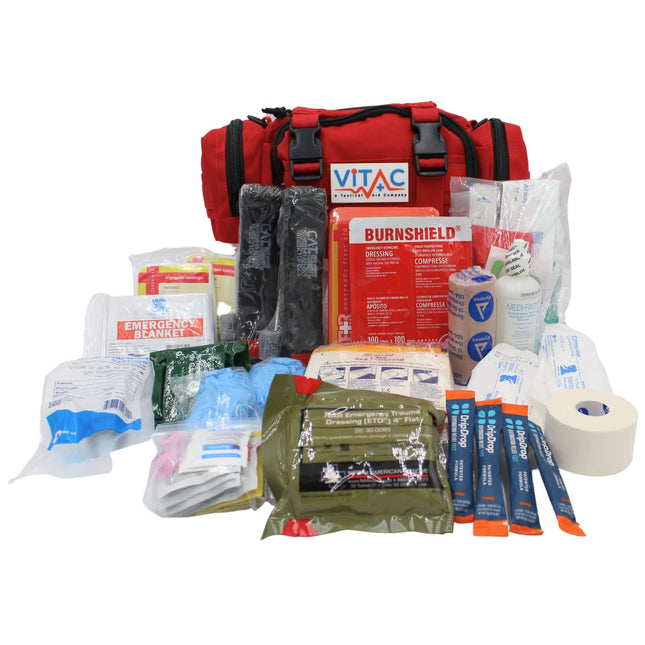
The ViTAC 104-Piece Soft-Sided Vehicle Kit is built for vehicle storage and covers the routine wound care category: a broad range of bandages, antiseptic supplies, gauze, tape, gloves, and over-the-counter medications in a compact, soft-sided case that fits under a front seat or in a door pocket. It addresses the high-frequency, lower-severity injuries that families generate on the road and serves as the general first aid layer for a two-kit configuration.
For Trauma Capability
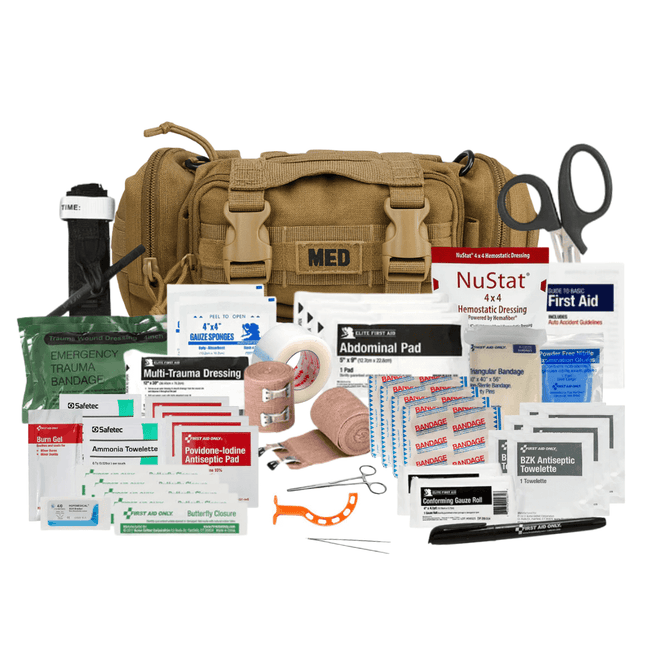
The Rip-Away Tactical Trauma Kit provides full trauma capability in a vehicle-optimized form factor: tourniquet, hemostatic gauze, chest seals, pressure dressing, and airway management tools in a rip-away carrier designed for seatback MOLLE mount or center console staging. For highway travel, remote routes, and any driving where EMS response exceeds 10 minutes, this is the trauma layer that pairs with the general first aid kit.
For Expanded General Coverage
The General Purpose First Aid Kit Pro scales up from the 104-piece kit for larger families, multi-day trips, or drivers who prefer a single comprehensive kit with expanded supply depth across both wound care and basic trauma components.
Browse the full Vehicle-Ready Kit collection to find the configuration that fits your family size, trip profile, and vehicle type.
Training for Family Preparedness
A trauma kit accessible to multiple family members is only as useful as the number of people who can deploy it correctly. The adult passengers most likely to respond in a crash scenario are the ones who should complete training. The Stop the Bleed program provides a two-hour, hands-on course covering direct pressure, wound packing, and tourniquet application — the three skills that address the leading causes of preventable trauma death. Courses are available in all 50 states with no prerequisites. For families who travel significant distances, completing this training before the next road trip is a direct investment in the capability the kit provides.
Maintenance for Road Trip Readiness
A family vehicle kit requires more frequent restocking than a solo driver's kit because children consume general first aid supplies at a higher rate. Inspect contents every three months and immediately after any use. Check expiration dates on medications, sterile gauze, and hemostatic agents. Confirm that tourniquet webbing is intact and windlass function is unimpaired. Vehicle heat degrades supplies over time — store the kit in the center console or under a seat rather than the trunk or on the dashboard. For a detailed breakdown of heat-related kit degradation and inspection protocols, see How Vehicle Heat Damages First Aid Supplies and What to Inspect.
Frequently Asked Questions
What makes a vehicle trauma kit suitable for family road trips?
A family road trip kit must cover two categories: routine wound care for the minor injuries children generate, and trauma capability — tourniquet, hemostatic gauze, chest seals — for the high-energy crashes that require intervention before EMS arrives. A kit that covers only one category is incomplete for family travel.
How often should a family vehicle kit be checked?
Inspect every three months and immediately after any use. Families with children consume routine supplies faster than solo drivers — a quarterly check ensures the kit is adequately stocked. Check expiration dates on medications and sterile items at each inspection.
Can family members other than the driver use a trauma kit?
Yes — and they should. In a crash where the driver is the patient, another occupant must be able to locate and deploy the kit. Stage it accessibly, train at least one additional passenger, and ensure the kit is labeled clearly enough for an untrained adult to identify critical items quickly.
What is the difference between a basic first aid kit and a trauma kit for road trips?
A basic first aid kit covers minor wounds, medications, and everyday injuries. A trauma kit is built for life-threatening emergencies: arterial hemorrhage, penetrating wounds, and airway compromise. The two kits address different injury profiles and are not interchangeable.
Do I need training to use a vehicle trauma kit?
Training is essential for trauma components. A tourniquet applied incorrectly does not stop hemorrhage. Complete a Stop the Bleed course before relying on trauma kit components under stress.
How should a vehicle trauma kit be stored for long road trips?
Stage the trauma kit in the center console or on a seatback MOLLE pouch — accessible from the driver or front passenger position without searching. Avoid trunk storage for the primary kit. Use a sealed container and avoid direct sun exposure to protect contents from heat degradation over long drives.
Bottom Line
The best vehicle trauma kit for a family road trip is not the most expensive kit on the market — it is the one that covers both the wound care category for the injuries that happen frequently and the trauma category for the injuries that kill quickly. For most families traveling highway and mixed-terrain routes, that means a comprehensive first aid kit paired with a dedicated trauma kit staged in an accessible location in the cabin.
Configure for your actual trip profile. Train at least one adult passenger on trauma kit components. Inspect the kit before departure. Browse the Vehicle-Ready Kit collection to find the right configuration for your family and mission.
In Stock
Domestic Shipping (USA - Lower 48 Only) Orders are processed within 24 hours and typically ship within 1–2 business days. Once shipped, delivery takes an estimated 3–7 days, with most orders arriving in just 5 days. Please Note: We currently do not ship to Alaska, Hawaii, or international destinations. Questions? Contact us anytime at support@vitacsolutions.com or call 307-202-8426.
In Stock
Domestic Shipping (USA - Lower 48 Only) Orders are processed within 24 hours and typically ship within 1–2 business days. Once shipped, delivery takes an estimated 3–7 days, with most orders arriving in just 5 days. Please Note: We currently do not ship to Alaska, Hawaii, or international destinations. Questions? Contact us anytime at support@vitacsolutions.com or call 307-202-8426.
In Stock
Domestic Shipping (USA - Lower 48 Only) Orders are processed within 24 hours and typically ship within 1–2 business days. Once shipped, delivery takes an estimated 3–7 days, with most orders arriving in just 5 days. Please Note: We currently do not ship to Alaska, Hawaii, or international destinations. Questions? Contact us anytime at support@vitacsolutions.com or call 307-202-8426.
In Stock
Domestic Shipping (USA - Lower 48 Only) Orders are processed within 24 hours and typically ship within 1–2 business days. Once shipped, delivery takes an estimated 3–7 days, with most orders arriving in just 5 days. Please Note: We currently do not ship to Alaska, Hawaii, or international destinations. Questions? Contact us anytime at support@vitacsolutions.com or call 307-202-8426.
What are you preparing for? On-duty response, family preparedness, outdoor adventure... Answer 5 quick questions and we'll match you with the right gear.
Cold environments demand deliberate gear decisions. This guide covers the three-layer system — base, mid, and shell — from a preparedness standpoint: how each layer...
Identify Fake Gear: Ensuring Your Trauma Kits Meet TCCC Standards
Counterfeit CAT tourniquets fail under pressure. TCCC-standard gear has specific markings, materials, and testing — here's how to verify before your kit is tested for...
Uncontrolled bleeding is the leading cause of preventable trauma death. EMS averages 14 minutes nationally. A firearm stops the threat — only a trauma kit...
We've been downrange. We know what it costs to be unprepared. ViTAC was built by U.S. Army Special Operations veterans to make sure the people who run toward the threat — and the families who depend on them — have gear that works when everything is on the line.
— ViTAC Solutions Founders | 40+ years combined Special Operations experience
Most of our trauma kits and first aid supplies qualify for HSA and FSA reimbursement. Don't let your benefits expire — invest them in gear that could save a life.
The item was as promised. Everything in the kit was high-quality and I’m pleased with that. The only problem I have is I’m not sure it’s worth the cost. I found all of the contents individually for significantly less money. The only thing I didn’t find on my own was the pouch everything came in and that was a perfect fit so I would give it an A plus on quality, but a C on value.