Trusted by Law Enforcement & Tactical Professionals
Hunting First Aid Kit: Field Trauma and Self-Aid Essentials
8 min reading time
Build a comprehensive hunting first aid kit for field trauma & remote wounds. Essential components, advanced trauma care, and customization tips.
Hemorrhage is the leading preventable cause of trauma death in field settings. In the backcountry, where EMS response times routinely exceed 60 minutes, the contents of your kit — and your ability to use them — are the only intervention between injury onset and evacuation.
This guide builds a hunting first aid kit from MARCH priorities outward: Massive hemorrhage control first, then Airway, Respiration, Circulation, and Hypothermia. The same framework used by TCCC-trained combat medics applies in the field.
Hemorrhage Control — The Non-Negotiable Tier
Stop the bleed before anything else. A hunter with an uncontrolled arterial bleed will not survive the time it takes for a remote EMS response. These items are non-negotiable:
CAT Gen 7 Windlass Tourniquet — TCCC-approved, military-issue limb tourniquet. Carry at minimum one; ideally two. Must be practiced to apply correctly one-handed under stress.
QuikClot Combat Gauze — Kaolin-impregnated hemostatic gauze for junctional wounds where a tourniquet cannot be applied. Pack firmly into the wound channel with sustained direct pressure.
Pressure Bandage (Israeli-style) — Maintains sustained pressure after wound packing and frees hands for further care or self-rescue.
Field Note: Document Tourniquet Time — It Transfers with the Patient
Per TCCC protocol, tourniquet application time must be written on the tourniquet or marked on the patient's skin. Note the time — it is critical information for the receiving trauma team.
Chest and Airway
Penetrating chest wounds are a real-world hunting scenario — tree stand falls, accidental discharges, and processing game with sharp implements all carry puncture wound risk. A sucking chest wound allows air into the pleural space, collapsing the lung. Seal it immediately.
Vented Chest Seals (×2) — Apply to both entry and exit wounds if present. Vented seals allow air to escape the pleural space while preventing re-entry. If only non-vented seals are available, monitor for tension pneumothorax and burp the seal as needed.
Nasopharyngeal Airway (NPA) — For an unresponsive or semi-conscious patient with airway compromise. Lubricate and insert through the right nostril. Contraindicated with suspected skull base fracture.
Wound Care and Infection Prevention
Field wounds — lacerations from falls, knife cuts, animal contact — require systematic cleaning before any closure or coverage attempt.
Irrigation syringe (20–35cc) with saline or clean water — High-pressure irrigation removes debris that antiseptic wipes cannot address in deep wounds. Standard recommendation: 150–500cc of fluid at 8 psi minimum.
Sterile gauze pads (multiple sizes) and medical tape — For wound coverage after irrigation. Do not close contaminated field wounds; cover and protect only.
Antiseptic wipes or povidone-iodine — Surface-level disinfection around wound margins.
Nitrile gloves ×2 pairs — Wear before any wound contact. Protects both patient and provider from cross-contamination.
Trauma shears — Cut through clothing to access a wound without repositioning a potentially fractured limb.
Fractures and Mobility
Falls from tree stands, broken terrain, and heavy pack weight all generate fracture and sprain risk. Immobilization is the immediate field priority.
SAM Splint — Moldable aluminum core, foam padding. Splint the joint above and below the injury. Immobilize in the position found unless distal circulation is compromised.
Elastic bandages (×2) — Secure SAM splints, wrap sprains, provide support during evacuation.
Padding material — Spare clothing or foam wrap to prevent pressure sores during extended evacuation holds.
Hypothermia Management
Hemorrhagic shock and hypothermia are mutually reinforcing — a cold, bleeding patient dies faster than a normothermic one. Hartford Consensus and TCCC protocols both include hypothermia prevention as part of primary trauma treatment.
Mylar emergency blanket or SOF tactical blanket — Retain core body heat after hemorrhage or injury during extended wait for extraction. Wrap the whole body; heat loss is whole-body.
Waterproof shell layer — Wind and moisture accelerate heat loss exponentially. Cover the patient if weather is a factor.
Medications and Hydration
Ibuprofen and acetaminophen — Pain management during extended evacuation. NSAIDs also reduce inflammation in soft-tissue injuries.
Antihistamines — Allergic reactions to stings and plant contact are common field events.
Personal prescriptions — Do not assume you will be back in range for a scheduled dose.
Water purification tablets or filter — Clean water is required for wound irrigation and hydration. Do not rely on carried supply alone for multi-day trips.
Electrolyte packets — Hemorrhage and sustained exertion both deplete electrolytes. Oral rehydration supports recovery during field holds.
Customizing to Your Hunt Profile
Scenario
Priority Additions
Steep / rocky terrain
SAM splint, extra elastic bandages, ankle support
Remote multi-day backcountry
Larger wound care quantities, extra tourniquets, broad-spectrum oral antibiotic if prescribed
Cold weather / high elevation
Mylar blanket, chemical hand warmers, extra insulation layer
Suspension trauma risk: prioritize chest and torso trauma components; full-suspension protocol training recommended
Field Note: Communication Device Is Part of the Kit
A personal locator beacon (PLB) or satellite messenger is not a medical supply, but it belongs in every backcountry kit. Your ability to call for extraction determines how long your field supplies need to hold.
Kit Organization
Organize by MARCH priority, not by body system or item type. The first thing your hand reaches for under stress should be the tourniquet. Life-threat items at the top or in the outermost pocket; support items buried deeper. Label each compartment. Run the kit dry in a practice session before the season opens.
ViTAC Kits for the Backcountry Hunter
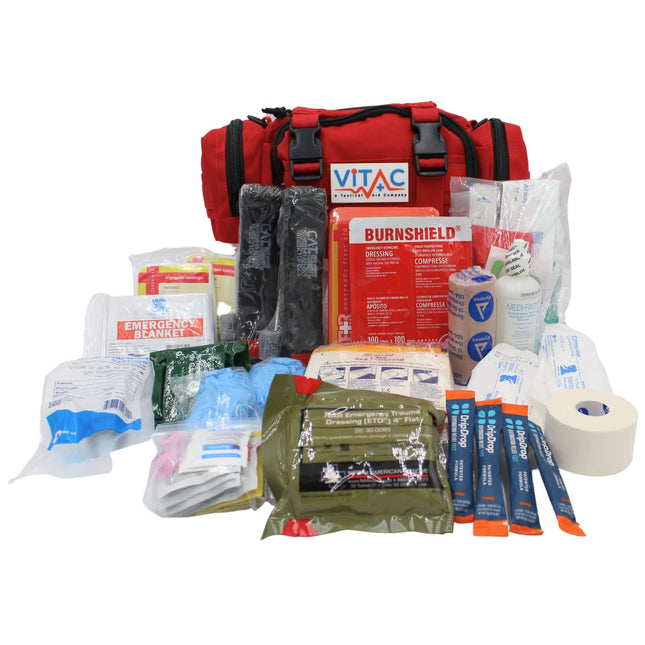
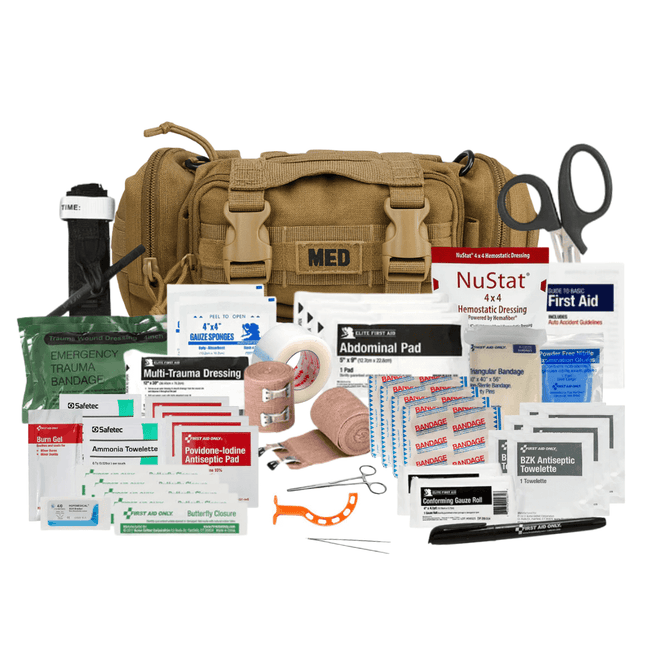
Pre-built kits sized for the field reduce the margin for missed components. ViTAC's hunting-relevant options:
What are the most important items in a hunting first aid kit?
Hemorrhage control comes first: a TCCC-approved tourniquet (CAT Gen 7 or SOFTT-W), hemostatic gauze for junctional wounds, and a pressure bandage. Vented chest seals for penetrating torso injuries are the next tier. Everything else supports those priorities.
Why do I need a dedicated kit when hunting?
EMS response to remote hunting terrain routinely exceeds one hour. A standard first aid kit is not built for arterial bleeds, penetrating chest wounds, or fracture stabilization during extended evacuation holds. The kit bridges the gap between injury onset and definitive care.
How do I organize a hunting first aid kit?
Organize by treatment priority. Tourniquet and chest seals in the outermost or top compartment. Wound irrigation and dressings next. Medications and support items last. Practice opening the kit one-handed under time pressure before the first trip of the season.
Is buying a pre-built kit enough, or do I need to customize?
A quality pre-built kit covers the baseline. Customize based on your personal health needs, specific terrain, and group size. Audit the kit before each season to confirm nothing is expired or missing.
How often should I restock and check the kit?
After every trip. Replace anything used. Verify expiration dates on medications and sterile supplies before each season. A kit with expired or missing components is not a functional kit.
What if I have existing injuries or medical conditions?
Account for them explicitly. Bad knee: carry a SAM splint and elastic bandages. Severe allergy: carry a prescription EpiPen, not just antihistamines. Any known cardiac or respiratory condition: ensure prescriptions are current and inform your hunting partner of your kit location before heading out.
Bottom Line
A hunting first aid kit is not a consumer first aid box with a few extra bandages. It is a MARCH-sequenced trauma kit sized for remote, high-energy injury in a setting where professional medical care is at minimum 60 minutes away. Build it that way, store it accessibly, and train on the components before the season opens.
In Stock
Domestic Shipping (USA - Lower 48 Only) Orders are processed within 24 hours and typically ship within 1–2 business days. Once shipped, delivery takes an estimated 3–7 days, with most orders arriving in just 5 days. Please Note: We currently do not ship to Alaska, Hawaii, or international destinations. Questions? Contact us anytime at support@vitacsolutions.com or call 307-202-8426.
In Stock
Domestic Shipping (USA - Lower 48 Only) Orders are processed within 24 hours and typically ship within 1–2 business days. Once shipped, delivery takes an estimated 3–7 days, with most orders arriving in just 5 days. Please Note: We currently do not ship to Alaska, Hawaii, or international destinations. Questions? Contact us anytime at support@vitacsolutions.com or call 307-202-8426.
In Stock
Domestic Shipping (USA - Lower 48 Only) Orders are processed within 24 hours and typically ship within 1–2 business days. Once shipped, delivery takes an estimated 3–7 days, with most orders arriving in just 5 days. Please Note: We currently do not ship to Alaska, Hawaii, or international destinations. Questions? Contact us anytime at support@vitacsolutions.com or call 307-202-8426.
In Stock
Domestic Shipping (USA - Lower 48 Only) Orders are processed within 24 hours and typically ship within 1–2 business days. Once shipped, delivery takes an estimated 3–7 days, with most orders arriving in just 5 days. Please Note: We currently do not ship to Alaska, Hawaii, or international destinations. Questions? Contact us anytime at support@vitacsolutions.com or call 307-202-8426.
What are you preparing for? On-duty response, family preparedness, outdoor adventure... Answer 5 quick questions and we'll match you with the right gear.
Cold environments demand deliberate gear decisions. This guide covers the three-layer system — base, mid, and shell — from a preparedness standpoint: how each layer...
Identify Fake Gear: Ensuring Your Trauma Kits Meet TCCC Standards
Counterfeit CAT tourniquets fail under pressure. TCCC-standard gear has specific markings, materials, and testing — here's how to verify before your kit is tested for...
Uncontrolled bleeding is the leading cause of preventable trauma death. EMS averages 14 minutes nationally. A firearm stops the threat — only a trauma kit...
We've been downrange. We know what it costs to be unprepared. ViTAC was built by U.S. Army Special Operations veterans to make sure the people who run toward the threat — and the families who depend on them — have gear that works when everything is on the line.
— ViTAC Solutions Founders | 40+ years combined Special Operations experience
Most of our trauma kits and first aid supplies qualify for HSA and FSA reimbursement. Don't let your benefits expire — invest them in gear that could save a life.
The item was as promised. Everything in the kit was high-quality and I’m pleased with that. The only problem I have is I’m not sure it’s worth the cost. I found all of the contents individually for significantly less money. The only thing I didn’t find on my own was the pouch everything came in and that was a perfect fit so I would give it an A plus on quality, but a C on value.