Together we help you assess risk, plan improvements, train your team, and stage life-saving tools—so you can act decisively in the first minutes before help arrives.
Security + medical response training and exercises
Equip
Staged, labeled tools and sustainment checks
Prefer a phased rollout? We can scope your project with outcomes and documentation that supports common safety funding and sponsorship pathways.
Church Security Training
CPR/AED + Bleeding Control
Placement Maps
Sustainment Checklists
Bulk/Quote Support
Funding-friendly options
Start with clarity. Scale with funding.
We begin with an initial assessment and phased roadmap. We then package the assessment, training/exercises recommendations, and medical readiness options into a clear, outcomes‑based project with a phased approach.
Church security is more than doors and cameras—it’s a trained team with a plan. And when an emergency occurs, the first 3–5 minutes are on you: threat mitigation, site security, medical response, and calm coordination until help arrives.
Protect His House
Church security training—recruiting, equipping, and developing safety teams with clear roles, practical skills, and repeatable drills.
ViTAC Solutions
Emergency medical readiness—CPR/AED, bleeding control, first aid basics, equipment staging, and sustainment.
Start now. Scale later. Keep it fundable.
Choose the level that fits your timeline. Each package can be scoped as planning, training/exercises, and equipment with a phased rollout.
Package A —
Readiness Starter (Planning + Documentation)
Best for: Teams that need clarity, leadership structure, and a fundable plan before purchasing equipment.
Recruit & organize church security team roles and coverage
On‑site/virtual readiness gap review (security + medical readiness)
Role & response map (911, AED/bleed kit retrieval, EMS meet point, youth/children protocols)
Placement map recommendations (zones for AED, bleeding control, first aid/trauma)
Many churches and nonprofits pursue state/local safety funding, preparedness budgets, and community sponsorships to support assessments, training/exercises, and life-safety equipment.
We can help you package your project with clear outcomes, scope, and phased pricing—so you can pursue available pathways with confidence.
What we can help with:
Clarify what belongs in planning, training/exercises, and equipment
Build a phased plan that starts with readiness wins and scales over time
Provide a project packet that makes approval and budgeting easier
A readiness gap review is a practical snapshot of what you have, what’s missing, and what to fix first. We look at: security team structure and coverage, communications and role clarity, incident response flow (including who meets EMS), AED availability and access, bleeding control and first aid kit placement, high-traffic and youth/children areas, building layout considerations (entries/exits), and basic sustainment (inspection/refill cadence). You’ll receive a prioritized findings report with quick wins plus a phased rollout map.
2. How do we build (or improve) a church security team?
We help you establish (or refine) the fundamentals: leadership structure, defined roles, coverage schedules, and repeatable drills. That includes clear responsibilities (e.g., comms lead, medical response lead, children’s-area coverage, EMS meet point), standard radio/phone protocols, and practical training that focuses on calm actions, communication, and confidence under pressure. The goal is a team you can run every week—not a plan that only works on paper.
3. Can we phase this over time?
Yes—phasing is built into the program:
Phase I (Assess & Report): baseline review + findings + phased rollout map (can stand alone)
Phase II (Deepen & Plan): threat-informed vulnerability work, risk register, mitigation plan, training plan
Phase III (Train & Execute): training, SOPs, equipment staging, and sustainment system
You can start with clarity and quick wins, then scale as budget or approvals allow.
4. Can you help us prepare documentation for common safety funding pathways?
Yes. Without tying you to any specific program, we can package your work into a clear, outcomes-based project: assessment summary, prioritized needs, phased scope, itemized equipment plan (if applicable), training/exercise plan, and measurable outcomes (trained responders, staged tools, inspection cadence).
This makes it easier to pursue local/state safety funding, preparedness budgets, or community sponsorships—and to justify a phased rollout to leadership.
5. Who should be trained and how long does it take?
Train by role:
Security/Safety Team: security operations plus bleeding control and basic first aid response roles
Staff/Key Volunteers:CPR/AED and emergency response basics
Greeters/Ushers/Children’s Teams: awareness + basic first aid response and how to activate the plan
Timing depends on format, but most trainings can be scheduled as half-day or full-day blocks, with refreshers and short drills layered in monthly/quarterly so skills stay sharp.
6. Where should bleeding control kits be staged?
Stage bleeding control kits where they’re most likely to be needed and easiest to access: main gathering areas (sanctuary/auditorium), lobby/commons, children/youth areas, and near exterior access points where incidents could occur before someone enters.
Kits should be wall-mounted or in predictable, labeled locations, paired with simple instructions, and integrated into your response roles (who grabs it, who applies it, who calls 911).
In Stock
Domestic Shipping (USA - Lower 48 Only) Orders are processed within 24 hours and typically ship within 1–2 business days. Once shipped, delivery takes an estimated 3–7 days, with most orders arriving in just 5 days. Please Note: We currently do not ship to Alaska, Hawaii, or international destinations. Questions? Contact us anytime at support@vitacsolutions.com or call 307-202-8426.
In Stock
Domestic Shipping (USA - Lower 48 Only) Orders are processed within 24 hours and typically ship within 1–2 business days. Once shipped, delivery takes an estimated 3–7 days, with most orders arriving in just 5 days. Please Note: We currently do not ship to Alaska, Hawaii, or international destinations. Questions? Contact us anytime at support@vitacsolutions.com or call 307-202-8426.
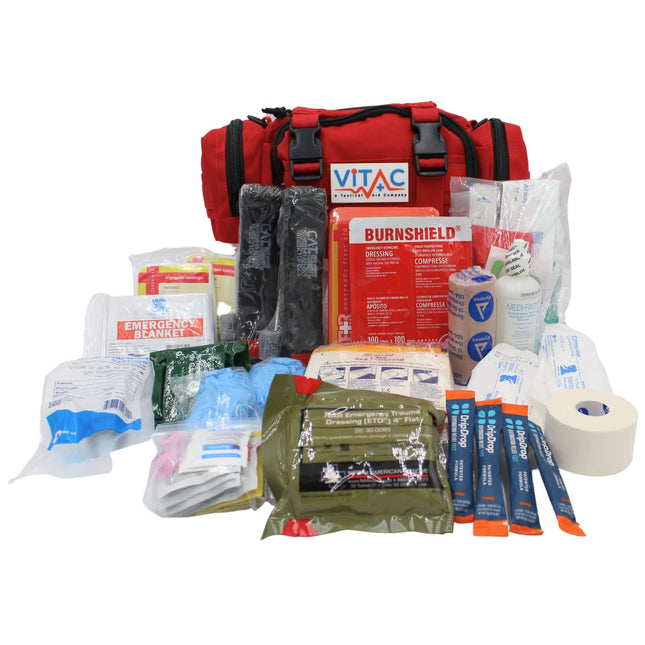
The item was as promised. Everything in the kit was high-quality and I’m pleased with that. The only problem I have is I’m not sure it’s worth the cost. I found all of the contents individually for significantly less money. The only thing I didn’t find on my own was the pouch everything came in and that was a perfect fit so I would give it an A plus on quality, but a C on value.


![[PHH] General Purpose First Aid Kit – Med Kit Pro with rip-away design and MOLLE straps for convenient tactical use.](//vitacsolutions.com/cdn/shop/files/GP_PRO_IFAK_w_PHH_Patch-1.png?v=1763422935&width=645)

![[PHH] Tactical Trauma Kit w/Rip-Away Feature in black with MOLLE straps and protective label.](//vitacsolutions.com/cdn/shop/files/Tactical_Trauma_Kit_w_PHH_Patch-1.png?v=1763422960&width=645)
![[PHH] Tactical Trauma Kit w/Rip-Away Feature fully stocked with essential first aid supplies for emergencies.](//vitacsolutions.com/cdn/shop/files/Tactical_Trauma_Kit_w_PHH_Patch-3.png?v=1763422965&width=645)




![[PHH] General Purpose First Aid Kit – Med Kit Pro with rip-away design and MOLLE straps for convenient tactical use.](http://vitacsolutions.com/cdn/shop/files/GP_PRO_IFAK_w_PHH_Patch-1.png?v=1763422935&width=645)

![[PHH] Tactical Trauma Kit w/Rip-Away Feature in black with MOLLE straps and protective label.](http://vitacsolutions.com/cdn/shop/files/Tactical_Trauma_Kit_w_PHH_Patch-1.png?v=1763422960&width=645)
![[PHH] Tactical Trauma Kit w/Rip-Away Feature fully stocked with essential first aid supplies for emergencies.](http://vitacsolutions.com/cdn/shop/files/Tactical_Trauma_Kit_w_PHH_Patch-3.png?v=1763422965&width=645)


