
Not sure which kit is right for your mission?
What are you preparing for? On-duty response, family preparedness, outdoor adventure... Answer 5 quick questions and we'll match you with the right gear.
Every range has a Range Safety Officer. Not every range has the gear to stop a catastrophic bleed. ViTAC Range-Ready kits are built around windlass tourniquets, hemostatic gauze, vented chest seals, and pressure dressings — the same capabilities carried downrange by U.S. Special Forces, organized for deployment under stress.
Penetrating gunshot wounds are not like any other trauma. They demand immediate hemorrhage control — a windlass tourniquet applied in the first 60 seconds, deep wound packing with hemostatic gauze, and an occlusive chest seal if the wound is thoracic. Standard first aid kits aren't built for this. ViTAC Range-Ready kits are.
Every kit in this collection includes at minimum a windlass tourniquet, hemostatic gauze, a pressure dressing, and vented chest seals. Professional configurations add airway adjuncts and decompression needles. All are organized for one-motion access when stress degrades fine motor skills — because fumbling kills.
Whether you're staging a hard-case kit at a range bay, carrying a compact IFAK in your range bag, or outfitting a training facility with multiple stations, this collection has the right configuration.



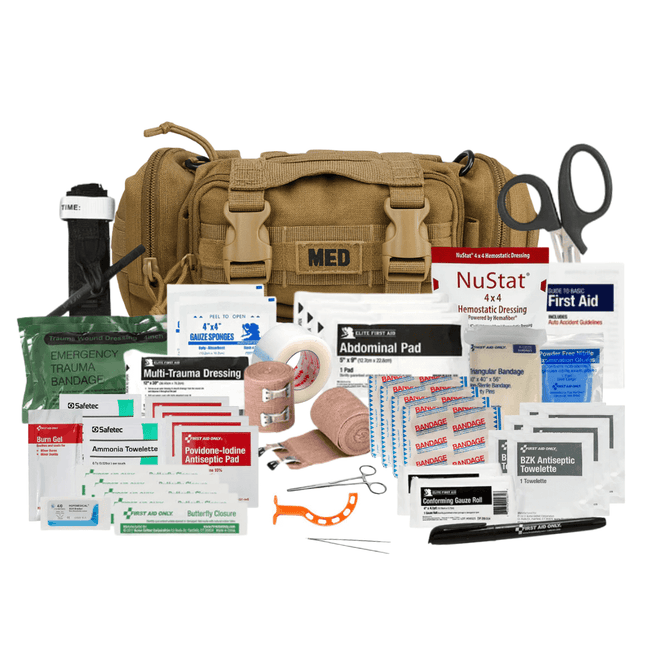

Keep essential trauma tools organized and ready so you can respond faster, stay calmer, and act with more confidence when serious injuries happen.
$124.95 - $224.73


A trauma backpack built to keep advanced bleeding-control and airway tools organized so you can respond faster and with more confidence in high-stress emergencies.
$269.97 - $319.97


Keep your core first aid and bleeding-control tools organized in one compact kit so you can respond faster and with more confidence at the range, in the vehicle, outdoors, or at home.
$139.95 - $169.95


The TORK® – Advanced delivers elite-level trauma response in a compact, field-ready design—trusted by operators who refuse to compromise on readiness.
$219.19 - $227.99


The M-FAK Mini First Aid Kit delivers maximum trauma capability in minimum space—proven tools, rapid access, and zero compromise when lives are on the line.
$101.99 - $173.99


$114.95 - $179.95


Engineered for mass-casualty response. NAR®-sourced C-A-T® tourniquets, HyFin® chest seals, and MARCH-organized layout let trained teams stabilize 2–4 critical patients before EMS arrives.
$371.15 - $399.49


The Mini Medic Kit delivers full-scale trauma capability in a compact, modular design—engineered for professionals who demand adaptability, speed, and precision under pressure.
$923.49 $899.97


The Solo IFAK is a professional-grade, personal trauma kit—compact, capable, and ready to save a life when you’re the only responder.
$220.59


The Range Trauma Aid Kit – Hard Case delivers professional-grade trauma capability in a rugged, watertight design—ready for any range emergency.
$665.29
 |  |  |  |  |  |  |  |  |  |  | |
|---|---|---|---|---|---|---|---|---|---|---|---|
HSA / FSA Eligible |
|
|
|
|
|
|
|
|
|
|
|
Number of Pieces |
|
|
|
|
|
|
|
|
|
|
|
Case |
Pouch
|
Pouch
|
Backpack
|
Pouch
|
Pouch
|
Pouch
|
Pouch
|
Other
|
Backpack
|
Pouch
|
Case
|
Weight (lbs) |
|
|
|
|
|
|
|
|
|
|
|
Tourniquet |
|
|
|
|
|
|
|
|
|
|
|
Tourniquet Type |
|
|
|
|
|
|
|
|
|
|
|
Hemostatic Gauze |
|
|
|
|
|
|
|
|
|
|
|
Pressure Dressing(s) |
|
|
|
|
|
|
|
|
|
|
|
Nasopharyngeal Airway (NPA) |
|
|
|
|
|
|
—
|
|
|
|
|
Chest Seals |
|
|
|
|
|
|
|
|
|
|
|
Needle D |
|
|
|
|
|
|
—
|
|
|
—
|
|
Fracture Care |
|
|
|
|
|
|
—
|
|
|
|
|
Burn Care |
|
|
|
|
|
|
—
|
|
|
|
|
Basic First Aid Tools |
|
|
|
|
|
|
|
|
|
|
|
A gunshot wound to an extremity can be fatal in under 3 minutes without tourniquet application. Standard first aid kits are not built to stop this. Range-Ready kits are.
Fine motor skills degrade under adrenaline. Every kit in this collection is organized so the tourniquet is the first thing your hand finds — not the last.
The Range Trauma Aid Kit's watertight hard case withstands dirt, recoil, and impact. Mount it at the bay, lock it to the range table, or keep it in your vehicle — it's always ready.
Entry kits cover extremity hemorrhage. Advanced kits add vented chest seals for thoracic wounds, airway adjuncts for unconscious casualties, and decompression needles for tension pneumothorax. Match your kit to your training level — and grow from there.
You're the last line of defense. Hard-case kits at the bay. Compact IFAK on your person. Both covered.
Run a tighter, safer class. Every student should see a trauma kit on the table — and you should carry one on your belt.
IDPA, USPSA, 3-Gun — you're responsible for yourself and the people around you. A compact IFAK in your range bag weighs nothing. Regret weighs everything.
Equip every bay. Standardize your kit across all stations. Contact us for volume pricing and custom facility builds.

Most of our trauma kits and first aid supplies qualify for HSA and FSA reimbursement. Don't let your benefits expire — invest them in gear that could save a life.

We've been downrange. We know what it costs to be unprepared. ViTAC was built by U.S. Army Special Operations veterans to make sure the people who run toward the threat — and the families who depend on them — have gear that works when everything is on the line.
— ViTAC Solutions Founders | 40+ years combined Special Operations experience
Range Ready Individual First Aid Kits (IFAKs) are purpose-built trauma kits designed for shooters, range safety officers, and tactical training environments. Unlike general first aid kits that focus on minor cuts and sprains, IFAKs contain life-saving tools for controlling severe bleeding, managing penetrating trauma, and maintaining airways—the injuries most likely to occur in high-risk training or defensive scenarios.
These kits are built around the principles of Tactical Combat Casualty Care (TCCC) and civilian trauma response, prioritizing the "golden hour" when rapid intervention makes the difference. Whether you're a competitive shooter, firearms instructor, or serious practitioner, a Range Ready IFAK ensures you're prepared for the worst-case scenario without carrying unnecessary bulk.
Not all IFAKs are created equal. Here's what to consider when selecting the right kit for your needs:
Carry Method & Accessibility
Belt-mounted pouches offer fastest access during active training. Pocket-sized kits work for concealed carry or minimalist setups. Larger bag-style IFAKs suit range bags or vehicle storage where space isn't a constraint.
Skill Level & Training
Advanced kits include decompression needles and nasopharyngeal airways that require formal training. Beginner-friendly configurations focus on tourniquets, pressure dressings, and chest seals—tools anyone can deploy with basic instruction.
Component Quality & Standards
Look for TCCC-approved or CoTCCC-recommended components. Tourniquets should be CAT Gen 7 or SOF-T Wide. Hemostatic gauze should be Combat Gauze or QuikClot. Chest seals should be vented (HyFin, HALO) for tension pneumothorax management.
Environment & Use Case
Outdoor ranges in remote areas benefit from kits with additional trauma shears, gloves, and markers. Indoor ranges may prioritize compact, single-casualty kits. Multi-day training courses may require redundant supplies or refill capability.
Compliance & Regulations
Some ranges or training facilities require specific IFAK configurations. Verify whether your environment mandates OSHA, ANSI, or military-standard kits before purchasing.
Refill & Expiration Management
Trauma supplies expire. Choose kits with clearly labeled expiration dates and available refill components so you can maintain readiness without replacing the entire pouch.
Best for:
Competitive shooters and firearms instructors who train regularly in environments where ballistic or impact trauma is a known risk. Range safety officers responsible for emergency response. Tactical professionals, law enforcement, or military personnel seeking civilian-compatible backup kits. Prepared individuals who've completed Stop the Bleed or equivalent trauma training.
Not ideal for:
General household first aid (consider a broader home kit instead). Hikers or campers prioritizing wilderness medicine over trauma response. Individuals without basic trauma training—these tools require knowledge to use effectively and safely.
While configurations vary, most Range Ready kits include:
These components address the leading causes of preventable death in trauma scenarios: uncontrolled bleeding and airway compromise.
Browse the Range Ready collection to find the IFAK configuration that matches your training environment, skill level, and carry preference. Every kit is built around field-tested components trusted by professionals—because when seconds count, your gear should never be the variable.
What's the difference between an IFAK and a regular first aid kit?
IFAKs focus exclusively on life-threatening trauma—severe bleeding, penetrating wounds, and airway emergencies. Regular first aid kits address minor injuries like cuts, burns, and sprains. If you're in an environment where ballistic or high-impact trauma is possible, an IFAK is the appropriate choice.
Do I need medical training to use an IFAK?
Basic trauma training is strongly recommended. Tourniquets and pressure dressings can be learned in a 1–2 hour Stop the Bleed course. Advanced components like decompression needles or airway adjuncts require formal medical or tactical training. Never deploy tools you haven't been trained to use.
How often should I replace IFAK components?
Hemostatic gauze and chest seals typically expire 3–5 years from manufacture. Tourniquets and bandages have longer shelf lives but should be inspected annually for damage. Check expiration dates every 6–12 months and replace expired items promptly to maintain readiness.
Can I carry an IFAK on a plane or in checked luggage?
Most IFAK components (tourniquets, gauze, bandages) are TSA-compliant in checked baggage. Trauma shears may be flagged in carry-on. Always verify current TSA guidelines and declare medical supplies when traveling internationally.
What's the best way to carry an IFAK at the range?
Belt-mounted MOLLE pouches offer fastest access during active shooting. Ankle or pocket kits work for concealed carry. Range bags are suitable if you're stationary (RSO, instructor). Choose based on your role and mobility needs—accessibility under stress is the priority.
Are Range Ready IFAKs suitable for vehicle or home storage?
Yes, but consider environmental factors. Vehicle kits should be stored in climate-controlled areas when possible to prevent heat degradation of adhesives and seals. Home kits benefit from larger configurations with redundant supplies for multiple casualties.
How do I know if my IFAK components are TCCC-approved?
Look for CoTCCC (Committee on Tactical Combat Casualty Care) recommendations on product packaging or manufacturer websites. CAT Gen 7 tourniquets, Combat Gauze, and HyFin chest seals are widely recognized TCCC-approved items.
What's the difference between a belt IFAK and a pocket IFAK?
Belt IFAKs are larger (typically 6"×4"×2"), MOLLE-compatible, and hold full-size tourniquets and dressings. Pocket IFAKs are ultra-compact (fits in cargo pocket), often contain mini tourniquets or compressed gauze, and prioritize concealability over capacity. Choose based on your carry constraints and response role.